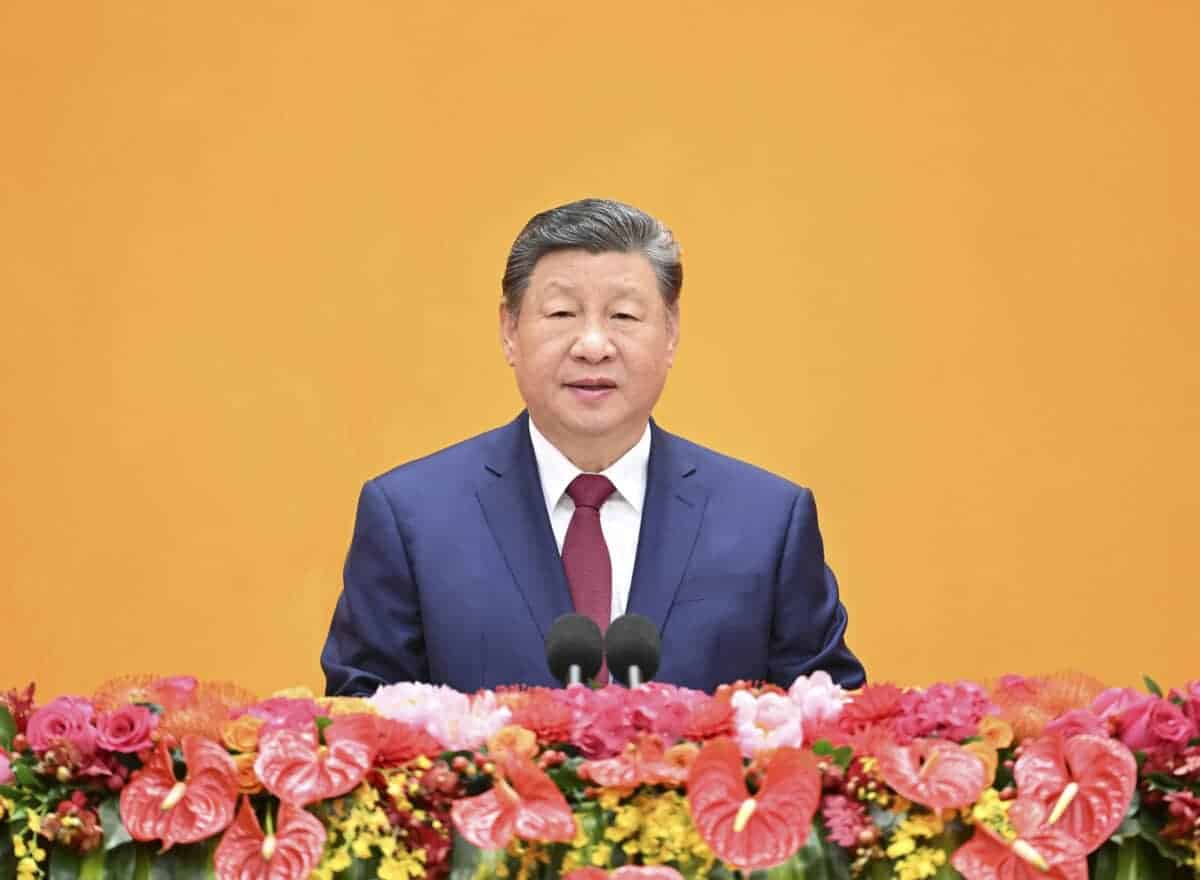
(260214) -- BEIJING, Feb. 14, 2026 (Xinhua) -- Chinese President Xi Jinping, also general secretary of the Communist Party of China (CPC) Central Committee and chairman of the Central Military Commission, delivers a speech at a reception to usher in the Chinese New Year at the Great Hall of the People in Beijing, capital of China, Feb. 14, 2026. The CPC Central Committee and the State Council held the reception here on Saturday. (Xinhua/Li Xiang) (Photo by Li Xiang / Xinhua via AFP)
In Quebec the English-speaking minority used to call them “tongue-troopers”: the government functionaries who come around to check that the French on signs in shops were in a typeface twice as big as the English.
Now, China will have tongue-troopers too, although the regime has no fear that Chinese might be replaced by Zhuang, Kazakh or Korean.
Frankly, French-Canadians have not had a real reason to fear that French might die out, either, at least not for the past 175 years.
The proportion of first-language-French speakers in Quebec has remained stable at 77%-83% since the 1850s.
Nevertheless, every niche in politics is always occupied by some ambitious politician seeking a platform and a cause.
In Quebec, therefore, there will always be some politicians who declare that French is in peril and promise to defend it.
When they win power, they do things like mandating bigger print for French on signs. But can this explain why the Chinese regime is requiring bigger print for Chinese in parts of the country where many people speak a minority language?
More than 90% of the country’s 1.4 billion people speak Chinese. Surely they don’t feel threatened by the minorities, who speak 52 different languages, even the biggest of which has only 14 million speakers.
Yet a new government law now requires all children to be taught Mandarin from before kindergarten all the way up to the end of high school.
However, to insist that students of minority groups be taught entirely in Chinese to the neglect of their native language, even in regions where the majority or a large minority speak that language, suggests a desire to demote the minority languages to the status of “kitchen languages” and to eliminate them completely.
Even if that is not the regime’s intention, that will be its effect. If your ultimate goal is to get rid of inconvenient minority languages that disfigure your dream of a pure and unified nation – big-language nationalists often dream such dreams – then here’s the secret of success.
Do nothing. Or at least nothing that will draw attention to the fact that the minority language is already steadily losing speakers to the one you favour.
Big languages like Chinese, Spanish and English have a magnetic attraction for many speakers of minority languages because they offer wider opportunities.
In free countries, however, the minorities can organise to create better opportunities for their own people and level the playing field. That’s what the Quebec government does for Francophones.
China’s minorities can’t do that: the state does not tolerate any rivals with different objectives. However, Beijing should not make a fuss about it.
Just the passage of time would see the minority languages erode as the younger generations drift towards Chinese, the language of opportunity.
Making laws that effectively ban their language in school will do the opposite. Parents want their children to grow up in their own traditions and language is foremost among them.
Trying to break that link is liable to mobilise them not just against that specific measure, but against the regime in general. That mobilisation will be ruthlessly crushed, of course, but why go through the whole sorry business at all?
My guess is that President Xi Jinping and his advisors just can’t help themselves. As lifelong communists, they have been trained from early adolescence to believe that everything must be controlled by the state, and no amount of practical evidence to the contrary can shake their core belief that uniformity is the road to unity.
So the new law will be applied and 110 million people will have to get used to the fact that their children are being educated in a language that is not their own and, eventually, the cycle of resistance and repression will probably turn violent.
Or the state could drop this nonsense now and save everybody a lot of time and misery.
About the Author