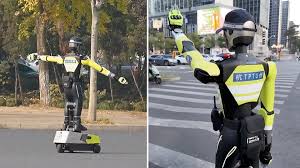
In a first-of-its-kind initiative, China will deploy humanoid robots to monitor and assist operations at the busy Fangchenggang border crossing, integrating AI into public security and border management.
Shenzhen-based UBTECH Robotics Corp. secured a $37 million contract to deploy its Walker S2 humanoid robots at the crossing in Guangxi, a coastal region near Vietnam. Deployment is expected to begin this December. The border handles a steady flow of cargo trucks, buses, and daily travellers, making it an ideal site to test robots under real-world operational pressures.
The Walker S2 is a full-size humanoid robot designed to operate in environments built for humans. It features jointed legs, arms, and a torso, and uses autonomous battery swapping to remain operational without direct human support. Equipped with cameras, depth sensors, and joint-based force feedback, the robots can maintain balance, detect movement, and avoid collisions, allowing them to perform multiple tasks rather than being limited to a single industrial role.
At the Fangchenggang crossing, the robots will support border officials by guiding passenger queues, directing vehicles, and answering basic questions from travellers. Some units will patrol waiting areas and corridors, monitoring for blocked exits or crowd build-ups that may require human intervention.
Others will operate in cargo zones, assisting logistics teams by checking container identification numbers, confirming seals, and sending updates to dispatch centres.
Beyond the border post, some robots are expected to inspect steel, copper, and aluminium facilities, following preset routes through high-temperature industrial environments. This initiative builds on UBTECH’s earlier deployments of humanoid robots in factories and data centres across China in 2025.
UBTECH reported that total 2025 orders for the Walker S2 series, including earlier projects, now stand at about $157 billion. Despite strong demand, the company remains unprofitable and faces pressure to demonstrate that rising orders can lead to long-term sustainability.
The border deployment aligns with China’s national policy on humanoid robotics, reflecting the government’s push to integrate AI-driven robots into both industrial and public service sectors.
About the Author