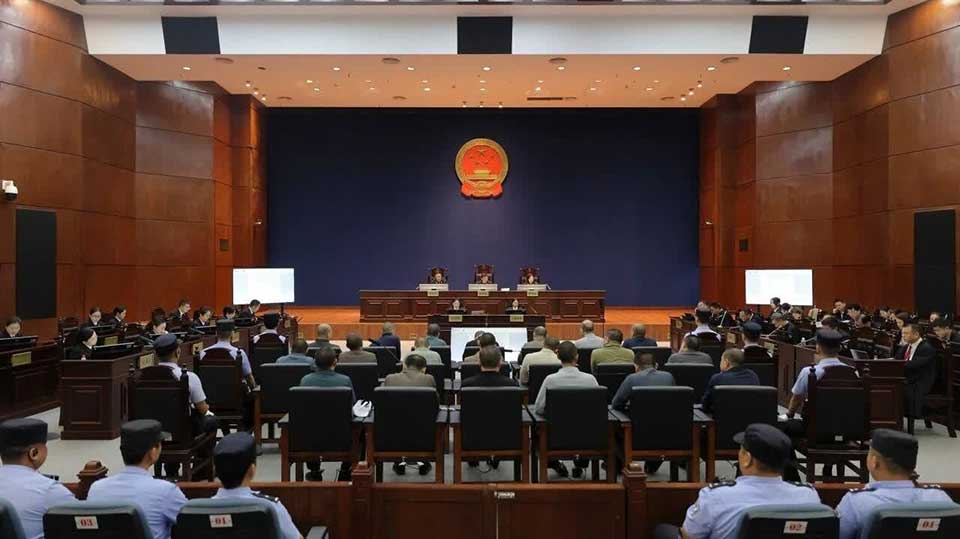
China has executed 11 members of a powerful mafia family that operated large-scale scam centres in Myanmar along the two countries’ northeastern border.
According to state media reports, the executed individuals belonged to the Ming family, a notorious criminal clan that once dominated Laukkaing, a border town in Myanmar’s Shan State.
A court in China’s Zhejiang province sentenced them in September for a range of offences, including homicide, illegal detention, fraud, and operating gambling dens.
Once an impoverished backwater, Laukkaing was transformed under the control of the Ming family and similar clans into a glittering hub of casinos, online scam operations, and red-light districts.
The town’s criminal empire collapsed in 2023 after ethnic militias seized control of the area during renewed fighting with Myanmar’s military and handed key figures, including members of the Ming family, over to Chinese authorities.
The executions mark Beijing’s strongest signal yet that it intends to deter transnational scam networks. However, analysts note that many of these operations have since shifted to other parts of Southeast Asia, particularly along Myanmar’s border with Thailand, as well as to Cambodia and Laos—regions where China’s influence is more limited.
According to United Nations estimates, hundreds of thousands of people have been trafficked across Southeast Asia to operate online scam schemes. Thousands of Chinese nationals were among those forced into the operations, while the primary victims—defrauded of billions of dollars—were also largely Chinese.
Beijing had grown increasingly frustrated with Myanmar’s military for failing to curb the scam industry, from which it was widely believed to be benefiting.
In late 2023, China tacitly supported an offensive by an ethnic insurgent alliance in Shan State. The group captured significant territory from the military and overran Laukkaing, a strategic border town central to the scam trade.
The 11 Ming family members are the first Myanmar-based scam bosses to be executed by China, but officials have indicated more sentences will follow. In November, five members of the Bai family were also sentenced to death, while trials involving members of the Wei and Liu families are still ongoing.
The Ming family’s trial was conducted behind closed doors, though more than 160 people—including victims’ relatives—were permitted to attend the sentencing hearing last year.
China’s Supreme People’s Court said the Ming family’s scam operations and gambling businesses generated more than 10 billion yuan (approximately $1.4 billion) between 2015 and 2023.
The court added that their activities resulted in the deaths of at least 14 Chinese citizens and caused injuries to many others. Appeals filed by the family were rejected in November.
More than 20 other members of the clan received prison sentences ranging from five years to life. The family patriarch, Ming Xuechang, reportedly took his own life in 2023 while attempting to evade arrest, according to Myanmar’s military.
Confessions from arrested members were later broadcast in Chinese state media documentaries, underscoring authorities’ determination to dismantle scam networks and warn potential offenders.
The Ming family was one of several powerful, godfather-style clans that rose to prominence in Laukkaing in the early 2000s after the town’s former warlord was ousted in a military operation led by Min Aung Hlaing—now the head of Myanmar’s military government following the 2021 coup.
Ming Xuechang oversaw one of Laukkaing’s most infamous scam compounds, known as Crouching Tiger Villa. While gambling and prostitution initially sustained the family’s wealth, they later expanded aggressively into online fraud, relying largely on kidnapped victims forced to run scams.
Inside the heavily guarded compounds, violence was routine. Survivors who were later freed described a brutal system in which beatings and torture were commonly used to enforce compliance.
About the Author