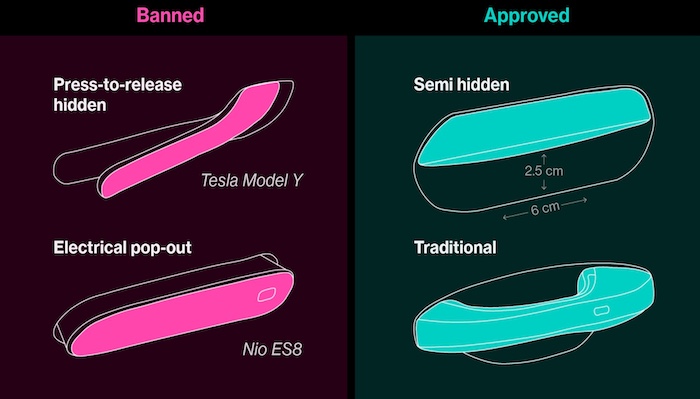
China has become the first country to ban hidden door handles on electric vehicles (EVs), citing safety concerns. The move targets designs popularised by Tesla and other manufacturers as deadly incidents, including fatal Xiaomi EV crashes, raised alarms about door access during power failures.
Under the new rules, set to take effect 1 January 2027, all cars must have mechanical door releases on both the inside and outside. The Ministry of Industry and Information Technology specifies that the outside of each passenger door (except the boot) must feature a recessed area at least 6cm by 2cm by 2.5cm for handle access. Inside, clear signs at least 1cm by 0.7cm must indicate how to open the door.
Vehicles already approved for sale will have a two-year window to update their designs. Hidden handles are currently widespread in China’s new energy vehicle (NEV) market, appearing on roughly 60% of the top 100 best-selling EVs, hybrids, and fuel cell cars.
Although the ban only applies to China, its impact is expected globally due to the country’s influence on the automotive industry. Tesla, in particular, faces related scrutiny: the US National Highway Traffic Safety Administration (NHTSA) is investigating its Model Y door handles after reports of sudden failures left passengers, including children, trapped. Some owners resorted to breaking windows to escape. European regulators are also considering similar measures.
Erizia Rubyjeana
About the Author