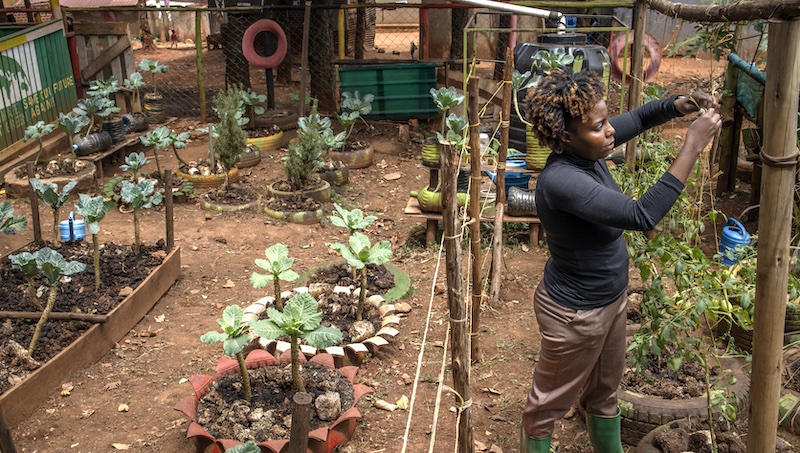
Cate Nabankema walks carefully across the uneven ground at Christian Youth Missionary Group in Kinawataka, Kampala, moving with the caution of someone who knows how deceptive the terrain is.
From a distance, she is instantly recognisable, yet there is an evident transformation. The young girl captured in past photographs has grown into a woman who carries herself with the composed assurance of a leader, one who has acquired a quiet confidence that tells you that she knows what she is about.
Around her, children in their large numbers are playing, screaming out instructions to each other. It is holiday time, so it is an expected sight. Nabankema later points out that these large numbers of children playing this early in the day are the same number, even when schools are open.
The children do not go to school. The reasons are painfully simple: families cannot afford basic scholastic materials. Pens, pencils, exercise books, small items that stand between a child and a decent future. For Nabankema, this reality is not theoretical. It is a painful memory.
“There were days I could not go to school because we did not have money for these things,” she says.
“If someone gave you even one exercise book, you felt like you could dream again.”
Raised by a single mother caring for several children, Nabankema grew up with a sense of how fragile opportunity can be. She frantically searches for a handkerchief from her bag to wipe tears that came quickly when the conversation pivoted to her early years.
“My mother used to tell me, stay focused Cate! When something is yours, it will come, and I have held on to that.”

Her first taste of community service came after Senior Six, when she volunteered as a peer educator at a local health centre. The young people she met, their honesty, confusion, and vulnerability, taught her how much a child needs a safe person to talk to.
She wanted to be that person. On November 20, 2019, Nabankema served as UNICEF Uganda’s Country Representative for World Children’s Day, shadowing Dr Doreen Mulenga and taking part in calls and staff meetings.
World Children’s Day is the anniversary of the adoption of the UN Convention on the Rights of the Child. On WCD, UNICEF and partners highlight children’s issues and support young people’s engagement. Nabankema almost turned down the opportunity.
“I was just 18. I was scared. I did not think I could do it.” But she went, and in a boardroom filled with decision makers, she made a plea that even now captures her approach to leadership: “Stop speaking for children, involve us.”
The following morning, her story appeared in national newspapers. Relatives called, her mother cried. Nabankema had stepped through a door that continues to open new paths for her and the communities she serves.
After that experience, Nabankema joined Network for Active Citizens, working in neighbourhoods like Kinawataka, Kisalosalo, Kimwanyi, Kanyanya, and Port Bell. She walked in with the humility of someone keenly aware of the cultural, social, and economic weight carried by the people she hoped to support.
One of the first community leaders she met was Paul, the now 35-year-old team leader of the Christian Youth Missionary Group, a community organisation that has served Kinawataka since 2008.
He describes this place from his years working within: “Kinawataka is one of the toughest slums in Kampala. Poor waste disposal. No jobs. Most families survive on one meal. Many children do not go to school.”
During the COVID 19 lockdown, hunger moved Paul’s team to transform a garbage dumping site into a small demonstration garden where families could learn simple urban farming techniques.
The idea was practical: grow vegetables in small spaces using buckets, sacks, old tyres, and recycled containers. Nabankema came along while the project was still in its early, struggling phase.
“She helped us organise,” Paul says. “She would meet us, sit with us, listen, and guide. She kept us on track. She made sure we got the training we needed. She pushed for us to get partnerships, but most importantly, she showed up consistently.”

Nabankema’s work becomes even clearer when seen through the lives of the women in the community, women whose daily resilience is often invisible. There is Sylvia, who is 31 years old, raising her six-year-old daughter, while supporting her own mother and five siblings.
She runs a small stall selling ‘katogo’ (beans and maize) on Robert Mugabe Road.
“It feeds my whole family,” she says. “All seven of us.” She credits the entrepreneurship training from the Network of Active Citizens, where Cate was part of the facilitation team, for giving her the confidence and skills to start her own business.
“When I do not understand something, Cate explains it in a way that I understand. She sees me when others cannot see me. If more young mothers can learn business, they will not depend on anyone.”
And then there is Faridah, a 17-year-old single mother. Her daughter is six months old. She sits at her small wooden stall selling tomatoes and onions while her baby lies on a mat beside her.
“I may never go back to school,” she says matter-of-factly. “But I want my baby to have the opportunities I will never have. She must go to school.”
She has received basic business training through community programmes, but she needs more. More support, more skills, more chances. What she wishes for her child is what Nabankema longed for when she was a child.
This is where Nabankema spends her days. In communities like this one in Kinawataka, with a small but functional urban garden providing vegetables for families and giving them a sense of dignity, a makeshift learning shelter offering textbooks, seats, and free internet for revising and downloading notes, a mushroom growing room training refugee girls from the Democratic Republic of Congo, a make shift room with a black soldier fly project run by youth producing sustainable livestock feed.
This place has become an ecosystem where learning, skills, and hope intersect, a small youth city built on collaboration. Nabankema is proud of what they do here.
“I don’t want another child to lose hope because of something small,” she says.
Her dreams for the future include her own organisation dedicated to ensuring children access education – fees, books, uniforms, pads, everything that keeps a child in class, and a master’s degree to strengthen her leadership and expand her work.
About the Author