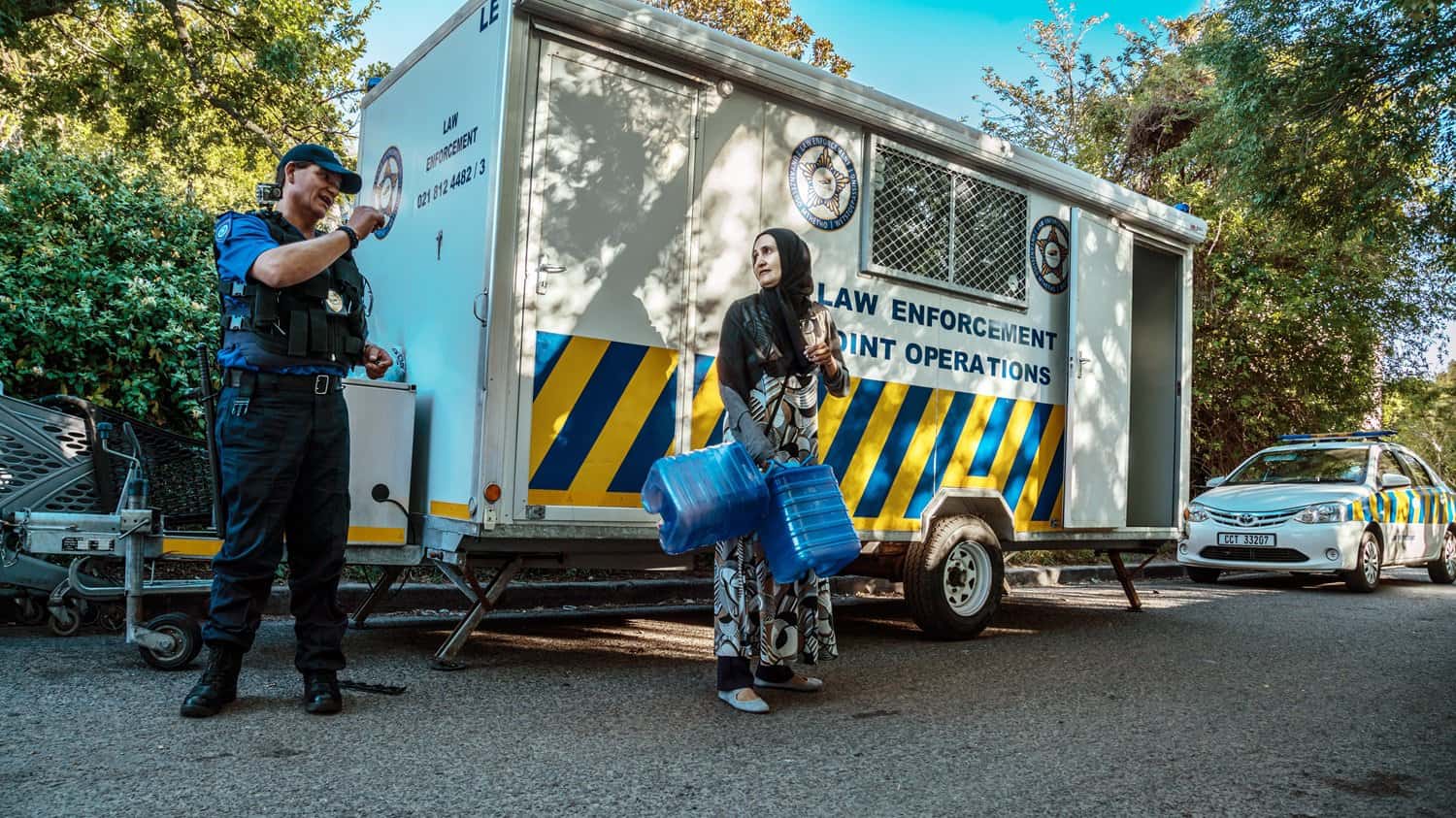
CAPE TOWN, SOUTH AFRICA - FEBRUARY 1: (EDITORS NOTE: Image was created as a still grab taken from video.) Police are now controlling Newlands Spring and limiting water collectors to carrying one 25 liter container at a time. Policemen guarding the entrance to the spring respectfully ask people to leave their extra containers at the entrance. People walk to the spring, fill a container, walk it back to their car, walk back to the spring with an empty container, then join the queue again and repeat. Diminishing water supplies may lead to the taps being turned off for the four millions inhabitants of Cape Town on April 16, 2018, known locally as Day Zero. Water will be restricted from 87 litres per day to 50 litres as temperatures reach 28 degrees later this week. Politicians are blaming each other and residents for the deepening crisis. (Photo by Morgana Wingard/Getty Images)
Cape Town’s water system is under growing pressure, and the city’s own infrastructure is partly to blame.
During its briefing on Wednesday, the municipality revealed it spends R460.8 million annually on repairs and maintenance of its water network, a sprawling 11 253km web of pipes, pump stations and reservoirs that loses millions of litres daily to leaks and bursts.
This comes as dam levels have fallen to around 55%, their lowest in roughly seven years.
The city has declared an “Early Drought Caution”, the first formal warning phase in its Drought Management Framework.
“Cape Town is not facing an immediate drought emergency, but dam levels are about 20% lower than last year, and the system is entering a phase where early choices will shape the months ahead,” said Councillor Zahid Badroodien, Mayoral Committee Member for Water and Sanitation.
He warned that the next 90 days were critical. “We still have a window to change the outcome of this winter, but that window is closing.”
ALSO READ: Here’s what level the six major dams in Cape Town recorded this week
Why Cape Town’s dam levels are at their lowest
The city’s main water supply comes from the Western Cape Water Supply System (WCWSS), a network of interconnected dams including Theewaterskloof, which alone accounts for roughly 30% of storage, and Wemmershoek, which contributes about 14%.
Both catchment areas received below-average rainfall during the 2024-25 hydrological year, with rainfall described as “spatially variable” and critically low in the areas that matter most for water security.
Compounding this, the rainfall season ended earlier than usual, triggering a faster-than-expected drawdown of dam storage from as early as November 2025.
Daily water use spiked to 1 073 million litres on a single Monday this February, well above the city’s target of 975 million litres per day.
Average per-person consumption is around 178 litres per day.
Lloyd Fisher-Jeffes, technical services manager for the water and sanitation department, said the trajectory heading into winter was deeply concerning.
Projections based on current usage trends and average rainfall assumptions indicate dam levels could fall to 40% by May, well into the city’s “Drought Response” alert zone.
“What happens between now and May really matters,” the city noted, adding that if demand remained high, “the likelihood of restrictions increases.”
Climate change is also reshaping the risk landscape. The city’s own data shows that Cape Town’s rainfall season has become shorter and more concentrated.
A greater proportion of annual rain now falls between June and August.
ALSO READ: Cape Town dam levels drop as water reserves continue to fall
The true cost of ageing pipes
Cape Town’s water distribution network stretches more than 11 000km and serves a formal residential population of approximately 4.7 million people, with a further 570 000 residents in informal settlements.
The system includes 76 pump stations, 134 reservoirs and tanks, and over 90 000 valves. It is, by the city’s own description, heavily burdened by ageing infrastructure.
Etienne Hugo, Director of Distribution Services for Water and Sanitation, said the city had been running a pressure management programme across its reticulation network for nearly 20 years to reduce losses.
“429 pressure reducing valves are installed across approximately 8 100km of the city’s reticulation network. These regulate water pressure within defined zones, enabling the city to maintain optimal pressure levels, minimise leakage, and improve overall service delivery,” he explained.
Hugo noted that the areas seeing the most bursts were “mainly on old infrastructure and small diameter AC pipes,” and that pressure reduction and planned replacements were the primary remedial actions underway.
R8.7 billion bet on water independence
The longer-term response to Cape Town’s structural water vulnerability rests on a plan to add 300 million litres per day of new water capacity by around 2031.
According to the city, currently, surface water accounts for 98% of Cape Town’s supply. By 2040, the city’s water strategy envisions surface water dropping to 75%, with groundwater contributing 7%, desalination 11%, and water reuse 7%.
The centrepiece of that plan is the Faure New Water Scheme, a direct water reuse facility estimated to cost R3.2 billion, which would process purified recycled wastewater through a multi-stage advanced purification process.
The scheme is projected to produce between 70 and 100 million litres per day. “Upon completion, it would be the largest direct water reuse plant in the world.”
The city said the anticipated completion is set for the 2030/2031 financial year.
Desalination, long debated and twice deployed on an emergency basis during the Day Zero crisis, is also moving forward at a permanent scale.
The Paarden Eiland desalination plant, estimated at approximately R5.5 billion, has received council approval to proceed as a public-private partnership, with an anticipated completion date of 2031/2032.
A second option at Witsands on the West Coast, with an estimated yield of 70-150 million litres per day, is under evaluation.
Killick told the briefing: “By 2040, Cape Town will be a water-sensitive city that optimises and integrates the management of water resources to improve resilience, competitiveness and liveability for the prosperity of its people.”
What Capetonians can do right now
The immediate priority, however, is getting through the next three months. The city’s modelling shows that small reductions in demand over the coming weeks can meaningfully shift the trajectory heading into winter.
With average rainfall, restrictions are unlikely but possible. With below-average rainfall and continued high demand, Level 1 or Level 2 restrictions are increasingly probable between July and November 2026.
Badroodien was direct about what is at stake. “Water restrictions are not a punishment. They are a tool to protect supply when risk becomes too high to ignore. The projections show that early, moderate demand management now can help avoid more severe restrictions later, when there is far less room to manoeuvre.”
He added that the city’s approach had always been to act early rather than wait for a crisis.
“If we use water wisely now, we can protect the system and avoid tough restrictions later. If we wait until the dams are much lower, our options become limited and the measures we need to introduce become far more disruptive.”
READ NEXT: Day Zero: What Cape Town’s water crisis can teach Joburg
About the Author