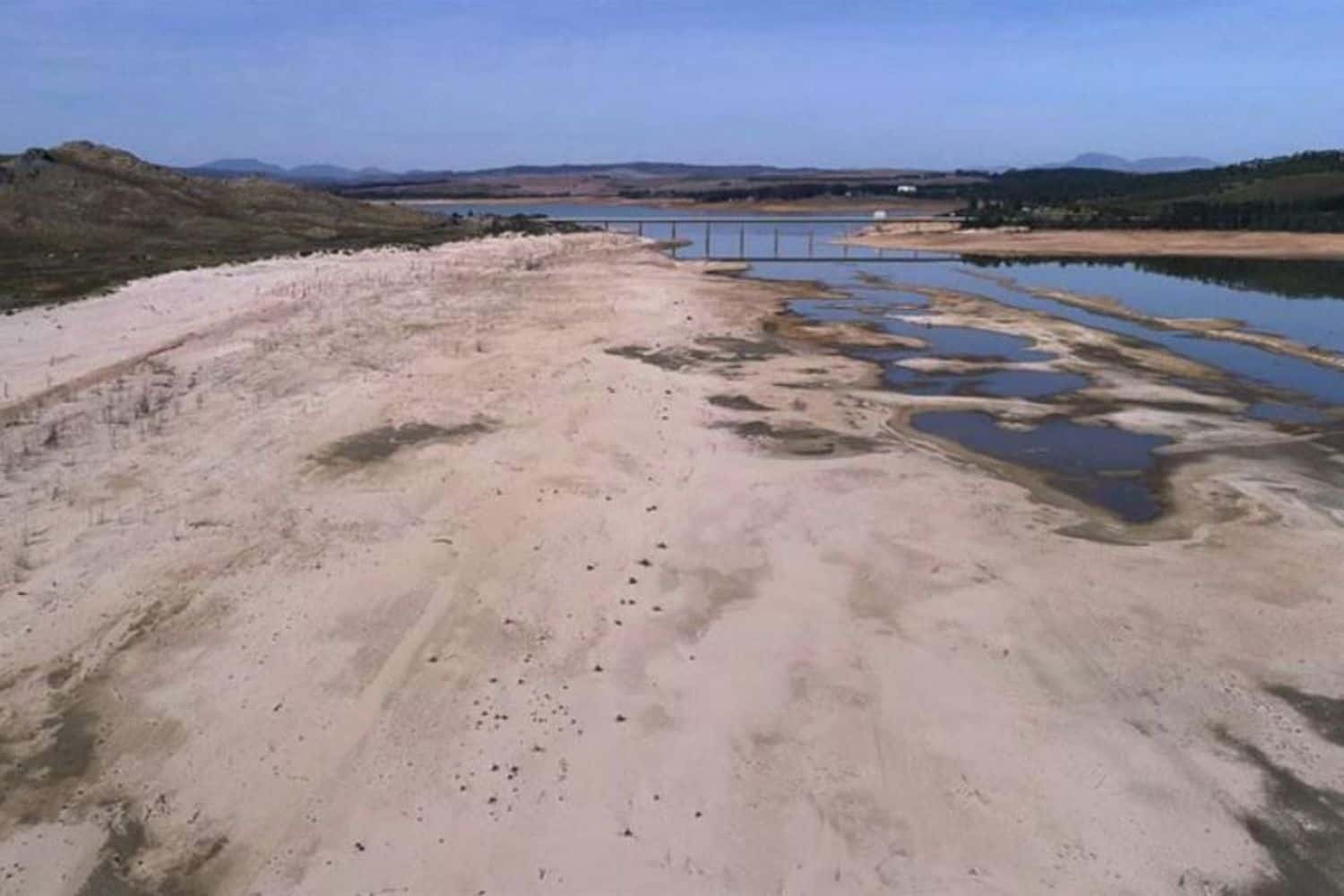
Cape Town’s combined dam system is holding just above half its total capacity, with the latest readings showing an overall storage level of 57%.
This is a decrease from 58.3% the previous week and a full 19.2 percentage points lower than the 76.2% recorded during the same period in 2025.
The City of Cape Town and the National Department of Water and Sanitation jointly monitor dam levels to determine how much water is available for residents, businesses, and agriculture across the region.
The dams that supply Cape Town form part of the broader Western Cape Water Supply System – an integrated network of dams, pump stations, pipelines, and tunnels that also provides water to towns in the Overberg, Boland, West Coast, and Swartland regions, as well as irrigation water for agriculture.
Cape Town’s overall water storage year-on-year comparison
As of Tuesday, the six major dams in the system collectively held 512 161 megalitres out of a combined capacity of 898 221 – a total storage level of 57%.
This is a decline from the 57.2% and 513 711 megalitres recorded on Monday, which was itself down from 58.3% and 524 097 megalitres the week before.
At the same point in 2025, the system held 684 325 megalitres, equating to 76.2% of total capacity.
The week-on-week decline of roughly 10 386 megalitres is consistent with the summer drawdown period, when demand typically exceeds inflow.
The Department of Water and Sanitation notes that the most reliable measure of overall system health is not any single dam’s reading, but the aggregate figure.
“Because each dam size is different, the best indicator of overall dam water levels is the total quantity stored expressed as a percentage of total dam capacity,” the department explained.
ALSO READ: ‘Water shifting’ quietly begins in Gauteng
Theewaterskloof Dam
Theewaterskloof Dam, the largest in the system with a full capacity of 480 188 megalitres, was recorded at 53.7% on Tuesday.
The weekly reading showed it at 53.8% on Monday, marginally higher than the daily figure but still down from 54.3% the previous week.
A year ago, Theewaterskloof Dam was at 76.5%, nearly 23 percentage points higher than its current level.
Voëlvlei and Berg River trending down from last year’s higher reserves
Voëlvlei Dam, the second-largest in the system with a capacity of 164 095 megalitres, recorded a storage level of 64.4% on Tuesday.
The weekly reading of 64.6% on Monday was already down from 66.3% the previous week.
Compared to 2025, when Voëlvlei stood at 75.5% during the equivalent period, the dam is now running more than 11 percentage points lower.
Berg River Dam, with a capacity of 130 010 megalitres, stood at 54.1% on Tuesday.
The weekly data show a steeper decline: the dam was at 54.5% on Monday, down from 57.4% the week before.
A year ago, Berg River was at 76.8%, placing the current reading more than 22 percentage points below the comparable 2025 figure.
ALSO READ: Crisis deepens: Is water being throttled in Joburg?
Wemmershoek and Steenbras dams show steadier levels
Wemmershoek Dam, with a capacity of 58 644 megalitres, was at 66.8% on Tuesday.
The weekly data shows a gradual decline from 67.1% on Monday and 68.5% the previous week.
As of 2025, Wemmershoek was at 69.3%, meaning it is now approximately 2.5 percentage points below last year.
Steenbras Upper, with a capacity of 31 767 megalitres, was the most stable dam in the system over the past week, recording 69.1% on both Tuesday and Monday.
It was slightly down from the previous week’s 69.2%. Despite this short-term stability, Steenbras Upper remains well below the 93.8% recorded in 2025.
Steenbras Lower, at 33 517 megalitres capacity, recorded 51% on Tuesday, having declined from 51.7% on Monday and 53.5% the week prior; a year ago it stood at 67.7%.
NOW READ: WATCH: Joburg in deep crisis as Pemmy Majodina sings ‘water song’ in Ethiopia