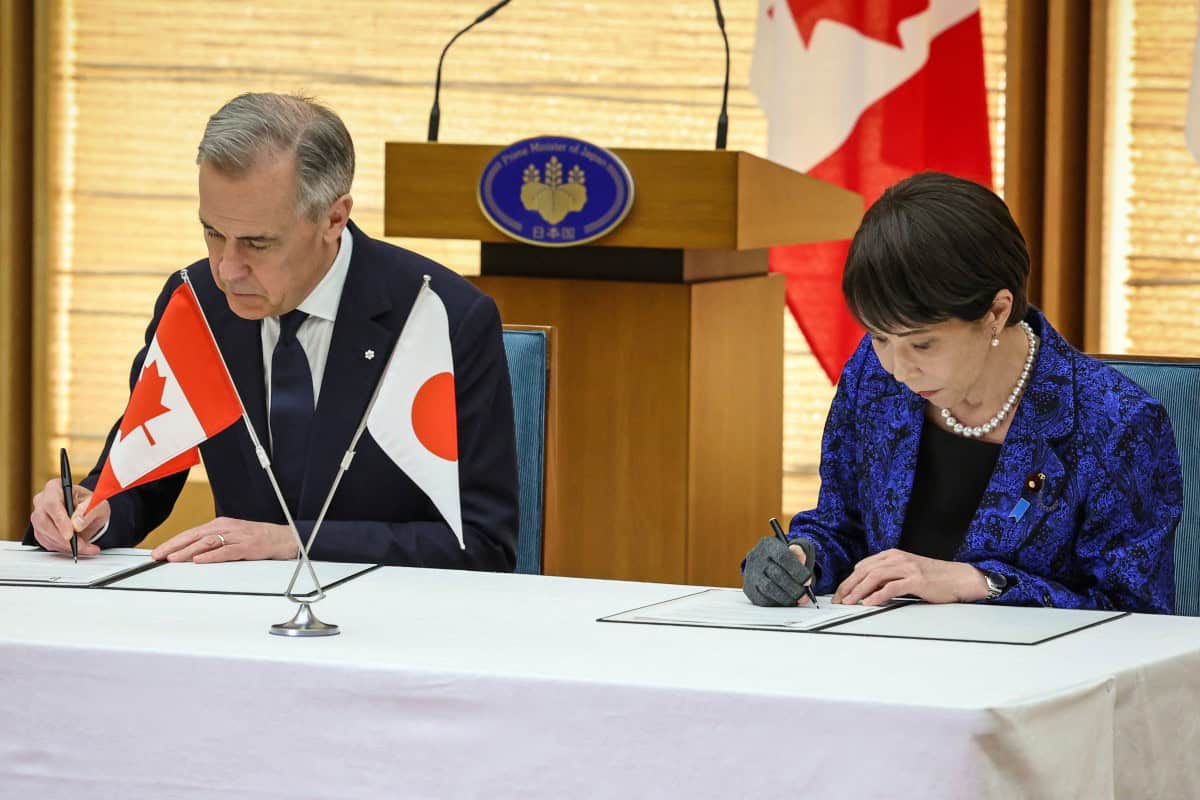
Canada's Prime Minister Mark Carney (L) and Japan's Prime Minister Sanae Takaichi take part in a signing ceremony in Tokyo on March 6, 2026. (Photo by Takashi Aoyama / POOL / AFP)
Canada’s Prime Minister Mark Carney vowed Friday to strengthen defence cooperation and economic security with Tokyo, in the Japan leg of his Asia-Pacific tour aimed at shedding reliance on the United States.
Having arrived from Australia in his multi-country tour seen as a hedge against what he has described as a fading US-led global order, Carney met Japanese premier Sanae Takaichi.
“We are enhancing our security and defence cooperation through information sharing, technology transfers, cooperation in maritime security,” Carney told reporters in a joint statement with Takaichi.
Also among the “six priority areas” with Japan he laid out was the strengthening of “economic security with robust supply chains”.
“We’re expanding our existing cooperation within the G7 critical minerals alliance to secure reliable stockpiles and build our processing capacity.”
Prior to their meeting, Japanese media had reported both sides want to share more intelligence on Chinese and Russian cyberattacks and boost joint military exercises.
ALSO READ: Japan suspends restart of world’s biggest nuclear plant
In his earlier Australia visit, Carney said he couldn’t rule out his country’s military participation in the escalating war in the Middle East, and that US-Israeli strikes on Iran appeared “inconsistent with international law.”
Fresh from saying in Davos in January that under US President Donald Trump the world was seeing a “rupture”, Carney also called in Canberra for “middle powers” to work more together.
In Tokyo, the Canadian leader made no reference to the war, although Takaichi said they will discuss Iran over dinner.
“Mark’s visit here under this tough international situation is very meaningful,” she said, pledging to “carve out a new chapter in the Japan-Canada relationships.”
As a strong backer for the rules-based international order, the Iran war has put Japan — another similarly sized power — in a difficult position.
Japan is a close US ally that is home to some 60,000 US military personnel and which relies on US backing as China flexes its muscles in the region.
ALSO READ: WATCH: Canadian curling team accused of cheating in Winter Olympics scandal
The world’s fourth-largest economy is also its fifth biggest oil importer, with some 70 percent shipped through the Strait of Hormuz, which Iran has effectively closed.
Takaichi said Tuesday that she would hold “candid” discussions on the war with Trump at their talks in Washington on March 19.
Japan-China ties have worsened since Takaichi suggested in November that Japan might intervene militarily in any Chinese attempt to take Taiwan.
China-Canada relations have, meanwhile, thawed, with Carney visiting in January and signing a trade deal after years of tit-for-tat arrests and tariff disputes.
His current tour, which also included India, is part of efforts to pivot Canada away from excessive reliance on its southern neighbour under Trump.
“Japan is a natural partner for Carney’s desire to ‘be on the table, not on the menu’,” said Yee Kuang Heng, a professor specialising in international security at the University of Tokyo.
ALSO READ: World’s biggest nuclear plant edges closer to restart
Up for discussion could be coordinating naval transits through the Taiwan Strait, as well as better tracking and intercepting of Russian-Chinese bomber patrols in the western and northern Pacific, Heng told AFP.
Canada may also potentially be interested in buying future fighter jets made under the Global Combat Air Programme (GCAP) between Japan, Italy and Britain.
Carney was due to return to Canada on Saturday.
About the Author