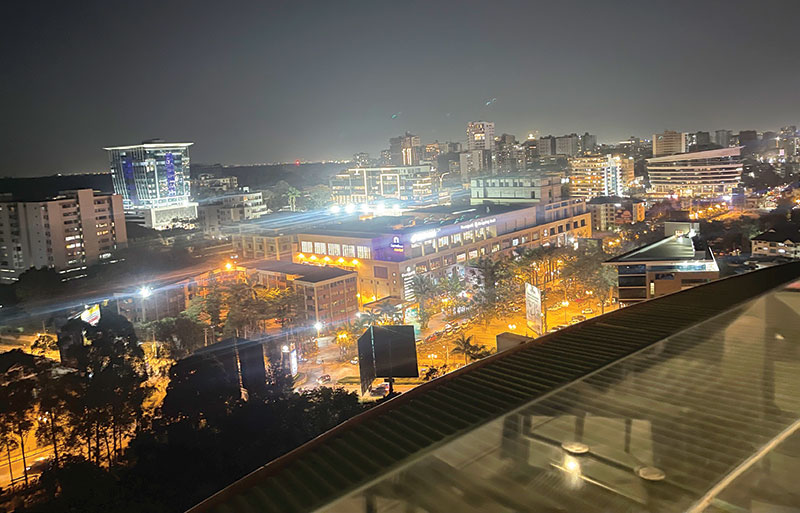
I had not been to Nairobi in a couple of years, yet, just like the last time I visited, I was shocked by the speed at which this city was growing and expanding.
I lose count of the times I have visited one city or the other in our eastern neighbour, but for some reason, this most recent one to Nairobi left me seething with envy and then anger at our leaders.
True, like every other African state, Nairobi has its seedy side that is punctuated by poor garbage disposal issues, corruption, slums and the unrelenting warnings from our hosts to hold our purses tight, keep our phones out of view and the car windows sealed; still, it is the other side of the city that left me mesmerized.
So much like Kampala in many ways, yet vastly ahead of us now, it would take a major reset in how Uganda is managed, to ever catch up. I was in Nairobi for the Digital Media Africa conference at Aga Khan University a few kilometres away from the Novotel hotel where I stayed.
As we drove from Westlands daily to the university campus, and considering both trips to and from the airport, I could not help but imagine the glory days my mother often refers to before the Idi Amin era, when Kampala was the beauty and marvel of East Africa.
According to her, Kampala quickly went downhill after that, and going to any city in Kenya will prove that to you quickly. Before Nairobi, I had been to a dusty, annoying Kisumu in the mid-nineties, only to return there a few years ago and be completely blown away by how clean, big and modern it is now.
I have been several times to Eldoret, and wonder at how fast things are moving there. I have been to Mombasa, and even smaller enclaves like Naivasha or even Kabarnet, somewhere in the Eastern rift valley and left feeling that now similar sense of anger mixed with envy that I get every time I travel, at our planners and leaders.
Especially considering that they travel a lot and see these places, but don’t seem to benchmark them. Almost all Kenya’s major cities now have functional international airports, on top of the stellar general infrastructure.
Novotel, which is a relatively new hotel in the Westlands, is walkable distance to Sarit Centre and Westgate mall – both of which put the arcades we call malls in Kampala to shame.
I loved how their economy has attracted many of the major international retailers/brands in fashion, furniture, cars, mechanics, manufacturing, hospitality, name it, and their young people are being absorbed in these spaces, despite their own seemingly chronic anger with their government.
It is no wonder Kenya’s GDP per capita is now over $1,000 more than Uganda’s (at $2,206, compared to our $1,072, or Tanzania’s $1,185, according to 2024 estimates). You see it in small things like price differences at franchises found in both countries.

I bought beauty products at Lintons in Nairobi, and was surprised to pay more than 10 dollars less than what I usually pay in Lintons Kampala. I have seen people complain on X that CJ’s – a Ugandan restaurant franchise – now has more, bigger, swankier outlets in Nairobi than back home in Kampala.
Well, that is what ‘economics that work’ actually do; I don’t know what Finance PS Ramathan Ggoobi was talking about… Even at the DMA conference itself, the statistics about and by Kenyan and Rwandan digital startups…? Sigh.
HOW WE ARE SIMILAR
Speaking of youth and Gen Z anger with government, I found it interesting that I could not find a single young person who had a good thing to say about the Ruto government.
It was rant after rant, and it felt very much like speaking to a Ugandan young person downtown. If you have been to Jomo Kenyatta International Airport, for example, like me you must be wondering how those young people recently breached airport security, making it all the way to the tarmac and aircraft bearing the remains of their fallen opposition leader, Raila Odinga.
JKIA is not only huge, it seems fortified for miles. I still cannot fathom how they beat all those checkpoints. Maybe we are not so similar, after all; in Uganda, grief or no grief, such a story about a security breach of that magnitude at the airport would have read very differently, with a kicker stating how many were killed!
But back to the similarities, in the Westlands, which were once a preserve of the rich and affluent, high rise apartments and businesses have taken over what was once a quiet residential area favoured by rich Asians, foreign missions and affluent Kenyans.
Now with properties being devalued by the monstrous apartment blocks towering over private residences, I was told the former residents are moving out, reminding me of what is happening here to Kololo.

In fact, seeing what Nairobi’s Westlands has become should tell our Kololo neighbours what lies in store for them. I was at a home in Kololo last year, and the expatriate resident was unhappy because they could no longer use their swimming pool without attracting spectators on the dozens of balconies now leaning over their property, and that was not mentioning the days when Kololo national ceremonial grounds hosts a show and the noise continues till late.
Well, these rich people problems are shared acutely on the other side of our eastern border, and from all indications, Kololo will get worse.
HOW WE ARE DIFFERENT
Kenya has understood the importance of tourism to their economy and livelihood, and everything and everyone seems eager to sell you their country’s packages.
The cab driver will not fail to mention that there is a national park right in the capital city, should you have time to spare.
The drive from the airport is littered with lifelike wildlife sculptures, and so are several spots in the city centre; they do not let you forget the possibilities for your trip. In Uganda, there was a commendable effort with the huge gorilla sculpture at the refurbished airport, but it beats my understanding why it is at the entrance to the departure lounge and not at arrivals!
And that is about it; forget that tourism is one of the top forex earners for this country, fetching an eyewatering $1.28bn in 2024. Kenya pays homage to tourism, every chance they get.
Uganda does tourism favours in terms of funding, promotion, priorities, etc. Delegates finished the conference and drove a few kilometres out of the city to feed giraffes, while others disappeared into the national park for more memories.
My highlight of the stay, away from the DMA that challenged my thinking massively, was probably that trip to Gaucho’s, a restaurant where you eat all the meat your system can take.
The servers keep delivering all tribes of meat, until you indicate that you are done. And what I did not like was also the food, ironically. Uganda is still the region’s food basket, and I terribly missed some home food, our street foods and pineapples after five days in Nairobi. And strangely, regardless where I go, or what I see, there is just no place like home for me.
caronakazibwe@gmail.com
About the Author