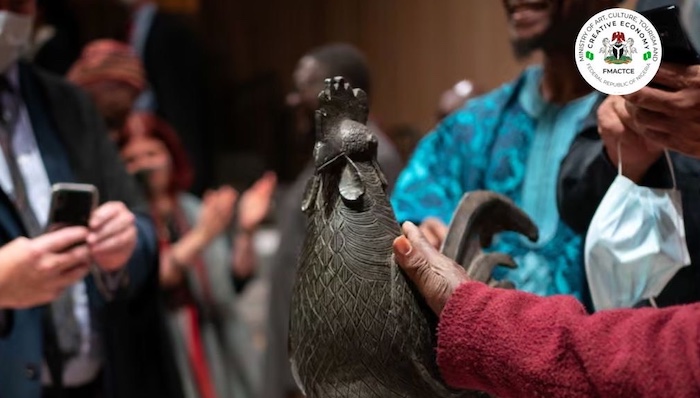
Cambridge University has officially returned legal ownership of 116 Benin artefacts to Nigeria’s National Commission for Museums and Monuments (NCMM), the university announced in a press release issued on Sunday.
The artefacts, part of the Museum of Archaeology and Anthropology (MAA) collections, will be repatriated under a management agreement with the Benin Royal Palace.
The decision follows a formal request from the NCMM in January 2022 for the return of objects taken by British armed forces during the sacking of Benin City in 1897. The University Council approved the claim, with authorisation from the UK Charity Commission.
While the majority of artefacts will be physically returned, a small number will remain on loan and on display at the MAA, accessible to museum visitors, students, and researchers.
The 116 objects, primarily brass with some ivory and wooden sculptures, were seized during the so-called ‘Punitive Expedition’ following a violent trade dispute.
Olugbile Holloway, Director-General of NCMM, said: “This development marks a pivotal point in our dialogue with the Museum of Archeology and Anthropology at University of Cambridge and it is our hope that this will spur other museums to head in a similar direction. The return of cultural items for us is not just the return of the physical object, but also the restoration of the pride and dignity that was lost when these objects were taken in the first place.
We would like to thank the Honourable Minister of Art, Culture, Tourism and the Creative Economy, Hannatu Musawa for all her invaluable support in making this happen and also we applaud Cambridge for taking this step in the right direction. We look forward to welcoming the artefacts back home soon.”
Professor Nicholas Thomas, Director of MAA, added: “It has been immensely rewarding to engage in dialogue with colleagues from the National Commission of Museums and Monuments, members of the Royal Court, and Nigerian scholars, students and artists over the last ten years.
Over the period, support has mounted, nationally and internationally, for the repatriation of artefacts that were appropriated in the context of colonial violence. This return has been keenly supported across the University community.”
The move aligns with similar repatriation commitments by other museums across the UK, US, and Europe.
Faridah Abdulkadiri
About the Author