BRIAN GEORGE OTIENO (BRANJI), 28, has lived quite the life.
He once balanced five plates of steaming pilau through a crowded Eldoret nyama choma joint at 2 am. In a hostel bedsitter, he has edited tech vlogs on a second-hand Lenovo, whose “J” key was missing.
Yet when Quick Talk caught him on a Sunday afternoon recently, he had just flown in from headlining the Kisumu Business Ecosystems Summit and was still wearing the Manchester United golf shirt he had played 18 holes in that morning.
He slid into the chair at a quiet garden restaurant overlooking Uhuru Park, greeted the waiter by name, then ordered his usual: “Chai ya Luo kali, hakuna sukari, tangawizi mingi.” Strong, bitter, fiery, exactly like the stories he tells.
Take Quick Talk back. What was the first story that truly moved you?
There’s a young man I can never forget. Rural Kenya, no electricity most evenings, yet he was building biometric school-attendance systems using nothing but electronic waste, old extension cables people had thrown away, broken phone chargers, cracked glass from spoiled gadgets.
Trash to everyone else. He turned it into functioning tech right there in his mother’s sitting room. Suddenly I saw the Africa the world never shows: the Africa that builds, not the one that begs.
You often say 2025’s CNN Academy in Dublin was the highlight of your year. Why?
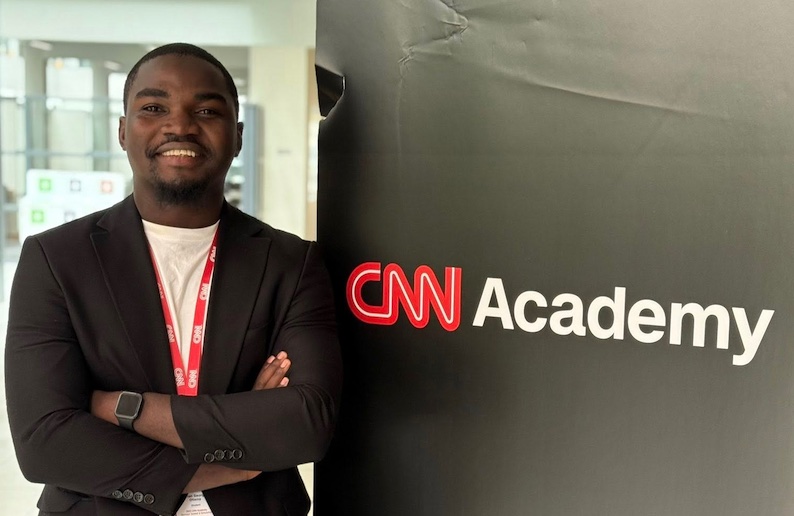
Because at 12 years old I was that barefoot boy in Bondo, watching CNN on a 14-inch CRT, promising myself I’d one day be inside that screen. In July 2025 I walked into the actual building.
I cried in the bathroom quietly, like a proper Luo. It wasn’t the fancy studios that got me. It was the obsession with truth: fact-checking to the bone, arguing over one adjective at 2 am because it could shift perception.
Standing among people I grew up idolising, I felt I already had one foot inside CNN, not because they offered a job [they didn’t], but because they handed me the blueprint. CNN Academy stretched me, humbled me, and reminded me exactly why I chose this career in the first place.
How has moderating in 12 countries changed the way you tell African stories?
You finally see the global perception of Africa through Africa’s own children. In Dubai, Cairo, Lagos, Johannesburg, Geneva, Shanghai, you sit with climate negotiators, central bankers, unicorn founders, diplomats and the professionalism forces you to level up. Panels are tight, research is nonnegotiable, timekeeping is religion, networking is oxygen.
The biggest revelation?
Africa is no longer just a topic on the agenda; Africa is a player at the table. When you moderate internationally you’re not limited to a two-minute TV package; you get depth, data, live examples.
I’ve literally worn VR headsets to “walk” inside climate-finance models. I come home to the NTV newsroom richer, more global, and paradoxically more rooted, because I’ve seen our solutions hold their own against the world’s best.
Many young African journalists dream of international stages. What is your honest, no-sugar-coating advice?
I keep telling my fellow journalists “Don’t Shrink”; refuse to make yourself smaller so others feel comfortable.
It means walking into rooms with your full accent, your full story, your full demand to be heard and seen. My lived version has seven commandments I repeat like prayer: Never apologise for how you sound.
Post your work every single day until the algorithm knows your name. Cold DM organisers like your rent depends on it [because once it did].
Carry a USB of your self-made work everywhere. Ask for the seat today; if they say no, ask again tomorrow. Readiness is a myth. Network like you’re too broke to stay invisible. Prepare until your preparation scares people.
And study Nigerians religiously… they walk into global rooms like the landlord sent them personally. That confidence is learnable.
What excites you most about African tech and innovation right now?
We finally stopped copy-pasting. For years people imported European or Gulf solutions and tried to force-fit them onto African problems. It never worked; our terrain, demographics, culture, informality are too specific. Now we build for us, by us.
How do you see East African startups shaping the continent’s economic future?
Startups are about to flip the script: they will write policy, not wait for it. They already employ up to 80 per cent of our workforce. When you hire 22 people you feed 22 families you become an economic stakeholder whether the government recognises it or not. The future of African GDP is not in oil or aid; it’s in the kid coding in a cyber café in Githurai.
You’ve worked in about a dozen African countries this year. Which one is your favourite so far?
[Grinning]: Nigeria, hands down. The energy is organised chaos in the best way. In Lagos a panel can end at midnight and the real conversation continues in traffic at 3am with pure passion. Plus the jollof is undefeated.
What role does the media play in promoting (or killing) African innovation?
The media chooses what the world stares at. If we only serve famine, conflict, and corruption, that becomes Africa’s brand.
But when we spotlight the women-only taxi app in Kinshasa, the solar engineers in Turkana, the 19-year-old building drones from e-waste, we shift the identity. Innovation thrives when people feel seen.
Our job is not PR. It’s ruthless accuracy. And Africa’s solutions deserve to be reported with the same rigour we give to war.
With such a demanding schedule, how do you stay grounded?
Sundays are sacred: phone off from Saturday night to Monday morning; church, fish on the jiko with family, 18 holes of golf [27 handicap keeps the ego nicely bruised]. And I still travel with the burnt apron from Eldoret days.
[Laughs] Before every big moderation I touch it and whisper, “Don’t embarrass the people who carried plates so you could carry microphones.”
I also never forget: the mama mboga in Githurai deserves the same respect I give a head of state. When you treat every human being like their story matters, the world cannot inflate your head.
How do global experiences reshape your view of Africa’s opportunities?
They expose the painful irony: everyone else already sees Africa as the world’s next growth frontier, yet too many of us still see ourselves as a charity case.
We have the youngest population on earth, the largest deposits of cobalt, coltan, gold, oil; more arable land than Russia and Canada combined; unmatched creative energy. FDIs are flooding in because other continents are stagnating.
Yet we over-tax each other, keep borders closed, and make it cheaper to fly Nairobi–Dubai than Nairobi–Kigali. I dream of the day a Kenyan can wake up and work in Luanda without visa drama, a Malawian can fly to Abidjan cheaper than to Paris, and a Tanzanian coder’s app moves across 54 markets as easily as WhatsApp.
Africa is rich; not just in resources, but in possibility. We only lack the political will to unlock it. Travel has shown you, “the rest of the world already treats Africa as the next growth frontier, yet many Africans still see ourselves as a charity case”.
Where does that contradiction hurt you the most?
It hurts at the borders and in the tax codes. We have creative energy that exports music and memes to the world. Foreign direct investment is pouring in because everywhere else is aging or stagnating.
Yet we make it cheaper for a Malawian to fly to Paris than to Accra. We wrote the AfCFTA on beautiful paper and then kept the gates locked with visas and tariffs.
The world is ready to bet billions on us; we’re still busy betting against each other. That self-sabotage is the wound I carry from every trip.
Final words for every young African dreaming of global stages…
It’s like asking me what would I tell my 19-year-old waiter self over a cup of strong Luo tea? I’d brew it properly strong, no sugar, extra tangawizi, sit him across the table, look him dead in the eye and say: “Listen carefully, son. The world will try to make you feel small because of where you’re from.
Don’t believe the lie for even one second. Your accent is evidence, not apology. Your village stories are universal medicine. Your continent is not a charity case, it is the future arriving early.
Walk into every room like you paid for the building. One day your children will. And when the world finally asks who taught you to own the stage, tell them it was the boy who carried five plates of pilau at 2am so he could buy a microphone and speak for everyone who looks like him.”
ashleymwesigye@gmail.com
About the Author