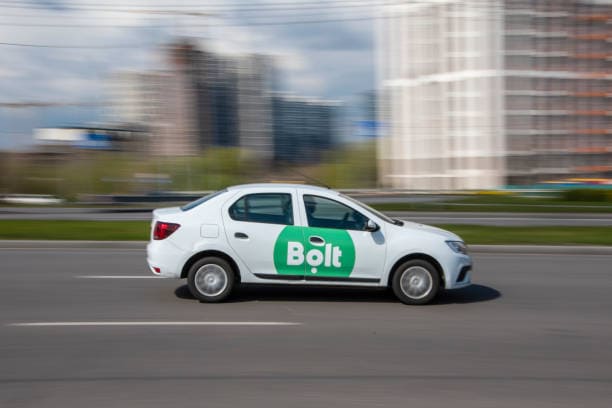
Ukraine, Kyiv - 26 April 2021: Taxi Bolt White Renault Logan car moving on the street. Editorial
Mandla Madonsela was unemployed before he decided to buy a car to support himself by driving for Bolt. Every day, he worries that he might be scammed, attacked, arrested, or worse, killed.
He has been a driver for about two years and says that it has become “very dangerous”.
Following the brutal death of Isaac Satlat, the 22-year-old Bolt driver whose murder was recorded on the car dash camera and circulated on social media earlier in the year, e-hailing drivers continue to fear for their lives as passengers try their luck during trips, threatening their job security.
This, despite Bolt SA’s efforts to improve regulation and safety compliance with the National Public Transport Regulator (NPTR).
Inappropriate propositions and threats
He says there have been many times when female passengers have made inappropriate offers to him instead of paying money, and, when he would decline, they threatened to report him.
“They say they’re going to send you to jail for sexually harassing them.”
“I took someone, and she was like, ‘I forgot something.’ I know those stories, so I said, ‘let us go back’, because I wasn’t far from where I picked her up. On our way back, she told me, ‘No, we can go, I have it [the money].’
“She then asked, ‘What if I don’t have money?’ And I’m like that’s not how it works. If you didn’t have money, you could’ve told me, and then maybe I could’ve given you taxi money or something.”
“She’s like, ‘hai, I’m gonna show you something. I’m gonna report you, and I want Bolt to block your account.”
Short payment
He said that on other instances, riders will add stops on a trip and leave after the first stop, not completing the trip and short-paying.
He claimed that when it was reported, the company would not make up the difference.
A price drop at night also makes it difficult to earn enough to get by, at a time when your life is most in danger.
When he arrives at a suspicious or poorly-lit location, he declines the ride.
“Even though you are not safe, it still affects your driving score. There’s nothing you can do.”
ALSO READ: Arrests mount in e-hailing driver Isaac Satlat’s murder case as three more appear in court
High commission rates
According to Madonsela, the commission taken on every trip is between 30% and 100%, regardless of the trip cost and distance. Madonsela suggested that a deduction of 10% to 15% per trip is a more reasonable price reduction.
Senior general operations manager and spokesperson at Bolt SA, Simo Kalajdzic, told The Citizen that the commission rate is strictly 24% across the board, “it does not fluctuate.”
“Today, we charge a standard flat fee of 24% across all trips for the driver commission. So, drivers will keep 76% of the total fare on every trip that they complete.”
Panic button
Kalajdzic emphasised the initiatives and regulations the company has set to ensure drivers and riders are both protected on the roads.
“When we look at crime in South Africa specifically, it is a widespread issue, and it impacts many sectors, including transportation. No platform can fully eliminate all criminal risk in the societal context.”
Kalajdzic said the company has an emergency assist button available for drivers and riders, linked to private emergency and medical services.
In December last year, Madonsela pressed the emergency button after a heated encounter with a passenger who refused to pay for a trip.
He expected an immediate response but instead had to wait nearly two hours.
“When someone from the company called, they were unhelpful and “couldn’t even speak properly.”
Mandonsela said there was a follow-up call 30 minutes later, but at this point, he was already on another trip, trying to ensure he had enough money to buy petrol for the next day’s trip.
When asked about Mandla’s situation and the response time to his call, Kalajdzic said: “I can’t exactly comment on this particular case because I don’t have the facts.”
“What I can say is that we do hold our [emergency assist] providers to strict SLAs (service level agreements) and there are also strict penalties in place when they don’t meet the requirements that we’ve initially set out in the contract.”
Kalajdzic says that the reaction speed is very important, “in terms of how we keep both our riders and drivers safe on the platform.”
Other safety features include real-time trip sharing for both the rider and the driver, where they “can share their live location with trusted contacts, also directly from the app.’
“In addition to that, we’ve also got our trip monitoring features so we can detect any abnormalities… such as a stationary vehicle, route deviations. And in the event we detect that, we will reach out and offer the best level of support, where applicable.’
“Whether from a customer support perspective or yes, if it is escalating to a real emergency. That’s where this private emergency dispatch service comes into play.”
Rider Misconduct
Mandla also emphasised how riders do not leave the car in the same state that it was found. On late nights out when drunk people puke in his car, he has to pay for it to be cleaned.
According to Kalajdzic, there are forms of compensation available to drivers when riders leave the car in a messy state.
“You don’t need to do it on your own accord. We’ve got providence and assistance in place, and we will deal with the rider ourselves.”
“Try not to engage directly because things can escalate depending on how you approach the situation.”
“The same way, we as Bolt hold drivers accountable to particular ways of operating in terms of the conduct. The same is applied to riders.”
“We will engage with the rider, send them communication to let them understand what went wrong, and also to take it as a warning.”
The rider’s behaviour will be monitored on the application. If inappropriate conduct continues, the rider will ultimately be blocked from the platform.
Preventative and verification mechanisms
According to Kalajdzic, dash cameras have been introduced in cars to support evidence collection and Saps with further investigations.
“Whenever we detect any form of criminal activity involved, we will work closely with Saps and provide the relevant information to support all investigations that do go on. There are serious consequences both from a platform perspective and potentially from a legal perspective.”
“Drivers also have immediate access to our high-risk and dangerous area notifications on every trip.”
“If it’s originating from a dangerous area, we do give this information to our driver, and the driver now has that information up front and can make a decision as to whether they want to accept the trip and go into that area or not. “
“And if the driver refuses to accept the ride, there is no impact to their account. It’s an optional choice for the driver.”
Profile Verification and safety
In an effort to prevent fake driver profiles, all drivers need to submit a valid and legitimate professional driving permit (PDP). These documents are verified through the eNATIS platform (Electronic National Traffic Information System).
Riders are also prompted to verify their identity through the platform rider verification, and pickup codes ensure drivers and riders are associated with the correct cars.
“What we need to do at Bolt is continue to learn about how drivers are infiltrating these loopholes, where they do exist, and quickly close them.
“That is our focus moving forward; we will always preempt and build better technologies to ensure that we eradicate this problem completely from the platform.”
Bolt SA’s New Regulations
Bolt SA has also become the first e-hailing company to officially register under South Africa’s newly implemented transport regulations. On the 27th of February 2026, the National Public Transport Regulator (NPTR) issued a certificate of registration formally confirming compliance.
READ MORE: E-hailing body decries crimes against drivers
About the Author