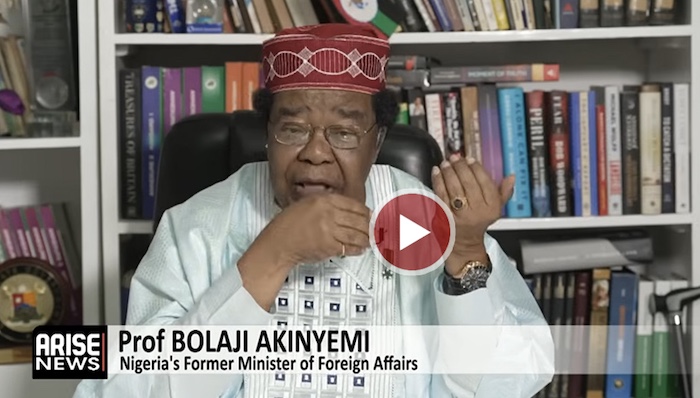

Nigeria’s former Minister of Foreign Affairs, Bolaji Akinyemi, has defended the recent state visit to the United Kingdom, describing it as a powerful signal of Nigeria’s global relevance and warning against politicising a diplomatic engagement of such magnitude.
Speaking in an interview with ARISE NEWS on Friday, Akinyemi said the focus should be on the significance of the visit rather than criticisms surrounding its timing, insisting that the reception accorded Nigeria by King Charles III reflects the country’s enduring importance on the world stage.
“The visit has been described as historic, symbolic, and cultural… what we should be talking about is the significance rather than trying to limp in about whether the visit should have gone on or not,” he said.
Akinyemi noted that the grandeur and precision of the royal reception at Windsor underscored Britain’s regard for Nigeria.
“You cannot detract from the magnificence of the show that was put on by the king. Nobody does it better than the British when it comes to protocol. Nothing was missing,” he said.
He highlighted key symbolic elements, including the visit occurring during Ramadan and being only the second time a Muslim head of state was hosted under such circumstances. He also pointed out that it was Nigeria’s first state visit invitation in nearly four decades.
“This will be the first Nigerian head of state in 37 years, I believe, to be invited on a state visit. You must read a meaning into that,” he said.
Addressing criticism that the visit should have been postponed following the Maiduguri tragedy, Akinyemi was emphatic:
“What happened in Maiduguri was a disaster for Nigeria’s image… it is something we should be weeping about. But you don’t change a state visit at the last second because of something that happened. Disasters happen, but state events go on.”
He added that cancelling at short notice would have been diplomatically inappropriate.
“You don’t do that to Britain. You don’t do that to the United States. So you keep all those people waiting because you have stopped because of something that happened in your country? No.”
Akinyemi expressed gratitude to King Charles III for maintaining the full ceremonial programme, including the state dinner.
“As a Nigerian, I thank King Charles III for putting on that show and not taking anything from it,” he said, while also praising the discipline and organisation of British protocol.
“I hope protocol in Nigeria was watching… nobody was rushing, nobody was pushing. People knew their position.”
According to him, the visit sent a broader geopolitical message:
“This was not just a signal to Nigerians that we are better than we think we are; it is also a signal to the rest of the world that if Great Britain… could value Nigeria, the rest of the world should also be paying attention.”
On domestic reactions, Akinyemi criticised attempts to politicise the visit.
“It was Winston Churchill who said politics stops at the shore… I feel rather put off when people bring politics into something like this. Maybe they don’t know what they are talking about.”
He also pointed to the optics of President Bola Ahmed Tinubu during the visit, particularly amid concerns about his health.
“To watch the president climb those steps… after the crisis in Turkey, that was a signal that whatever his medical problems are, it is one that could be accommodated… they may have an old person as their president, but it is not a dying person,” he said.
However, Akinyemi expressed dissatisfaction with the reception by the British Prime Minister, Keir Starmer.
“I’m not happy about what happened on the side of the prime minister… there’s no reason why he could not have met President Tinubu the way he meets President Zelenskyy,” he said.
On diplomatic outcomes, he argued that Nigeria must be more assertive in negotiations, including raising unresolved historical issues.
“The British have this habit of draining you… while they are rather silent on what they owe you,” he said, citing past experiences during his tenure, including discussions with former Prime Minister Margaret Thatcher.
He supported calls for Nigeria to raise issues such as compensation related to historical injustices, noting:
“We also should have raised it… not with the king, but in discussions with the government.”
On judicial matters, including calls to intervene in high-profile cases, Akinyemi cautioned against political interference.
“There are too many Nigerians. We should learn our lesson, obey the law, and let the law take its course… I’m not really fond of political interference in judicial issues,” he said.
Reflecting on protocol and diplomacy, Akinyemi acknowledged the complexities of interactions between elected leaders and royalty.
“Presidents are, in a way, lower than kings… but when it comes to political discussions, you must stand your ground,” he said, recalling similar dilemmas from his time in office.
In conclusion, he urged Nigeria to consolidate the gains of the visit through strategic diplomacy and disciplined engagement, emphasizing that the true value lies not just in ceremony but in long-term national benefit.
Beyond the pageantry in London, many Nigerians are left grappling with grief and anger as families in Maiduguri mourn their dead, underscoring a painful contrast between global diplomacy and the urgent realities of insecurity at home, where citizens continue to demand not just strong international ties but decisive action to protect lives.
Boluwatife Enome
About the Author