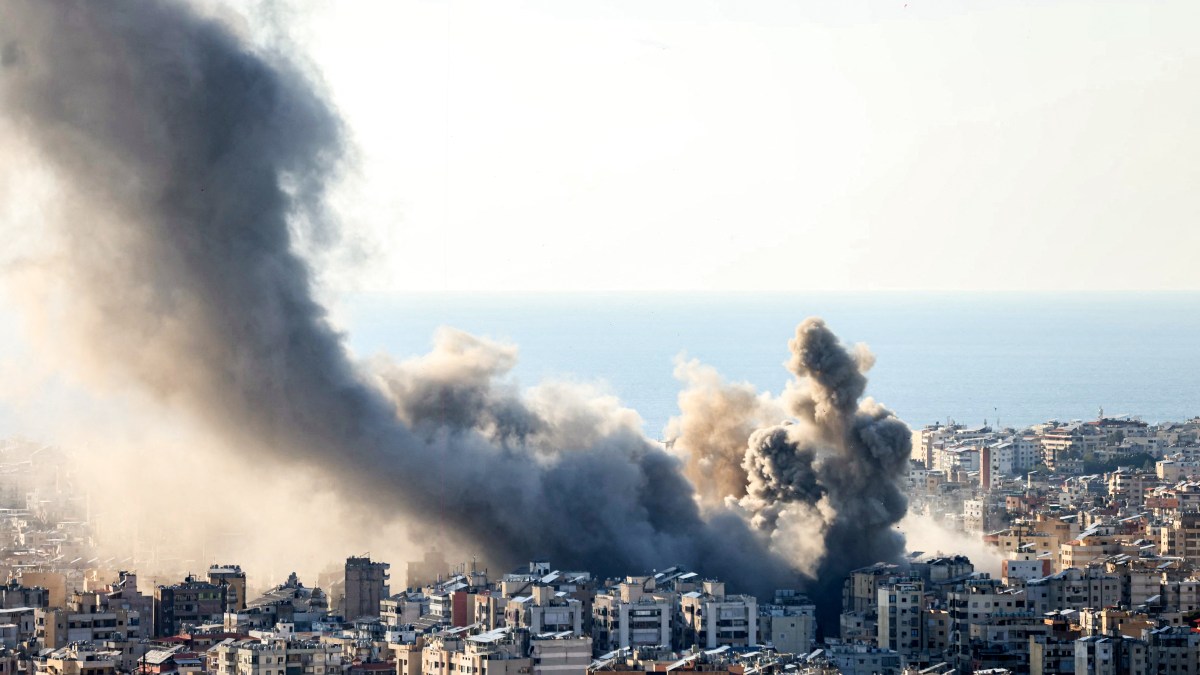
The escalating Middle East conflict has entered its seventh day, with renewed Israeli airstrikes targeting the southern suburbs of Beirut following what the military described as a “next phase” in its campaign.
The Israeli military issued an unprecedented evacuation warning covering the entire southern Beirut area, urging residents to “save your lives and evacuate your homes immediately.” The warning triggered widespread panic and mass displacement as residents fled the region.
The conflict has continued to spread across multiple regions, drawing in neighbouring countries and heightening global security concerns.
In global political developments, Donald Trump rejected the possibility of Mojtaba Khamenei succeeding his late father, Ali Khamenei, describing him as a “lightweight.”
Trump suggested he would prefer a leader who could foster “harmony and peace” in Iran, while indicating a willingness to engage with figures from within the Islamic Republic rather than pursuing regime change.
“I have to be involved in the appointment process, similar to what happened with Delcy,” Trump said in an interview, referencing the political situation in Venezuela.
He also warned that further escalation of the war could follow if what he considered a suitable alternative leadership arrangement was not achieved.
The war expanded into Lebanon earlier in the week after Hezbollah launched attacks against Israel in retaliation for the killing of Khamenei.
Israel responded with airstrikes and limited ground operations along Lebanese border villages, later targeting Hezbollah infrastructure in Beirut’s southern districts.
The evacuation warnings prompted chaotic scenes, with traffic congestion reported on the outskirts of the suburbs as security forces urged civilians to leave immediately.
On Beirut’s coastline, hundreds of displaced families gathered with nowhere else to go, many expressing fear and frustration over the unfolding violence.
Lebanese authorities reported that at least 123 people have been killed since the latest escalation began on Monday, with more than 680 injured and approximately 90,000 people displaced.
The conflict has also raised tensions beyond the primary theatre of war.
Neighbouring Azerbaijan warned that a recent drone attack on one of its airports would “not go unanswered,” heightening concerns that additional regional actors could be drawn into the fighting.
While Iran denied involvement in the strike and instead blamed Israel, Azerbaijani President Ilham Aliyev accused Tehran of acts he described as “terrorism”.
Elsewhere, several countries have increased military readiness.
Australia deployed two military aircraft to the conflict zone, while Canadian Prime Minister Mark Carney said his country was not ruling out potential military involvement.
Satellite and video footage from Tehran showed smoke rising from damaged infrastructure and burnt-out vehicles following continued strikes.
Iranian state-linked sources claimed the death toll from US and Israeli strikes had reached 1,230, though this figure could not be independently verified.
Meanwhile, Iranian Foreign Minister Abbas Araghchi adopted a defiant stance, stating that Tehran had no immediate plans for a ceasefire and saw little reason for negotiations with the United States.
Regarding a potential ground invasion, he warned that such a move would be catastrophic for opposing forces.
Israel claimed that its military operations had destroyed approximately 60 percent of Iran’s missile launchers and about 80 percent of its air defence capabilities.
Israeli military chief Eyal Zamir announced the beginning of a “next phase” in the campaign, adding that more operational surprises were expected.
In Tel Aviv, fresh Iranian missile attacks triggered widespread explosions, forcing emergency responders to battle fires at a residential building near the city’s commercial centre.
The conflict has also affected Gulf countries, which are typically considered relatively stable amid regional unrest.
Officials reported that at least 13 people—including seven civilians—have been killed across Gulf states since the war began, including an 11-year-old girl in Kuwait.
Authorities in Bahrain stated that Iranian forces targeted two hotels and a residential building in the capital, Manama, although no casualties were reported.
Meanwhile, Saudi Arabia said it intercepted three ballistic missiles aimed at a military air base.
In Qatar, air defence systems reportedly intercepted a missile strike, with explosions shaking Doha and thick smoke visible across the skyline.
In the United Arab Emirates, falling debris from a downed drone injured six people in Abu Dhabi.
The widening conflict continues to raise fears of a broader regional war as military and diplomatic tensions escalate across the Middle East.
About the Author