Bangladesh’s interim government has announced plans to airlift a prominent leader of the 2024 student-led uprising to Singapore for advanced medical treatment after he was critically wounded in a suspected assassination attempt ahead of national elections.
Student leader Sharif Osman Hadi was shot by masked gunmen on Friday as he exited a mosque in the capital, Dhaka.
The bullet reportedly struck his ear, leaving him in critical condition. The attack occurred just one day after authorities announced the date for the country’s first elections since last year’s uprising that toppled the long-ruling government of Sheikh Hasina.
In a statement issued late Sunday, the interim government said it would fully fund Hadi’s evacuation to Singapore, adding that an air ambulance and a team of medical specialists had been placed on standby to facilitate the transfer.
Hadi is a senior figure in Inqilab Mancha, a leading student protest movement, and a vocal critic of India—Bangladesh’s powerful neighbour and a longtime ally of Hasina, who remains in self-imposed exile there following her ouster.
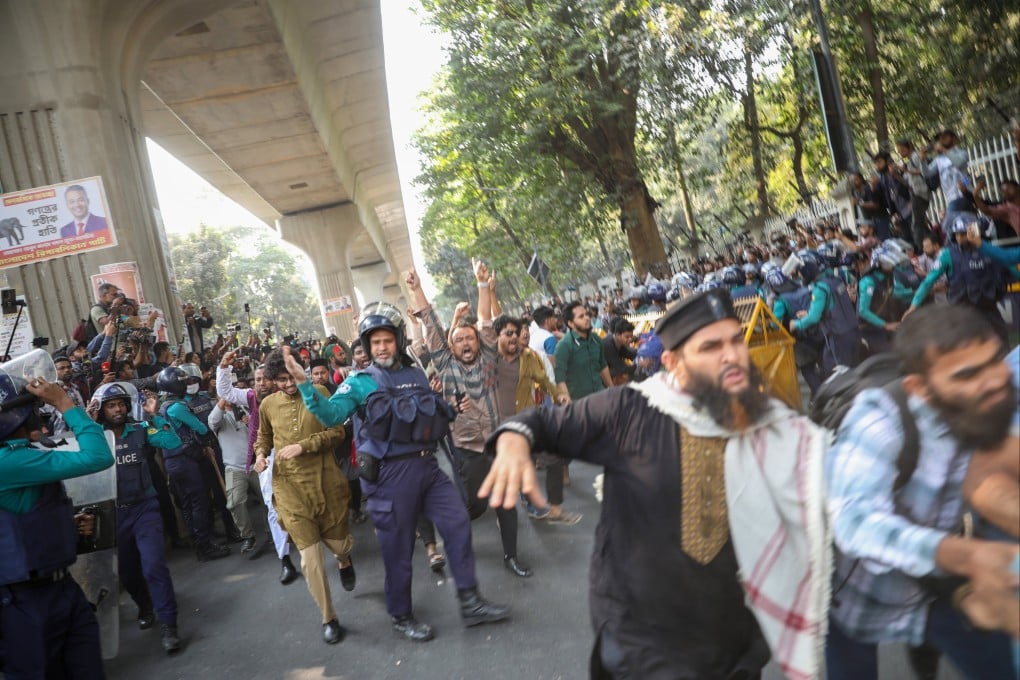
The shooting has sparked widespread outrage. Hundreds of protesters gathered in Dhaka on Monday to denounce the attack, describing it as an assault on the country’s fragile democratic transition.
“This is an attack on our political solidarity,” said Gazi Sadia, a 21-year-old student protester, speaking to AFP.
The rally drew supporters from across the political spectrum, including members of Jamaat-e-Islami, Bangladesh’s largest Islamist party, and the National Citizen Party (NCP), a political group formed by students who played key roles in last year’s uprising.
Police said they have launched a nationwide manhunt for the assailants, releasing photographs of two prime suspects and offering a reward of five million taka (approximately $42,000) for information leading to their arrest. Dhaka police spokesman Muhammad Talebur Rahman also confirmed that border security had been placed on high alert.
‘Attempt to Derail the Election’
Interim leader Muhammad Yunus, the 85-year-old Nobel Peace Prize laureate guiding the country toward elections scheduled for February 12, described the shooting as a calculated and politically motivated attack.
“The objective of the conspirators is to derail the election,” Yunus said on Saturday. “This attack is symbolic—intended to demonstrate their strength and sabotage the entire electoral process. We must resist such attempts.”
In response, the government on Sunday ordered heightened security measures for all political candidates, pledging protection for their residences, offices, movements, rallies, and even online activities.
Bangladesh’s 170 million citizens are expected to vote directly for 300 members of parliament, with an additional 50 seats reserved for women. A referendum on a sweeping democratic reform package will also be held on the same day.
Political tensions remain high as parties prepare for the polls in a country still grappling with instability. Sheikh Hasina, who was convicted in absentia last month and sentenced to death, has refused to return to face trial and continues to remain in hiding in India, despite repeated extradition requests from Dhaka.
Adding to the unrest, veteran journalist Anis Alamgir was arrested on Monday on allegations of “anti-state activities” linked to promoting Hasina’s now-banned Awami League party. Human rights organisation Ain o Salish Kendra condemned the arrest, calling it “a direct attack on freedom of expression.”
The last general elections, held in January 2024, handed Hasina a controversial fourth consecutive term, with her Awami League securing 222 seats amid opposition boycotts and allegations of widespread rigging.
The Bangladesh Nationalist Party (BNP), led by former prime minister Khaleda Zia, is widely expected to perform strongly in the upcoming vote.
Zia is currently receiving intensive medical care in Dhaka, while her son and political heir, Tarique Rahman, is scheduled to return from exile in the United Kingdom on December 25, after 17 years abroad.
About the Author