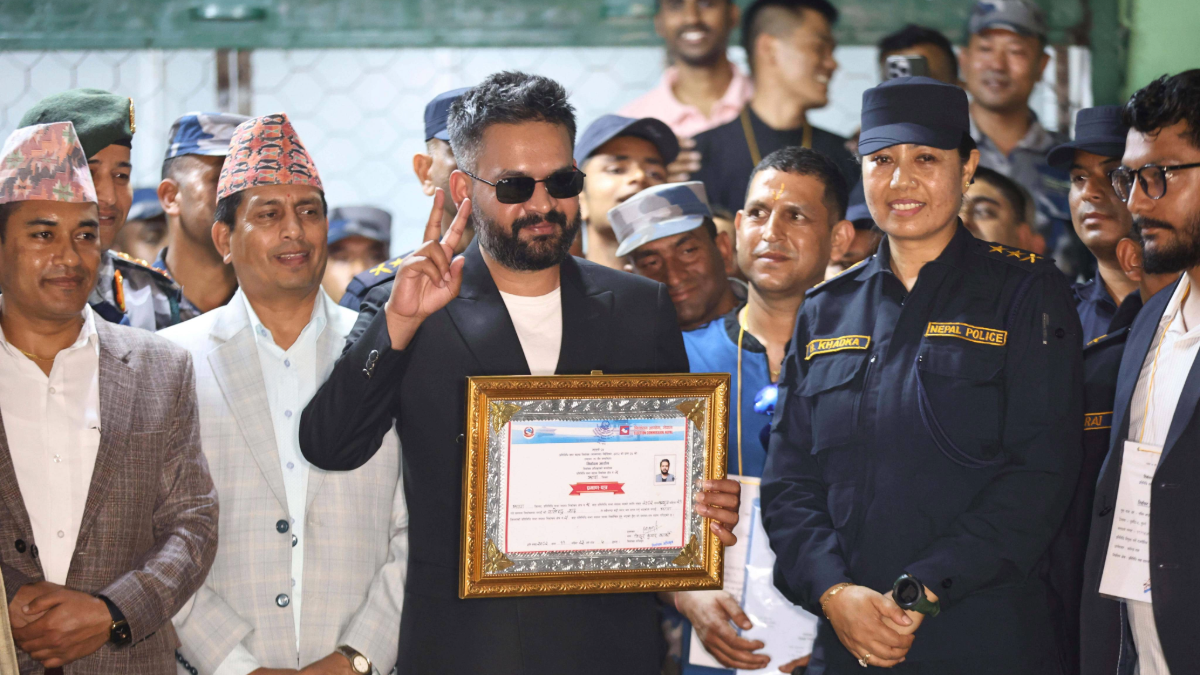
Vote counting is continuing in Nepal as the party led by rapper and former Kathmandu mayor Balendra Shah moves closer to securing a historic parliamentary supermajority.
The Rastriya Swatantra Party (RSP) is potentially just one seat away from gaining a two-thirds majority in parliament, a result that would mark the first time in decades that a single political party has achieved such dominance in the country’s legislature.
Nepal’s electoral system combines direct constituency elections with proportional representation, making it traditionally difficult for any single party to secure an outright majority.
If confirmed, the RSP’s victory would therefore represent a major shift in the country’s political landscape.
The 35-year-old Shah also scored a significant personal victory by defeating former prime minister KP Sharma Oli in Jhapa-5, a constituency long regarded as a political stronghold for the former leader.
The result has effectively cleared the path for Shah to become Nepal’s next prime minister.
Across the country, Shah’s supporters have been celebrating the election outcome, gathering in streets to cheer and ring bells the election symbol used by the RSP during the campaign.
The election, held on March 5, took place six months after widespread youth protests that toppled the government led by Oli.
The demonstrations were driven by frustration among young people over elite political control, nepotism, corruption and growing economic inequality.
The protests turned deadly at times and eventually forced the government to step down.
According to the Election Commission of Nepal, results for 164 of the 165 first-past-the-post seats have already been announced.
Counting of proportional representation votes is still underway.
Election officials say more than 10.3 million proportional representation votes have been counted so far, with between 500,000 and 600,000 ballots still to be tallied.
Suman Ghimire, an information officer at the commission, said the counting process is expected to be completed by Tuesday evening local time.
However, it could take up to four days before the commission formally declares the final election results.
Meanwhile, attention has also turned to Nepal’s unfinished parliament building, which remains under construction.
Officials say that although the building is not yet fully completed, a conference hall within the complex should be ready in time for the oath-taking ceremony and opening parliamentary session expected in the coming weeks.
Construction scaffolding and cranes are still visible around the structure as the country prepares for a new parliament dominated by Shah’s party.
The previous parliament building was damaged by fire during last year’s youth-led protests.
Current projections suggest the RSP could secure around 125 of the 165 seats allocated through direct voting.
The party is also expected to gain approximately 58 of the 110 seats distributed through proportional representation.
A two-thirds majority in the legislature requires at least 184 seats, meaning the party could fall just one seat short of that threshold.
The possibility of such a “supermajority” has sparked debate about whether the RSP might attempt to amend the country’s constitution.
During the campaign, the party promised several reforms, including changes to Nepal’s federal structure and adjustments to the way national leaders are elected.
However, constitutional changes would be difficult to implement immediately.
While the RSP is on course to dominate the lower house of parliament, Nepal’s constitution requires a two-thirds majority in both houses of the legislature to approve constitutional amendments.
The upper chamber, known as the National Assembly of Nepal, is elected through an electoral college made up of provincial assembly members and local government representatives rather than by direct popular vote.
As a result, the RSP currently lacks the numbers needed in the National Assembly to push through constitutional reforms on its own.
Erizia Rubyjeana
About the Author