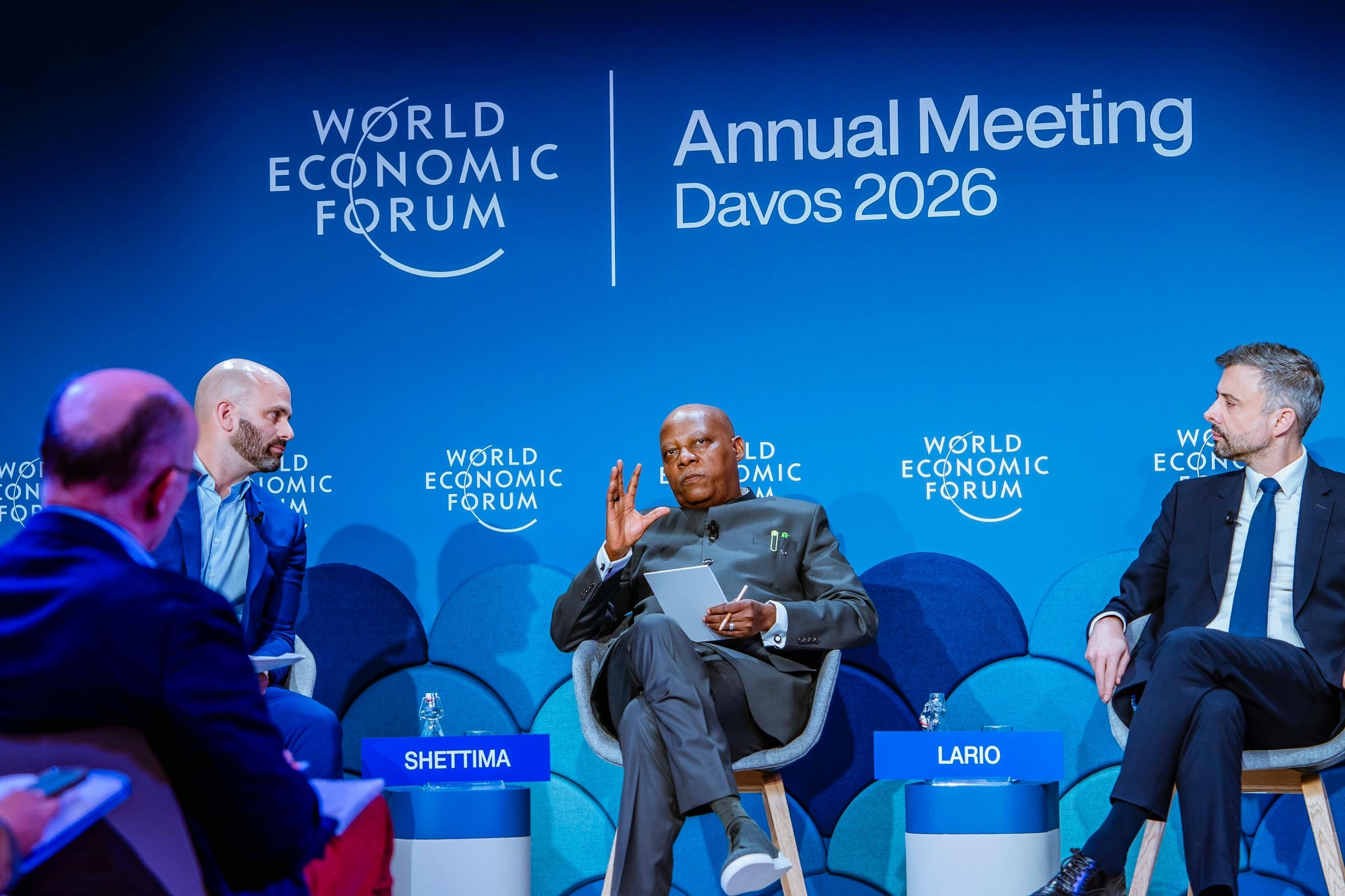
Vice President Kashim Shettima has canvassed homegrown solutions to Africa’s economic challenges, urging the continent to embrace innovation, domestic production, and investment-driven growth as pathways to sustainable prosperity.
Shettima made the call on Thursday at the High-Level Accra Reset Initiative meeting, held on the margins of the ongoing 2026 World Economic Forum (WEF) Annual Meeting in Davos, Switzerland. He stressed that Africa can only achieve resilient wealth by building domestic productive capacity rather than relying on external aid.
According to him, Africa is no longer on the periphery of global relevance but stands at the centre of the world’s demographic and economic future. However, he warned that prosperity would not come by expectation or applause alone.
“It is only by building domestic productive capacity that African nations can convert their population and natural talents into real, resilient wealth. Prosperity cannot be parachuted in; it must be homegrown and earned,” Shettima said.
Citing Nigeria as an example, the Vice President pointed to the Dangote Refinery, noting that the country is on the verge of becoming a net exporter of refined fuel after decades of import dependence.
“Africa cannot rise on applause alone. We rise when we build. After decades as a net importer of value, Nigeria is on the verge of becoming a net exporter of refined fuel, powered by Africa’s largest refinery in Lagos—the Dangote Refinery,” he stated.
He added that when African capital is matched with industrial ambition, nations move from being price takers to value makers, stressing that infrastructure and policy clarity are critical to this transition.
Shettima highlighted the decline in Africa’s manufacturing contribution to GDP—from 16 per cent in 1980 to under 10 per cent by 2016—but said the continent must now leapfrog through technology, modular factories, artificial intelligence, and robotics.
“Africa can industrialise faster in the 21st century than ever before. The era when we are known only for what we dig or grow is giving way to the era when we are known for what we build,” he said.
The Vice President also emphasised the importance of human capital mobility, noting that Africans in the diaspora sent home about $95 billion in remittances in 2024—more than total foreign direct investment.
“That is not charity. Let skills and ideas flow as freely as goods and capital, and prosperity will follow,” he said, adding that Africa must treat free movement as a competitive advantage.
On health security, Shettima disclosed that Nigeria is treating healthcare not just as a social obligation but as an industrial value chain through the Presidential Initiative for Unlocking the Healthcare Value Chain (PUHVAC), launched in October 2023.
He described the Accra Reset Initiative as a call to shift Africa’s mindset “from dependency to dignity, from aid to investment, from rhetoric to results,” expressing confidence that the continent could witness a boom built on innovation, industry, and cooperation.
Earlier, Ghanaian President John Mahama decried Africa’s transactional relationship with the global north, saying it has trapped the continent in cycles of conflict and poverty. Former Nigerian President Olusegun Obasanjo and former Vice President Yemi Osinbajo also called for coordination, discipline, and strategic execution to secure Africa’s place in the evolving global order.
Deji Elumoye,
About the Author