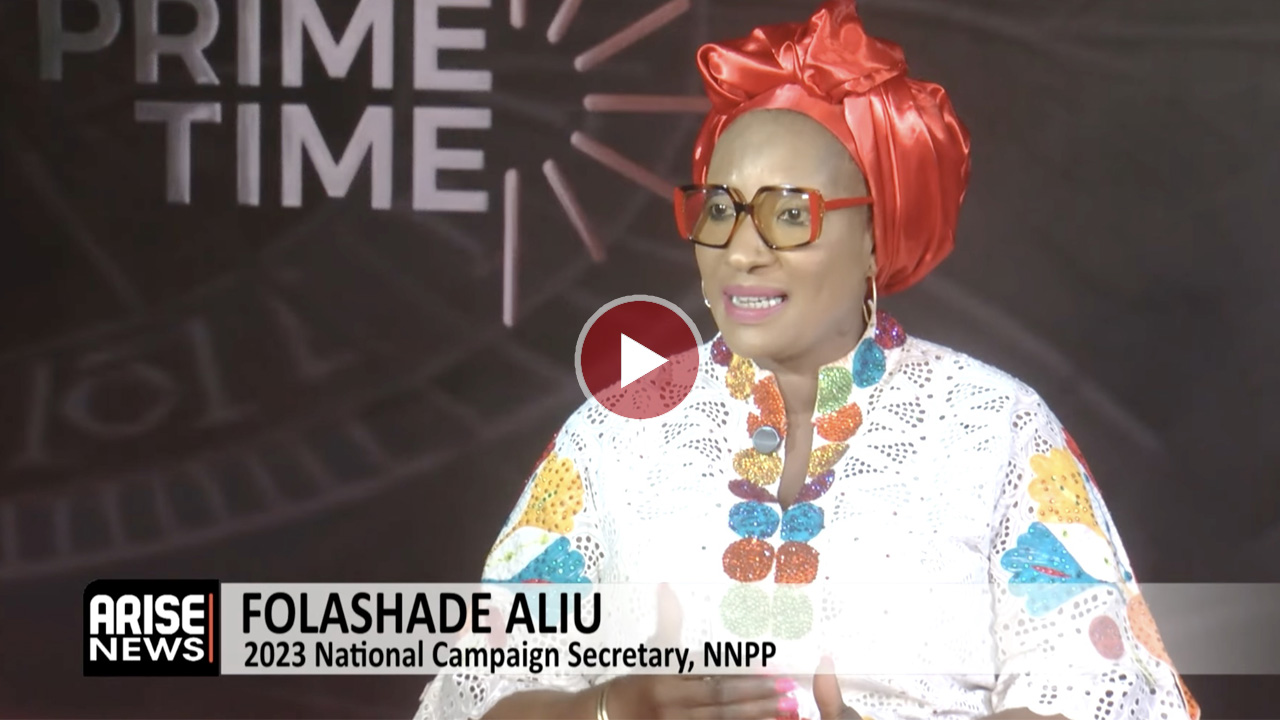
2023 National Campaign Secretary of the New Nigeria Peoples Party (NNPP) and close aide to Senator Rabiu Musa Kwankwaso, Folasade Aliu, has described a proposed United States bill linking the former Kano governor to alleged religious freedom violations as “seriously malicious” and “politically motivated,” insisting his inclusion is unfounded.
In an interview with ARISE NEWS on Thursday, Aliu said the Nigeria Religious Freedom and Accountability Act 2026, currently before the US Congress, wrongly mentioned Kwankwaso and lumped him together with groups he has “nothing whatsoever to do with.”
“I’ve seen it. I have gone through it, reviewed it with our team, and I’ve captured it all over the place on social media. But my perception of the whole thing is that if you go through the entire document, you can tell that this is simply malicious,” she said.
Aliu maintained that her team has begun taking steps behind the scenes to challenge the development.
“We are not folding our hands. We have done so much in the back end, and possibly you’ll be hearing from us. This is not the end of it because we believe that it is politically motivated. We also believe that it’s very malicious,” she stated.
Questioning why only Kwankwaso was singled out in a bill addressing broader concerns about terrorism and religious violence in Nigeria, she added: “Out of everything we have heard about terrorism, kidnapping and so on in Nigeria, you just have one individual named in a bill that serious. It’s simple one plus one.”
Aliu argued that the section referencing the senator appeared in the part of the bill outlining proposed consequences, where his name was “lumped together with some organisations” without any proven alignment.

“The fact of the matter is that you have an individual that you have not in any shape or form aligned with these organisations, even in Nigeria, and all of a sudden his name just appeared. What else can we call that if it’s not malicious?” she said.
Addressing concerns about the expansion of Sharia-based legal systems in northern Nigeria, Aliu rejected claims that Kwankwaso initiated or uniquely drove such policies.
“He’s talking about the fact that he originated, that he’s the first governor that had something to do with Sharia law, which is not correct. When you are talking about Sharia, you are talking about something based on the constitution. It’s not a one-man thing. It’s not a one-state thing. Everybody knows that,” she said.
Aliu, who identified herself as a Catholic, also defended Kwankwaso’s personal record on religious tolerance.
“I’m a Catholic. I work directly with him. I have not seen anything and no indication whatsoever that would tell me that this person has anything to do with religious bigotry or terrorism. I would not associate with something of such,” she said.
Describing him as “a person of character, a nationalist, inclusive, accessible and compassionate,” she added: “He appreciates that I go to my evening Mass at 6 p.m., and he does his Muslim prayers. Those are the little details that show that this individual understands and respects other people’s religion.”
Aliu further suggested that political rivals may have influenced the bill through lobbying efforts.
“If you pay any lobbyist enough, they will do whatever they need to do. I’m seeing the handwriting on the wall,” she said, adding that “this thing would have been initiated from somewhere. It has Nigeria all over it.”
While acknowledging the diplomatic implications of the bill, especially in the United States, she insisted she was not personally worried about its long-term impact on Kwankwaso’s political standing.
“Yes, it’s a big deal that America is involved. But I am not concerned because I know the man, Distinguished Senator Rabiu Musa Kwankwaso. He’s not a baby politician. He has been around. They have tried everything possible to blackmail this person and they have not succeeded,” she said.
On whether the senator would engage directly with U.S. lawmakers, Aliu responded: “He definitely will. And we’re starting from Nigeria all the way to the US Congress. We are engaging.”
She said the engagement would occur at “different levels,” beginning domestically.
“Charity begins at home. We are not going to be running to America for every little thing. We are going to start from Nigeria and go all the way to the US Congress. We are going to do everything humanly possible to retract this,” she said.
Aliu concluded by questioning the intent behind the bill’s framing, arguing that isolating Kwankwaso while mischaracterising issues such as Sharia and other associations indicated haste and ill motive.
“If they can include just one individual wrongly and even quote the whole essence of Sharia wrongly, it tells me they are rushing this. That tells you they don’t have good intentions. By God’s grace, we will come back and you will see the impact of what we’re going to do,” she said.
Boluwatife Enome
About the Author