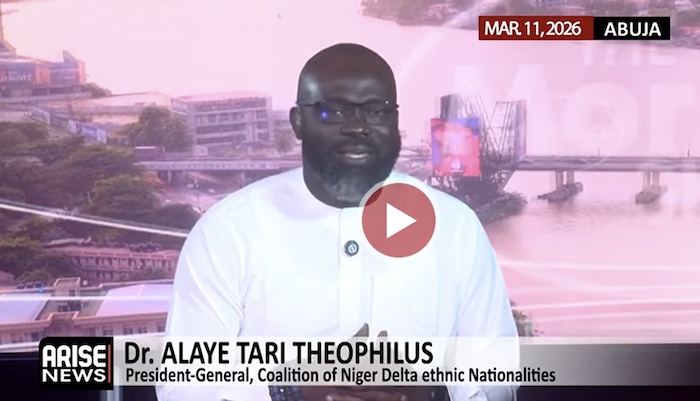

The President-General of the Coalition of Niger Delta Ethnic Nationalities, Dr. Alaye Tari Theophilus, has defended the ongoing National Assembly probe into Nigeria’s multi-billion-dollar pipeline surveillance contracts, insisting that legislative oversight cannot be threatened and calling for the decentralisation of the contracts across the Niger Delta.
Speaking during an interview with ARISE News on Wednesday, Theophilus dismissed warnings by some stakeholders that the probe could destabilise the region, saying the National Assembly is constitutionally empowered to investigate government expenditures.
“First of all, the National Assembly is saddled with the responsibility of monitoring and providing oversight on what is happening in every company, agency or parastatal of government. So, as long as the National Assembly committee is carrying out its constitutional responsibility, there is no way anybody should threaten them or say they should not do that,” he said.
The Niger Delta leader argued that the current pipeline surveillance arrangement is effectively monopolised by a few companies and should instead be decentralised to allow broader participation by communities across the oil-producing region.
According to him, the surveillance contracts awarded by the Nigerian National Petroleum Company (NNPC) were originally meant to address long-standing agitation by Niger Delta communities for greater participation in the management of their natural resources.
“What we are saying is that this pipeline surveillance contract came as a result of the agitation of the people of the Niger Delta. It is just a fragment of what the people have been asking for. So we cannot call for equity and justice when we are not clean with our own hands,” Theophilus said.
He added that decentralisation would create jobs and improve accountability within the region.
“This little fragment that has come to our place should be decentralised so that everybody can monitor everybody. Decentralising the job will give people more opportunity to checkmate the activities happening in the region.”
Theophilus traced the controversy to decades-long demands by Niger Delta communities for resource control, which he said fuelled militancy in the region between the mid-1990s and late 2000s.
“The Niger Delta people have always agitated for resource control. When the Ijaw Youth Council was established, we said resource control by any means necessary. We wanted to control the resources in our land.”
He explained that the militancy era severely damaged Nigeria’s international image and oil production until the 2009 amnesty programme introduced by late President Umaru Musa Yar’Adua, which persuaded militants to lay down arms in exchange for development promises.
“When the late President Umaru Musa Yar’Adua introduced the amnesty programme with the promise that the issues we raised would be addressed — infrastructure, inclusion in the resources produced in our land — the people dropped their arms and accepted the amnesty.”
Despite the surveillance contracts and the reduction in illegal refining activities, Theophilus questioned why Nigeria’s oil production remains significantly lower than past levels.
“Even at the peak of militancy and armed struggle in the Niger Delta, Nigeria was producing roughly 2.2 to 2.5 million barrels per day. Today, illegal refineries have been reduced drastically, yet we are struggling with about 1.2 to 1.3 million barrels per day. Something is wrong.”
He argued that the situation suggests possible inefficiencies or malpractice within the current surveillance framework.
“What we should be producing today is not what is being produced. Based on the current situation, we should be producing at least 2.8 million barrels per day.”
Theophilus also alleged that only a few companies directly hold the surveillance contracts, while many others operate merely as subcontractors.
“The companies engaged directly by the NNPC are the ones we are talking about. Pipeline Infrastructure, Tantita and Maton are the three major companies engaged. Most of the other companies you hear about are subcontractors to one of them.”
He argued that the arrangement has created opportunities for abuse and reduced transparency.
“Because the process has been monopolised, nobody is checking what is happening in the creeks. Fishermen and local people have reported seeing illegal vessels coming to load crude from platforms, and complaints have been made to the Office of the National Security Adviser.”
The coalition leader further criticised the effectiveness of some contractors, claiming that local vigilante groups appear more committed to protecting pipelines.
“The process has shown a high level of incompetence. The vigilante groups and the man-o-war groups are even more committed than some of these surveillance contractors.”
He also alleged poor labour practices within the system.
“There is hardly any employment structure. People working for some of these contractors are not even given appointment letters.”
Theophilus raised concerns about alleged crude theft involving foreign vessels.
“There was a vessel that was reportedly caught in America with Nigerian crude and Nigerian crew members. How did it come into our waters and load about 1.9 million barrels through the backdoor? Something funny is happening.”
Responding to questions from the programme’s hosts about his claim that Nigeria could produce up to 2.8 million barrels daily, Theophilus pointed to historical production figures.
“Between 2004 and 2005, when militancy was at its peak and pipelines were constantly being disrupted, Nigeria was still producing about 2.2 to 2.3 million barrels per day. If that was possible during such instability, what should we be producing now that security operations have improved?”
The debate over pipeline surveillance contracts has intensified following the National Assembly’s decision to investigate the approximately $5.6 billion reportedly spent annually on private security arrangements to protect oil infrastructure in the Niger Delta.
While some stakeholders warn that the probe could disrupt existing security gains, Theophilus insisted transparency and decentralisation are necessary to ensure fairness and improved oil production.
“What we are saying is simple: decentralise the process so that more stakeholders can participate and everyone can checkmate each other.”
Boluwatife Enome
About the Author