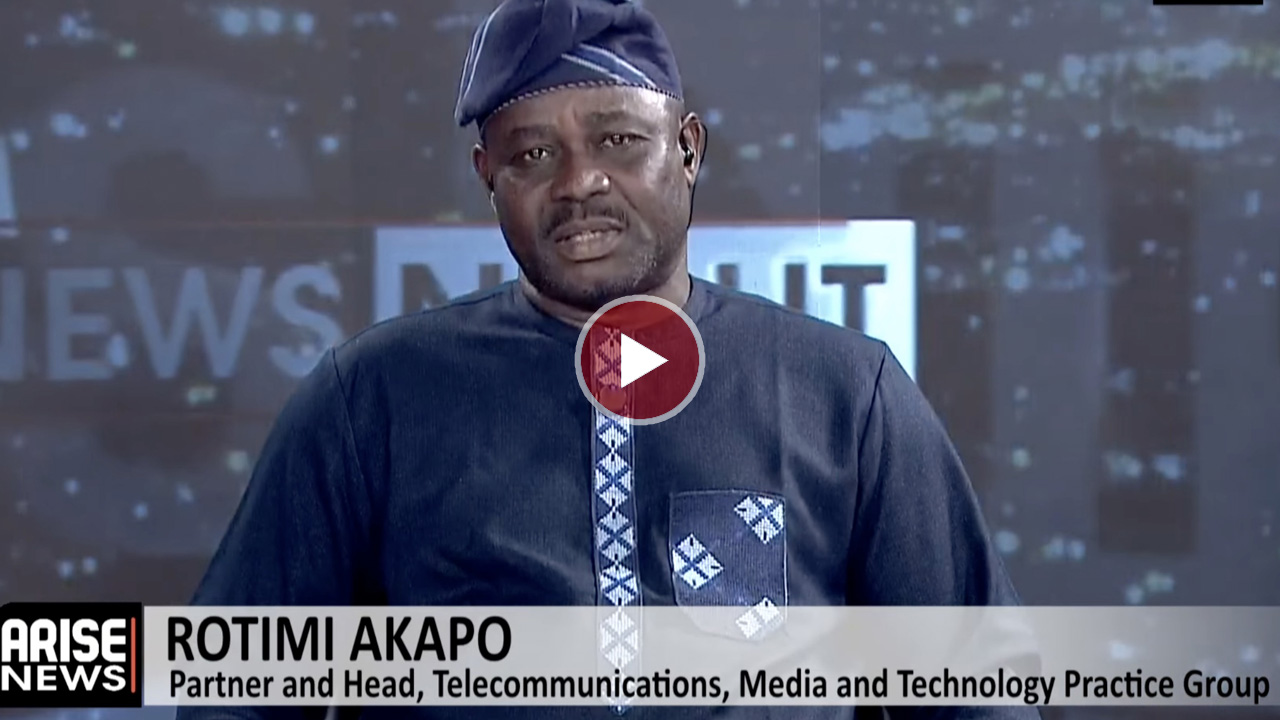
Partner and Head of the Telecommunications, Media and Technology Practice Group, Rotimi Akapo, has dismissed claims that Nigeria lacks the infrastructure to deploy electronic transmission of election results, insisting that the real obstacles are legal clarity, system design and public trust.
Speaking in an interview with ARISE News on Friday, Akapo argued that waiting for a “perfect” technological environment would permanently delay electoral reform.
“To expect that we would have a hundred per cent ready system for the deployment of technology tools for the electoral process means we would never use technology,” he said.
Akapo challenged the frequent argument that poor broadband coverage makes real-time transmission impracticable, noting that network availability across the country is already substantial.
“My understanding is that about 90 per cent of Nigeria currently has network coverage. If we are going to be serious about this, we should not be using technology as an excuse,” he stated.
“We should be talking more about how we design the process to accommodate the use of technology in our electoral process.”
He stressed that electronic transmission concerns only one stage of the voting exercise, not the entire electoral process.
“We are not even talking about the entire process being subjected to technology. Transmission is towards the end of the process,” Akapo explained.
“And election results do not require heavy broadband. Results can be transmitted with minimal connectivity.”
Responding to concerns about uploading results from areas without immediate network access, Akapo said the process is already familiar to Nigerians.
“We do this every day on our phones. Sometimes a video does not upload immediately. When you get to an area with connectivity, it uploads. It is the same principle,” he said.

However, he acknowledged that the issue at the heart of the debate is confidence in the system.
“What you are referring to is a matter of trust. Do we trust the process? And that can be taken care of by design,” Akapo noted.
He emphasised that while no technological system is completely foolproof, risks can be managed through proper safeguards.
“There is no system that is infallible. But it is how we design it to mitigate the risks that is critical,” he said.
According to Akapo, the most important step in restoring confidence is establishing an unambiguous legal framework empowering the electoral umpire to deploy technology.
“The legal framework itself needs to be very clear. There must be no ambiguity about the ability of the electoral umpire to adopt technology,” he stressed.
He added that modern election technologies are inherently transparent and auditable.
“These technology tools leave trails. They can be audited. If anybody tampers with the system, you will know at what point the tampering occurred, from which system, and who was responsible,” Akapo said.
“Those are the kinds of safeguards that must be built into the system at the design stage.”
On whether electronic transmission should be mandatory, Akapo said the law must make it the default position, with clearly defined exceptions.
“Electronic transmission should be in the law as a matter of default. Every other thing should be an exception,” he argued.
“If there is no connectivity in a particular area, that can be an exception, but those exceptions must be clearly spelt out.”
He warned against leaving such decisions to discretion without rules or consequences.
“Even when judges exercise discretion, there are rules guiding that discretion,” Akapo said.
“If a polling unit officer says it is impossible to transmit in real time, the rules guiding that conclusion must be clear. It must not be left to personal discretion.”
Akapo said Nigeria’s electoral laws currently lack enforceable sanctions for abusing technological loopholes.
“When people hide behind technology, there is no consequence. That is what is missing in our electoral laws,” he said.
He concluded that transparency must be guaranteed from polling units to the central server.
“Once there is ambiguity, it gives people an opportunity not to be transparent,” Akapo warned.
“The process must be easily auditable so that anyone can see where the fault lies, who complied with the law, and who did not.”
Boluwatife Enome
About the Author