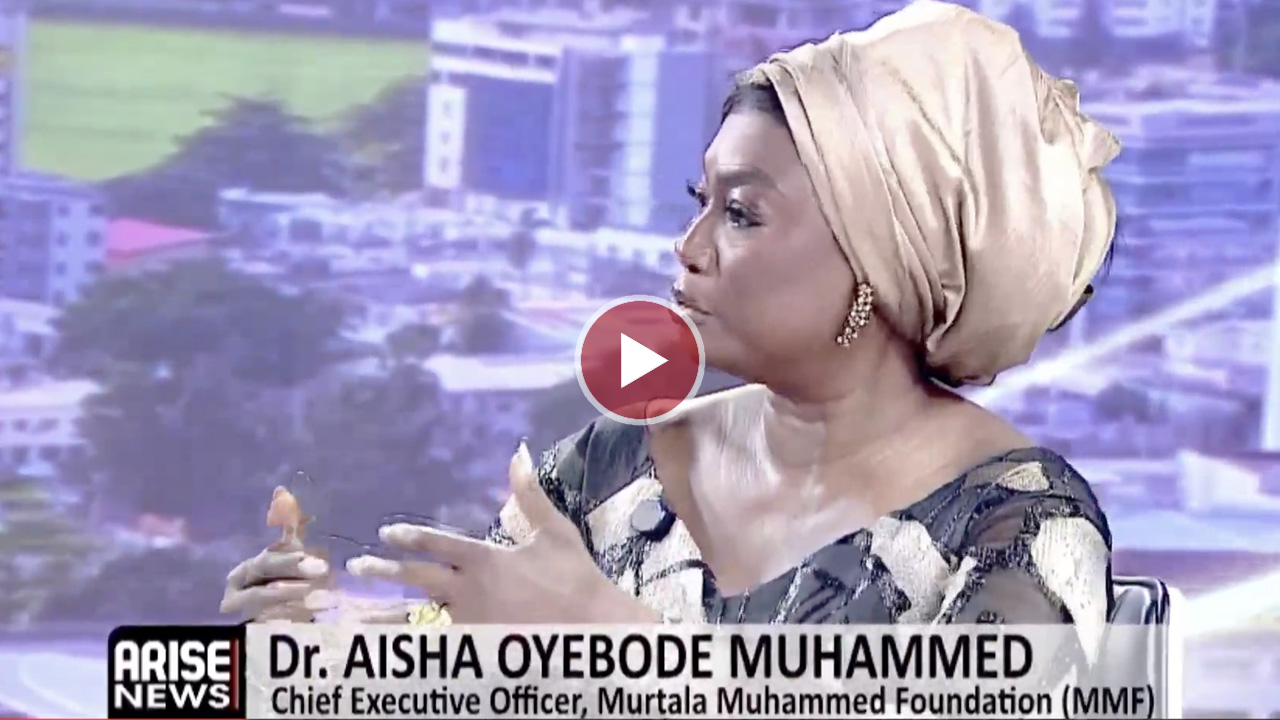
Dr. Aisha Oyebode Muhammed, CEO of the Murtala Muhammed Foundation has shared insights into the late Murtala Muhammed leader’s enduring legacy, Emphasising that his leadership and vision remain relevant today, especially for young Nigerians seeking to understand the country’s role on the continent.
Speaking In an interview with ARISE NEWS on Monday, Dr. Muhammed reflected on Nigeria’s pivotal position during the 1970s, noting that General Murtala Mohammed’s leadership was defined by assertiveness and moral clarity.
“I think the first thing is that it reminds us about the role that Nigeria played in the liberation of those countries that were mentioned earlier. More importantly, it reminds us of a time when we had a strong identity, whether it was on the African continent and internationally. I tell people that in those years, and it’s very hard for people of this generation to actually relate to that, when Nigeria seized the whole world, not Africa, the whole world, quote, unquote.”
Dr. Muhammed recounted the decisive actions taken to support Angola’s independence. “And one of the things that they told us, which was really instructive, not that we didn’t know, but it’s nice when people remind you, was when the American oil interests threatened a lot of Angola because of this whole apartheid stand that they were taking, and the fact that they were trying to get independence. And at that time, you know, Angola has oil like Nigeria, so it would have crippled the economy. And the Murtala Mohammed said, if you leave Angola, you must leave Nigeria. And the next day, everybody went back to work.
It was as a result of the whole apartheid struggle, if you recall, the British perpetrator was asked to leave Nigeria, but his bank was nationalised. So at that time, we were clear. We knew who we were. We took stance on issues that were important to us. We did not compromise. And we were happy to listen to the consequences of our decisions.”
According to her, Murtala Muhammed’s foreign policy moves exemplified Africa asserting its voice during the Cold War. “I think it was one of those moments in the days of the Cold War, when Africa had to give content and traction to the idea of non-alignment and strategic autonomy. I mean, to be non-aligned is simply to be neither hot nor cold in the literal sense. But when you’re strategically autonomous, you’re simply saying we have set our rule as an important actor. And we are a major capital of the world as Africa, and therefore you cannot take us for granted. Now, it’s important to place that within a larger historical context. There’s a German sociologist called Wolfram Eberhard, who has the notion of world time. And what he was simply saying is enough of this narrative that says we get our bearings according to the linear trajectory of European civilisation. Everything doesn’t have to count and matter because it takes its bearing from Europe. It’s the same for the other side. Now, using the Chinese superstructure, he argued that the rest of the world also has historical moments that define the world’s time. And so for us, this was Muhammed’s definition of Africa’s world time. I mean, to draw attention to the fact that Africa is not some unimportant part of the world. It is a critical player, especially on matters that have to do with Africa. You know, we take our bearings from our continent. It’s our own.”
Dr. Muhammed explained the significance of Murtala Muhammed’s leadership style, stressing his combination of conviction and humility. “Well, I think that Murtala Muhammed, we also knew him. So I think his leadership style was clear. He led with clarity. He believed in accountability. He believed in responsibility, you know, and then, you know, we’re all very familiar with his anti-corruption stance, you know, and corruption was not something you sort of just talk about. He actually literally felt that it was a canker wall that was going to destroy our society.And 50 years later, look at what has happened. But I also think that he felt that you had to embody the leadership, you know, in the way you yourself presented yourself. So if you know my father didn’t go around with motorcades and sirens and a lot of security. Now, there are people who say to me, 50 years later, it must have been quite painful because of the loss. But that was what he embodied. So that was why it was actually easy to assassinate him because he didn’t have a whole slew of security with him. Because he was in traffic just like everybody else. In fact, the traffic wardens stopped them and they stopped, just like everybody else. And that was when the coup plotters came out from behind the sectary of that kid.”

She reflected on the lasting resonance of his famous declaration. “Fifty years ago, when you cemented Uganda and Angola, the Murtala Muhammed said, Africa has come of age. And that was the defining moment in Nigeria’s foreign policy. What we did in Angola, what General Murtala Muhammed did in Angola, was simply to tell the world, not just that Africa has come of age because we are a civilisation. We are a world power. We are one of the movers and shakers of the global situation, which is what Eberhard’s world time actually talks about.”
On the importance of passing this legacy to younger generations, Dr. Muhammed stressed identity and awareness of Africa’s contributions. “You use the vehicle of the Murtala Muhammed Foundation. It’s about identity because at that time, we knew who we were. And because we knew who we were, we reflected who we were. I talk about it to young people. I mean, even situations where our young people go and apply for visas, rejected in a very, yes, solitary or South Africa, for example, xenophobia and all of that. Nigeria was in this forefront of the anti-apartheid movement. Nigerians really, given the role that we played, Nigerians should be going in and out of this country easily, you know, and with ease. And I think that what I managed to do is to be able to speak to young people, right? In terms of when you think about the country from the continent actually, I mean, you know, there’s so much within us, you understand what I mean? It’s where there’s structure, where there’s accountability, and these children are so participative. It means that always to see things consolidated, you understand what I mean? And creating an environment where our identity, we are clear about who we are. And once we are clear about who we are, then it’s not the rest of the world that will tell us who we are and how we need to act or what we need to be here.”
She also highlighted Murtala Muhammed’s moral leadership and the lessons it holds for today. “People that the world remembers and celebrates, they didn’t live for too long. I mean, many of them had very short moments in their history. So, it’s not in the years that you put in, it’s actually in the kind of person that you are. And I think that’s the difference that Murtala Muhammed has made. We need to be reminded that we had a Murtala Muhammed, and what he represented, and what he continues to represent. So, that means that we have a lot of work to do. I mean, in designing our leadership, you know, we must identify those that are icons of leadership and what they represent. You cannot be theoretical and conceptual about transformational leadership without anchoring those things on actual lived experiences. What Murtala Muhammed did, for instance, was a life of sacrifice. I mean, he had, you know, everything going for him, and he more or less committed suicide by reinventing himself, you know, to become, you know, the kind of person that would be taken morally seriously. And so, in that crusade, he was very conscious of the role that he had, his moral powerhouse, and the foundations that he needed to also transmit to the people.”
Looking ahead, Muhammed outlined plans for the 50th anniversary of Murtala Muhammed’s legacy. “So, we do have quite a few activities, especially with the Institute of International Affairs. I think it’s really important to have an intellectual discussion about these issues. So, it’s a time for remembrance. And I also think it’s a time for us to be able to define its legacy, and then see how it is relevant for young Nigerians today, and how we can project it into the future. So, on behalf of the National Defence, the National Institute of International Affairs. Yes, we’ll begin with a dialogue, a strategic leadership workshop on the 5th at the Institute.There’s a keynote on the 5th of February, three days from now. There’s a keynote addressed by Professor Boladi Akinyemi. And you played back a while ago, when General Murtala Abed visited the Nigerian Institute of International Affairs, and then Boladi Akinyemi was the Director General of the NIA.So, this is the whole point. We want to reenact and use that as a foundation to ask relevant questions. So, what has happened? Why are we where we are? What lessons are we learning from that? That’s on the 5th.But on the 12th, there’s a big event in Abuja, where Boladi Akinyemi and General Murtala Abed visited the Institute, and they formatted their ambassadorship. They were excited as well by General Murtala Abed and all of the people who were already familiar with the NIA.
That’s the Vice-Secretary for Engineering and Future Affairs.So, we have more events apart from the 6th and the 12th. We also have an exhibition that is going to continue. But you see, this is a year-long, and in fact, almost a charity because we’re thinking of sustainability.So, we have introduced a dialogue series that will meet from time to time, four times a year. So, a joint event with the Murtala Abed Foundation to look at the Nigerian Institute of International Affairs. But there are a few more events.There’s a wreath-laying ceremony here in Lagos, where the assassination happened, because that cenotaph is not going to be redeveloped. There’s another one in Abuja. So, we’re building a Centre for Ethics and Leadership in Abuja, the Murtala Abed Centre for Ethics and Leadership in Abuja. So, there’ll be a wreath-laying ceremony on the day of the groundbreaking for that. That’s on the 13th. There will also be prayers on Friday and on Sunday as well.”
She emphasised the value of these events in building ethical leadership in Nigeria. “We can’t belong to nothing anymore. Everybody, but I want you to know it is down. The brutality exists. And that’s why the foundation is going to, before they are institutionalised, they reduce values. We need, we need, it will not end up strong values in our society. Values are there, they are part of the socialisation process. I hear you talk about preachings and that sort. So these are not sermonising about. These are experiential things, very existential. We often talk about the importance of restoring values in our society, as part of our culture.”
She concluded by urging a return to the principles of decisive leadership, strategic autonomy, and national identity that defined Murtala Muhammed’s tenure. “And I think that’s the difference that Murtala
Muhammed has made. We need to be reminded that we had a Murtala Muhammed what he represented, and what he continues to represent. So, that means that we have a lot of work to do. I mean, in designing our leadership, you know, we must identify those that are icons of leadership and what they represent. You cannot be theoretical and conceptual about transformational leadership without anchoring those things on actual lived experiences.
So, I think that we should always go back to leadership that worked, so we can, you know, learn lessons from those things.”
Erizia Rubyjeana
About the Author