Screenshot
In 2019, government banned fishing on all major landing sites along Lake Kyoga to combat declining fish stocks, rebuild fish populations, and protect breeding grounds.
Following the ban, the Fisheries Protection Unit was deployed to crack down on illegal fishing using prohibited nets and undersized boats. The closure affected thousands who depended on the lake for their livelihoods, leaving many stranded and uncertain about their future.
With no clear alternatives, several fishermen and lake-dependent households abandoned fishing and began searching for new ways to earn a living. A few turned to farming, especially those who owned land.
In Namasale village, farmers planted various crops, but a prolonged drought wiped out their efforts. Even with watering cans, their gardens yielded little to nothing. After enduring repeated losses, the farmers united in 2022 and petitioned their local leaders for an irrigation project to support farming and improve household incomes.
The leaders forwarded the appeal to the ministry of Water and Environment. Among those most affected were 15 determined farmers who refused to give up, having no other means to escape the deep poverty in the area.
Through the intervention of local leaders, the ministry of Water and Environment approved an irrigation scheme for the community. Located at Apitopat village in Namasale town council, Amolatar district, the €189,216 project has become a game changer.
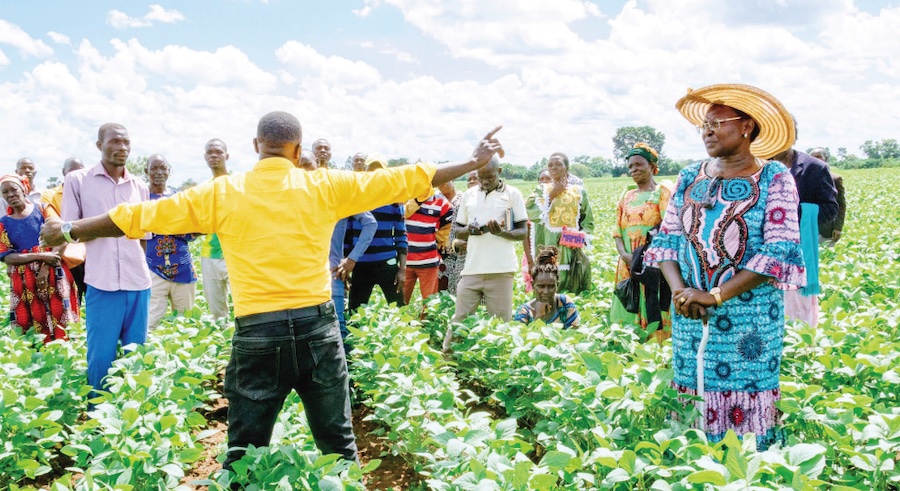
With a steady 24/7 water supply, the 12-acre farm now supports commercial vegetable production. Bosco Olum, chairperson of the farm committee, said that in the first season he planted watermelons and earned Shs 2.5 million.
Previously, when he grew maize and cassava, he could not earn even Shs 300,000. Seeking financial stability, the farmers formed a savings group where each member contributes 10% of their earnings to help purchase seeds, herbicides and other inputs. In the second season, Olum planted cabbages and earned Shs 2 million; he also grew green pepper which brought in Shs 1 million.
“I don’t have time to worry about school fees anymore. I pay on time because I now have the money. I have also established a poultry farm at home to increase my earnings, and I now own 10 sheep,” he said.
Currently, 22 farmers are operating on 36 plots. The group includes four women and 18 men. With six landlords involved, each plot is hired at Shs 100,000. Jessica Abulo, a mother of nine, is among those whose lives have been transformed.
“I was a fishmonger when government banned fishing on Lake Kyoga. We were not engaged about the closure, and we had no options,” she said.
After facing severe financial hardship, she approached the irrigation scheme’s management committee to request a plot, and she was accepted. She planted tomatoes and earned Shs 1.5 million, money she had never held in her life.
In the second season, she planted cabbages and earned Shs 1 million. Her farming income now pays school fees for her children, two in Senior Six, one in Senior Four, one in Senior One, and others in lower classes.
Recently, she purchased a cow, hoping to later acquire oxen for ploughing gardens and boosting her income further. Despite the success, Abulo said farmers still face challenges, especially unstable and inadequate markets for their produce.
“We would be earning more than what we earn now, but due to the unstable markets, our income is limited. We ask government to find better markets for agricultural products so that we can fully benefit,” she said.
About the Author