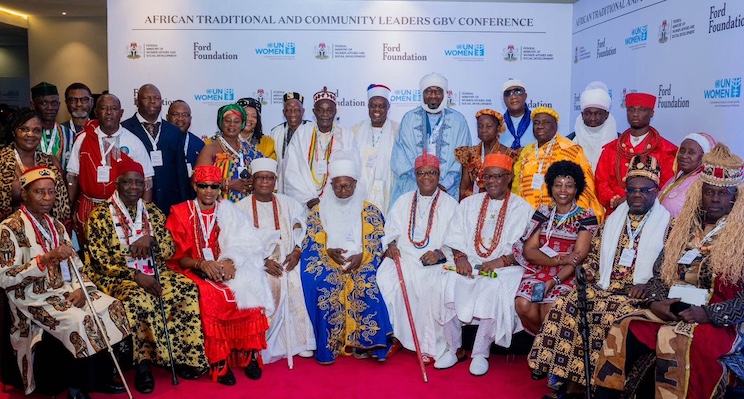
Traditional and cultural leaders from across Africa have pledged to intensify efforts to prevent gender-based violence (GBV) as a high-level continental conference opened on Monday in Lagos.
The Conference of African Traditional and Cultural Leaders on GBV Prevention, convened by the Ford Foundation and UN Women in partnership with the Government of Nigeria, brought together monarchs, policymakers, development partners and civil society actors to advance community-driven solutions to GBV.
The two-day meeting, holding from February 2 to 3, 2026, at the Radisson Blu Hotel, Ikeja, reflects growing recognition that sustainable approaches to preventing GBV must be rooted in cultural systems and traditional institutions that shape social norms across African communities.
Dignitaries at the conference include Lagos State Governor Babajide Sanwo-Olu; Ooni of Ife; the Emir of Fika; the Emir of Shonga; Chief Siansali of Zimbabwe; Ford Foundation President Heather Gerken; UN Women Regional Director for West and Central Africa, Maxime Houinato; Ford Foundation West Africa Director, Chichi Aniagolu; and UN Women Country Representative to Nigeria and ECOWAS, Beatrice Eyong.
Speaking on behalf of Governor Sanwo-Olu, Lagos State Commissioner for Health, Professor Akin Abayomi, described gender-based violence as a major social crisis requiring urgent and deliberate action. He stressed that silence enables abuse and called for laws and community structures that protect, rather than harm, women and girls.
Ford Foundation President Heather Gerken emphasised the importance of engaging cultural authority to drive social change, noting that collaboration with traditional and faith leaders is essential to dismantling harmful practices and promoting the dignity and rights of women and girls.
From a global policy perspective, UN Women Deputy Executive Director Nyaradzai Gumbonzvanda warned that many practices accepted as tradition are, in reality, forms of abuse. She said gender-based violence is a symptom of deeper structural inequalities that must be addressed through stronger norms and institutions that guarantee justice and equality.
UN Women’s Regional Director, Dr. Maxime Houinato, highlighted the central role of culture in African societies, noting that traditional leaders are key architects of social order whose alignment with justice and equality can significantly improve community safety.
Participants reaffirmed that traditional and cultural leaders, due to their moral authority and proximity to grassroots communities, play a critical role in challenging harmful norms and strengthening prevention and response mechanisms to GBV. The conference builds on engagement with traditional institutions, including the Council of Traditional Leaders of Africa, to formalise cultural leadership within national and regional GBV strategies.
Dr. Chichi Aniagolu of the Ford Foundation noted that culture is dynamic and shaped by those entrusted to preserve it, adding that efforts to end harmful practices ultimately reinforce, rather than weaken, traditional authority.
Offering a faith-based perspective, the Emir of Shonga, HRH Alhaji Dr. Haliru Yahaya Ndanusa, cautioned against the misuse of religion to justify violence, stressing that actions causing harm contradict religious principles.
Also speaking, the United Nations Resident and Humanitarian Coordinator in Nigeria, Mohamed Fall, urged traditional rulers to leverage their influence to protect lives and transform communities by championing dignity, equality and justice.
The conference is expected to conclude with the adoption of a Regional Declaration and Communiqué outlining shared commitments to end gender-based violence, alongside a Sustainability Roadmap aimed at integrating traditional leadership into long-term national and regional prevention strategies.
Organisers said the outcomes would strengthen partnerships among traditional institutions, governments, African Union bodies and civil society, improve survivor-centred support systems at the community level, and enhance coordinated resource mobilisation to combat GBV across Africa.
By Michael Olugbode, Abuja
About the Author