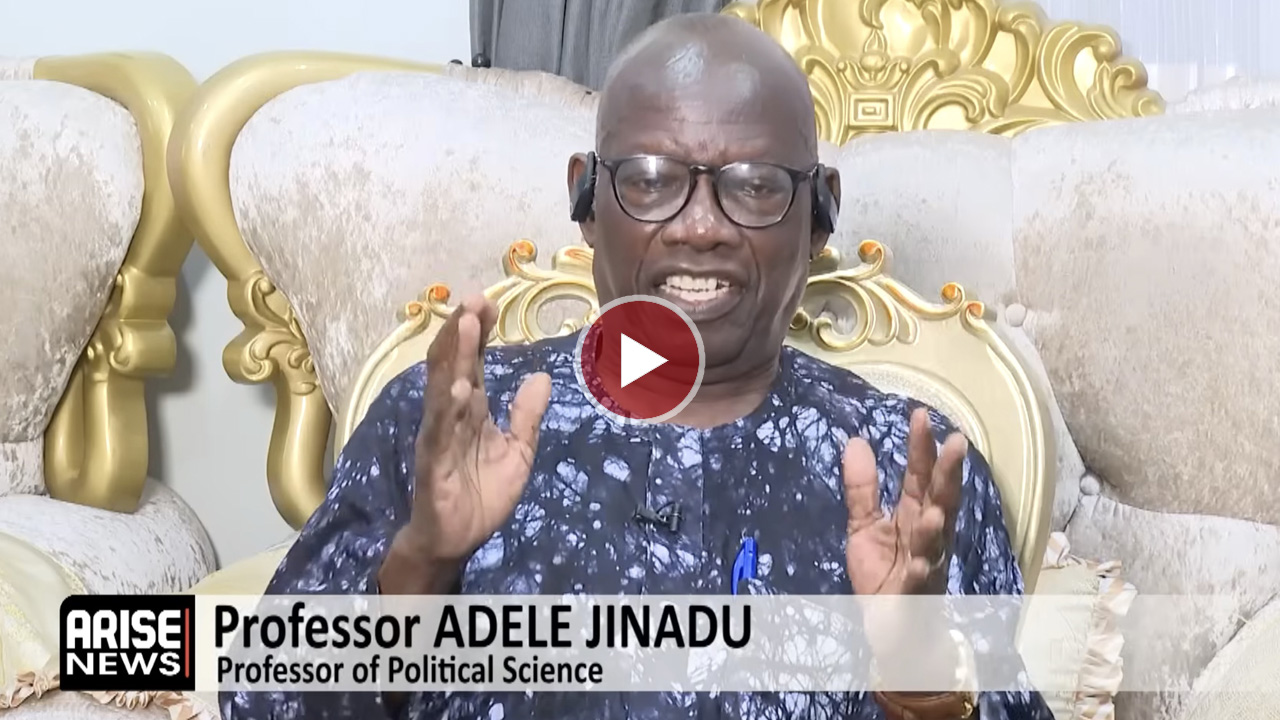
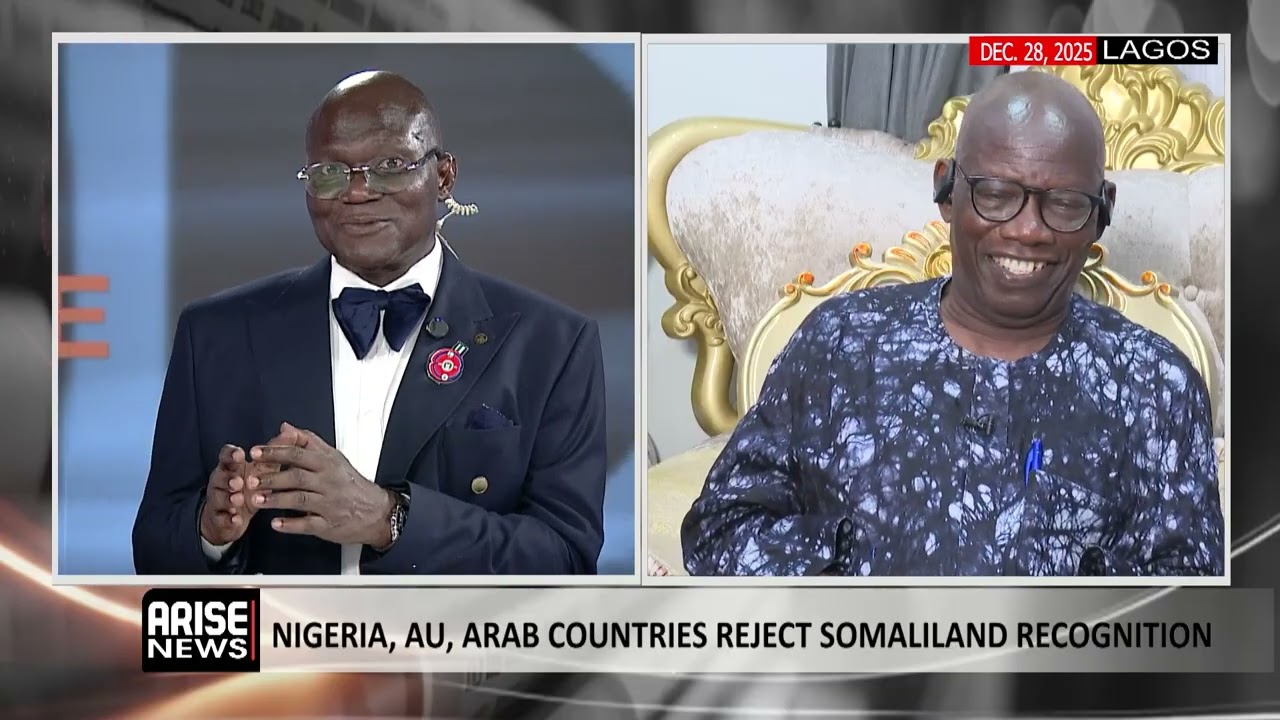
Professor of Political Science, Adele Jinadu, has warned that Israel’s decision to recognise Somaliland as an independent state is not an isolated diplomatic move but part of a broader geopolitical realignment linked to the Gaza war and shifting global power interests.
Speaking in an interview with ARISE News on Sunday, Jinadu said the objections raised by Nigeria, the African Union, Arab states and more than 20 countries were justified under international law, but stressed that the more critical question was why Israel chose this moment to take such a step.
“Well, I think they are right, but the question to ask, I think, is why now, since 1990, has Israel decided to recognise Somaliland? What is it in the present geopolitical situation in the Middle East and the world generally that is pushing the Israeli government towards recognising Somaliland?”
He argued that the move must be examined within the context of the ongoing Gaza war and wider strategic calculations involving major global powers.
“I think you have to look at this in the context of the Gaza war and the possibility that Israel may be acting as proxy for a number of countries. I mean, there’s already talk of taking over Gaza, and where do you send the Palestinians? So those questions, I think, are what we need to ask. And in the shadow of it all is the role of the United States of America.”
Jinadu described the Horn of Africa as a historically strategic region whose importance has endured for decades due to its location along key global trade and military routes.
“We know that the Horn of Africa, where Somalia is located, has always been a place of strategic importance, even since the Suez War in 1956, in terms of passage through the Suez Canal, staging posts for foreign military operations, seaports.”
He suggested that unseen diplomatic manoeuvres may already be underway among Western and Middle Eastern powers.
“I think there may be some realignment going on that we really don’t know yet within the corridors of the foreign ministries in some countries in Europe, in the US, in North America.”
Jinadu also linked Israel’s justification for the recognition to the Abraham Accords and questioned the unity of Arab states in responding to the development.
“It is also interesting that I think that Netanyahu has justified this in terms of certain peace accords which it has entered with a number of Arab countries — the Abraham Accords — which makes for cooperation of all kinds of things.”
“So the Arab countries themselves, you know, I think a lot depends on how united they are in terms of responding to this new onslaught. I think it’s deliberate, and they more than miss the eye to it.”
Turning to Africa’s response, the professor expressed concern about the continent’s limited influence at the United Nations, while urging stronger collective action from the African Union.
“It’s a pity African voice in the UN is not very, very effective now. But the African Union, I think, has taken a stand. It has to take a much more positive stand to make sure that this violation of the sovereignty of Somalia is not let off easily.”
He emphasised that Africa’s long-standing position against recognising secessionist movements was rooted in historical experience.
“It has been standard African practice at the level of the OAU, and now at the AU, that you don’t support secessionist movements in a country that became independent as one country at independence.”
Drawing parallels with Nigeria’s civil war, Jinadu warned of the dangers of setting a precedent.
“We went through this in Nigeria ourselves when a number of countries recognised Biafra, and the OAU then resisted and said no, we must respect boundaries. Otherwise, you’ll have a domino effect.”
He described the Horn of Africa and Red Sea region as a critical geopolitical corridor with deep-rooted global interests.
“That part is a very pivotal region of the world. The Red Sea area is very, very critical. This all dates back to what was done in the Suez Canal, when Western powers said this was a vital route to other parts of the world.”
Jinadu suggested that Israel’s move could be a strategic probe rather than a final position.
“My suspicion is that there must be something going on that way that has not been cleared. This is just a test run to see the reaction of the rest of the world, and particularly of Africa.”
He concluded by warning that unfolding events in the Middle East, including Gaza, could soon clarify the true motivations behind the decision.
“I think this is linked somehow to what is happening in Gaza and the attempt to displace Palestinians. We don’t know what is happening. Maybe in the next few weeks it will unravel, but we need to look at it in the context of global geopolitics, particularly in the Middle East.”
Boluwatife Enome
About the Author