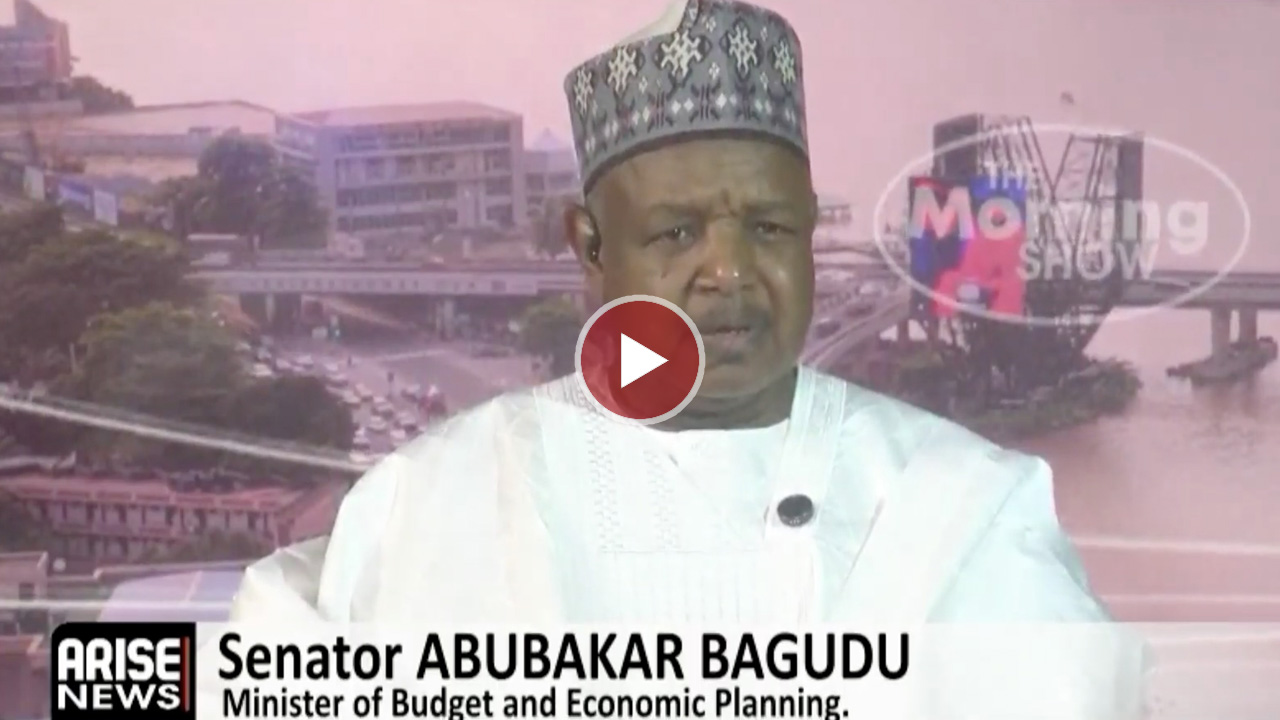

Minister of Budget and Economic Planning, Senator Abubakar Bagudu has strongly defended President Bola Tinubu’s economic reforms, declaring that the administration’s tough policy choices have strengthened public finances, improved funding for states and local governments, and laid the foundation for long-term national prosperity.
Speaking In an interview with ARISW NEWS on Wednesday, Bagudu rejected claims that the reforms has failed, insisting instead that they were necessary to halt Nigeria’s economic decline, reset fiscal management, and reposition the federation for sustainable growth.
“But I disagree with you, because what we said clearly as a nation in the agenda is that we are not where we want to be. We are not shy of admitting it. We are not where we want to be, because historically we have underinvested. We are, our economy is small relative to our, to both our potential and relative to our fears.”
Bagudu argued that the administration inherited structural weaknesses that required bold and, at times, painful decisions to correct. “So, to interrupt it, we have to take choices that are bold, courageous, tough, not necessarily pleasant, in order that we will stop the bleeding. And in order that we will begin to generate resources for all the three tiers of government, whether in the north or in the south, or elsewhere in Nigeria.”
He maintained that the impact of those reforms is already visible, particularly in improved allocations to subnational governments. “All the local governments in the north today are better funded. All the state governments in the north are better funded, like in the rest of the country. It would not have been so without the reforms. It is everywhere in Nigeria, but that is significant to the north as well, because it means that local governments and state governments have more resources in order to do those things that will increase socioeconomic indices.”
Bagudu also pushed back strongly against assertions that the federal budget was in disarray. “The budget, which you said is a shamble, no, I disagree with you. We are, like many countries, we are struggling with many pressures to this revenue, to where it should fund our budget 100%, to ensure that we meet our obligations, particularly debt service, to respond to global and international economic environment, which distort markets, distort budget planning, distort flow of revenue.”
He noted that revenue-expenditure gaps are common in democratic systems and cited global examples to underscore his point.
“Much between revenue and expenditure is a fact of life in any budget system, particularly in a democratic system. We have seen budget shutdown in the United States of America this year, even though the two chambers are controlled by one party. So, yes, we can do better, but certainly we are not in shambles.”
Responding to data suggesting widespread financial distress among Nigerians, Bagudu said “And if you quote a statistic that I say I don’t know, I think I’m being humble and sincere, but I’m saying there are other indices, the National Bureau of Statistics and other indices. And more so, there are other global institutions, from World Bank, from IMF, from the Economist magazines, Nigerian commentators who shared the belief that we have done what I said, that we have done well with the macroeconomic reforms, but we must take the reforms to include everyone.”
Beyond macroeconomic stabilisation, Bagudu highlighted what he described as a renewed commitment. “And luckily, one of the strategies approved by the National Economic Council, among numerous measures, is a plan to ensure that the 8809 wards of Nigeria are made centres of prosperity by a combined effort of the three tiers of government enshrined in the constitution.”
He explained that the approach would involve mapping each ward’s economic potential. “And to work together to map the potential of each of these wards, identify potentials, identify the challenges, particularly drivers of poverty in those wards, and put a programme in place where each ward will identify and mobilise economically active persons and businesses in those wards that over time can be supported to generate more growth and prosperity.
Bagudu further pointed to Nigeria’s vast agricultural base. “Equally, we have appreciated that based on a national census plan organised published last year by the National Bureau of Statistics and the Central Bank of Nigeria, we have no less than 42 million households undertaking one form of agricultural production or the other.”
He said the government’s task is to modernise and support those households to improve productivity and incomes. “How do we ensure that all of these 42 million households using the totality of society, the three tiers of government, private sector, and others, how do we ensure that we improve their lot? How do we ensure that they get rewarded for the hard work they are doing? How do we ensure that we compensate for the distortions that are coming from outside, whether it’s farming, crop farming, vegetable farming, food farming, fisheries, or livestock? How do we ensure that we modernise them quickly and wherever they live so that they can generate more income? They can contribute to more growth and do better for themselves in a sustainable manner.”
On the proposed sale of public assets, Bagudu dismissed claims that the move was designed solely to plug budget deficits. “Sale of assets is not to fund deficit. Deficit can benefit from that. But it has been an ongoing discussion in our national life.”
He argued that long-standing government ownership of certain assets has limited efficiency and discouraged investment. “Our aspiration is to utilise our oil and gas assets. Our aspiration, our reserve is that we can grow our oil production to 3 million barrels a day. Why are we at less than 1.5? The Minister of Petroleum and Gas said that our gas reserve is about 210 trillion, but we are now utilising less than 7. Why? Because maybe, among other factors, government has held on to assets that investors are not coming into. And there are opportunities for investors to come and buy into these assets so that they can be put to use and they can contribute to our national prosperity. Will that yield immediate revenue? Yes. But is that the purpose? Is that the only purpose? Certainly no.”
Reaffirming his support for the administration, Bagudu made clear his personal stake in the reform agenda. “Since he became president, I am his minister of budget. I am party to every decision, every reform measure that has been taken. I am party to it. I believe in it. I believe those are the choices that our country needs.”
He added that President Tinubu remains committed. “Mr. President has always been nationalistic in his approach to our national life.”
Erizia Rubyjeana
About the Author