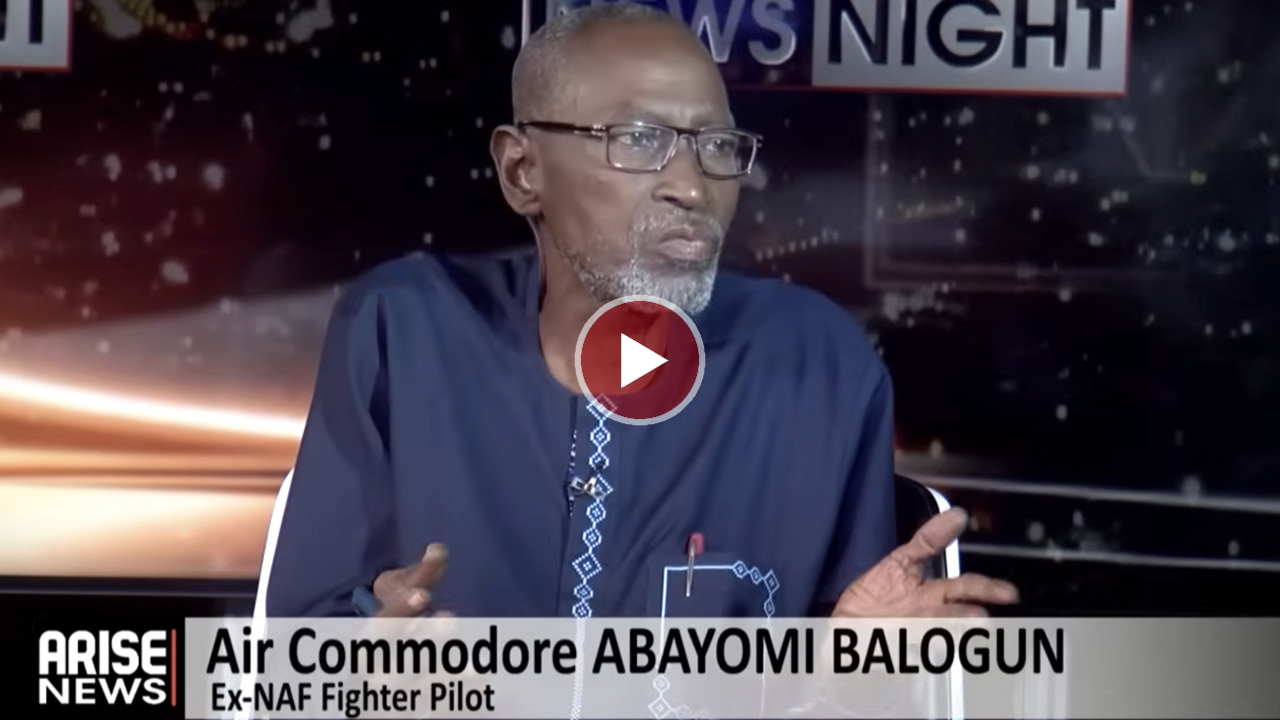

Retired Air Commodore Abayomi Balogun has defended Nigeria’s collaboration with the United States in recent precision strikes against terrorist targets, describing the operation as legitimate, coordinated and necessary in the long war against terrorism.
Speaking in an interview with ARISE News on Friday, the former Nigerian Air Force fighter pilot said Nigeria acted within accepted global practice by requesting external military assistance when local capacity alone is insufficient.
“Yes, that’s what we heard. The Americans say we collaborated, even the Nigerians say yes. It’s unfortunate that we had to get to this level, but it’s not unusual,”Balogun said.
He explained that counterterrorism operations often require international support, noting that Nigeria has received foreign assistance for more than a decade.
“In the war against terrorism and anti-terrorism, you need help. We’ve been on this trail for the past 15 years. Even before now, they had assisted in the past,” he said.
Balogun recalled the Chibok schoolgirls’ abduction, saying Western allies played key intelligence roles at the time.
“During the days of the Chibok girls, the US was always available. The British and the French assisted us in locating where the girls were. They only gave us intelligence, but it helped in locating them,”** he said.
He noted that while earlier cooperation was limited to intelligence-sharing, the current assistance involved kinetic action due to the evolving security challenge.
“For us to have asked for this assistance now in a kinetic way, yes. In global geopolitics, when you are not able to do some things, you are free to ask for help,”Balogun stated.
Rejecting concerns over sovereignty, he said the operation was not unilateral.
“They came with our permission. We work with them. So, there’s nothing strange. We have a challenge, we ask for a solution, and they have assisted us. I have nothing against it. It’s right,” he said.
Balogun added that the ultimate objective is to eliminate terrorists and restore peace.
“We should work more to get rid of these guys from Nigeria so that Nigeria can be more peaceful,”** he said.
Addressing questions about why strikes occurred outside traditional terror hotspots, Balogun said strategic military considerations guided the decisions.
“Before such actions are carried out, you must sit down and look at the overall situation. Strategic decisions are taken. There must be a reason why such places were chosen,”he said.
He explained that disrupting supply routes is a core element of warfare.
“If it was a route, part of the strategy of war is to break the lines of communication of your enemy. If you deny them that route, whatever they were getting through it will be cut off,”he said.
Balogun added that funding, food, fuel and logistics are all legitimate military targets.
“When you are fighting, you consider how they survive, where they get food, fuel and funding. You must cut off all those areas,” he said.
He stressed that such operations are not random.
“You won’t waste such ammunition on nonsense. You must look at the importance of such places,Balogun said.
However, he cautioned that terrorist groups are highly mobile.
“Terrorists and bandits are never static. They can be here now and gone the next minute. If you don’t get them today, that does not mean you will not get them tomorrow,”*he said.
Balogun said the strike sends a powerful psychological message to terrorist groups.
“Even if we did not get anybody today, it means you have nowhere to hide. Nigerians are now working with external sources. We will quickly pinpoint your location,”he said.
According to him, the operation signals that terrorists are under constant surveillance.
“It is sending a signal that wherever you are, we can get you,”he added.
On the nature of collaboration, Balogun said Nigeria and its partners bring complementary strengths.
“They have better technology to pinpoint targets, but we know the terrain better. We have people on the ground,” he said.
He emphasised that Nigeria retains control over operational decisions.
“We will say, don’t attack here because of social reasons. You help us in these places,”he said.
Drawing from personal experience, Balogun recalled working with foreign forces during the Chibok rescue efforts.
“They told us what they wanted to do, and we said no, you can’t do this, but you can do this for us. Which is the way it should be,”he said.
He concluded that collaboration must always be guided by Nigeria’s priorities.
“Once we are on the same table and working on the same page, they work with us. We determine the kind of assistance we want them to provide,”Balogun said.
Boluwatife Enome
About the Author