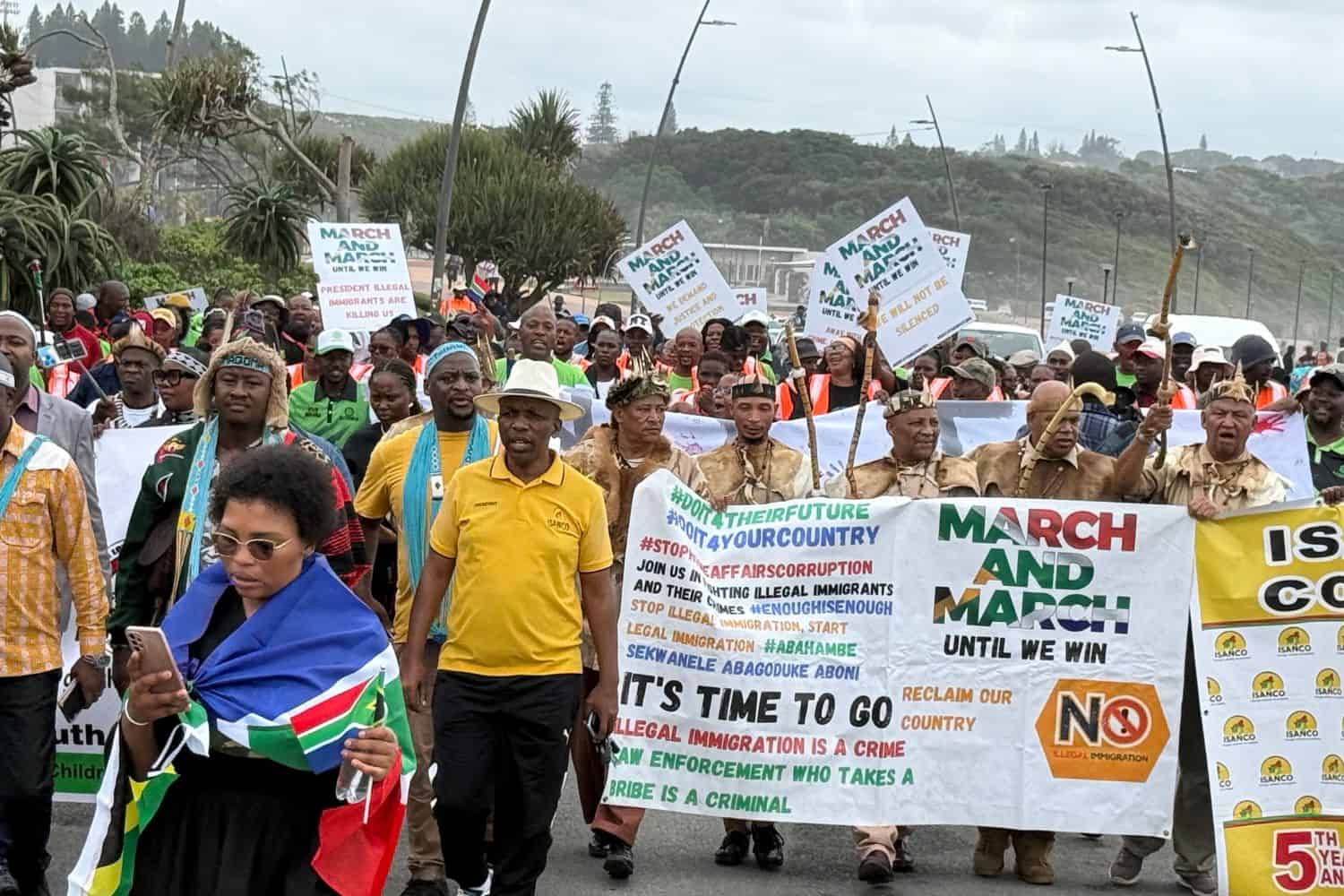
Tensions boiled over in KuGompo after a Nigerian national’s cultural ceremony was mistaken for a royal installation, sparking violent protests, a diplomatic crisis, and pointed questions about state failure.
On Monday, the AbaThembu royal kingdom distanced itself from the violence and looting that engulfed East London, now known as KuGompo, following a march against the alleged coronation of a Nigerian national as a traditional king in the Eastern Cape.
The Department of Cooperative Governance and Traditional Affairs (Cogta) also slammed the protest.
“These acts of destruction undermine the rule of law, threaten lives, and damage infrastructure that communities depend on for service delivery and economic activity,” said the Deputy Minister Prince Zolile Burns-Ncamashe.
ALSO READ: Deport Nigerian ‘king’ and all who crowned him, traditional leaders demand
AbaThembu kingdom distances itself from violence
While the kingdom affirmed its support for the constitutional right to peaceful protest, the kingdom made clear that the destruction that followed had no place in its name.
The kingdom spokesperson, Mayibuye Melisizwe Mandela, stated that it placed three things firmly on record: that it was not part of the march, that it stands with the people’s right to express their grievances, and that it does not associate itself with the violence that followed.
Mandela confirmed that His Majesty King Buyelekhaya Zwelibanzi Dalindyebo, along with every member of the AbaThembu Royal Council, had no involvement in the march.
“Those affiliated with the kingdom who attended did so purely in their personal capacity,” said Mandela.
He added that the kingdom was equally firm in acknowledging the protest’s legitimacy.
“The organisers of the march did not invite hooliganism, looting, or the destruction of property.”
What unfolded, the kingdom argued, pointed to something far more troubling: a failure of the state to anticipate and contain foreseeable violence.
Hard questions directed at police, intelligence and the premier’s office
Rather than stopping at condemnation, the AbaThembu kingdom focused on the institutions responsible for public safety, asking pointed questions about why the violence had not been prevented.
Mandela questioned whether any preventative measures had been put in place once the march was announced, and whether there had been proper coordination between provincial authorities, intelligence services, and the police.
He further questioned how those responsible for the looting could “operate with such boldness and coordination”.
“Are there elements within law enforcement or intelligence structures that, through action or inaction, enabled or emboldened these criminal acts?” Mandela asked.
The kingdom also queried what action had been taken when allegations emerged of a Nigerian-installed fugitive operating in KuGompo, and what intervention the Office of the Premier had undertaken.
“Who benefits from the instability, destruction, and breakdown of law and order that we have witnessed?”
AbaThembu expresses solidarity with AmaRharhabe, flags sovereignty concerns
Beyond the immediate unrest, the AbaThembu kingdom used its statement to affirm solidarity with the AmaRharhabe, on whose land kuGompo sits, and to raise what it described as serious questions of sovereignty and traditional authority.
The kingdom clarified that its support for the AmaRharhabe people is rooted in lawful, peaceful, and dignified processes.
“The Kings Forum will formally communicate with the Nigerian Consulate in South Africa regarding the alleged coronation of a Nigerian national as a king in the Eastern Cape,” Mandela stated.
Mandela framed this as a matter of principle, that foreign nationals cannot be permitted to establish rival traditional structures on South African soil.
“The Eastern Cape is not an annexure or colony of any foreign nation,” he said. “There must be accountability and clarity on how such a situation was allowed to arise.”
Cogta condemns violence, schedules high-level government meeting
Cogta entered the fray with a strong condemnation of the property destruction and violence, while simultaneously affirming communities’ right to protest.
Burns-Ncamashe called on community leaders, organisers, and stakeholders to ensure that protest action remained peaceful and within the law.
“We urge residents of KuGompo and surrounding areas to remain calm, avoid areas affected by protest action, and allow law enforcement agencies to perform their duties,” he said.
The department confirmed it was in active contact with the Eastern Cape Provincial Government, the Buffalo City Metropolitan Municipality, and law enforcement agencies to monitor the situation.
Cogta also drew attention to a separate but related incident, the alleged stabbing of a South African citizen by a foreign national during the unrest.
“Such acts of impunity risk plunging the country into chaotic instability and violence, which must be avoided at all costs,” Burns-Ncamashe said.
A high-level meeting has since been scheduled for 8 April 2026, bringing together the Presidency, State Security, Police, Home Affairs, and the Department of International Relations and Cooperation.
Nigerian High Commission apologises, calls ceremony cultural, not royal
The Nigerian High Commission in Pretoria stepped into the centre of the storm with two distinct communications: a safety advisory to Nigerians living in South Africa, and a letter of clarification and apology to Eastern Cape Premier Oscar Mabuyane.
In the unverified advisory issued on Monday, the commission urged Nigerian nationals to maintain a low profile, moderate their movements, suspend socio-cultural activities, and avoid demonstrations.
In its letter to Mabuyane, the High Commission sought to reframe what had occurred, insisting the event was never intended as a royal installation.
“The supposed installation was a mere cultural celebration, and we are genuinely sorry for the negative perception this development may have caused,” the commission claimed.
It acknowledged that the spectacle surrounding the event had understandably drawn public anger, adding that “the pomp, fanfare, and media coverage surrounding the event – which understandably drew public ire – are highly regretted.”
Furthermore, the commission went on to assure Mabuyane that there was no intention to establish a kingdom within South African borders.
Cogta to meet with Nigerian commission
It said Nigerian nationals in the country would not be permitted to disrespect traditional institutions.
“We hold the traditional institutions of South Africa in the highest regard and would not allow our nationals living in any part of the country to denigrate, disrespect or affront the traditional council,” the letter read.
Additionally, the commission appealed to Mabuyane to help de-escalate tensions in KuGompo.
“The historical and brotherly bond between South Africa and Nigeria is steeped in a shared history of ubuntu and the liberation of the African people. We will never endorse any act capable of undermining our warm and cordial relations.”
Burns-Ncamashe confirmed that the government had received the communication and that the matter would be addressed directly at the highest level.
“We will be meeting with the Nigerian High Commissioner, who has also written a letter to the Premier of the province, expressing the apology of the Nigerian government,” he said.
READ NEXT: Eastern Cape police on alert after violent protests in KuGompo [VIDEO]