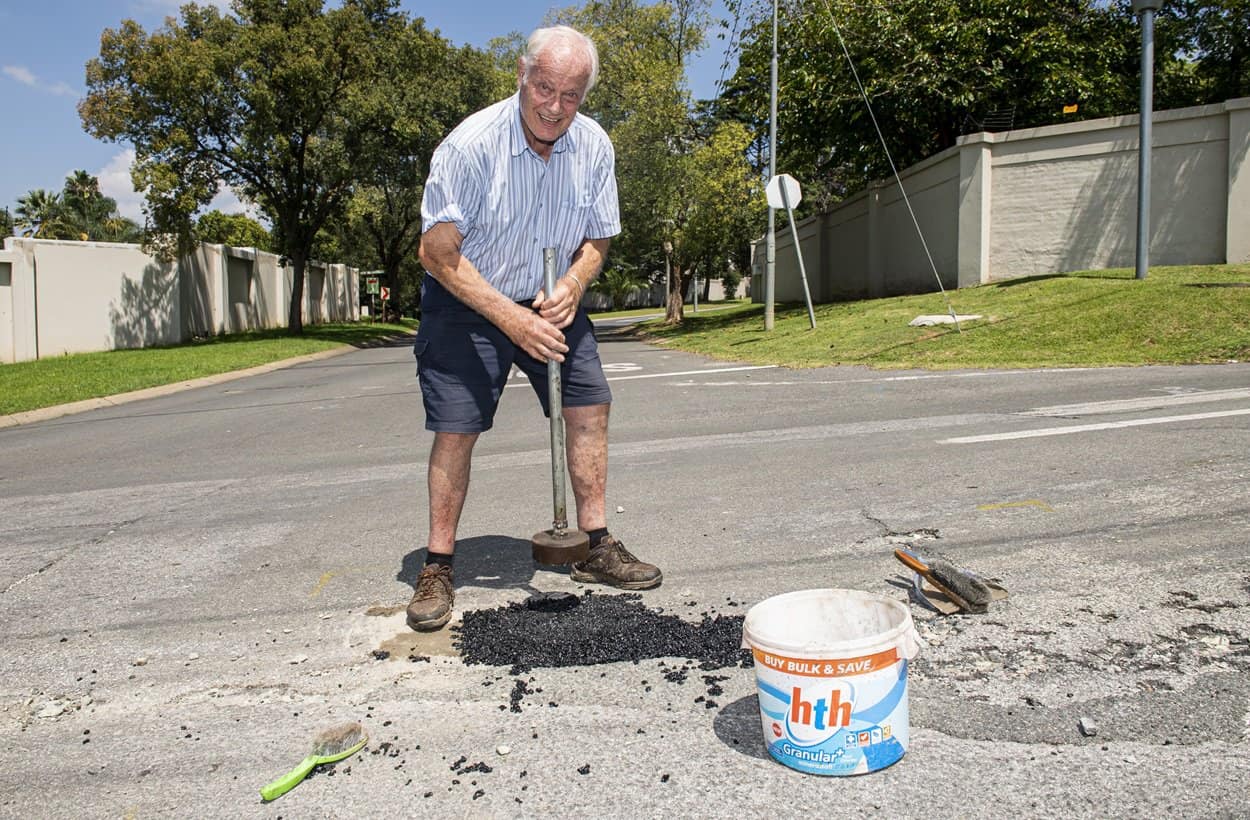
JOHANNESBURG, SOUTH AFRICA MARCH 08: Rainer Dixel (82), a retired mechanical engineer fixes potholes in his street with asphalt in Bryanston on March 08, 2023 in Johannesburg, South Africa. It is reported that the idea arose when the owner of a gas station asked him to repair potholes close to the station. (Photo by Gallo Images/Rapport/ Deon Raath)
Imagine a State of the Nation Address (Sona) delivered without triumph or ceremony. The president rises, not to announce renewal, but to offer thanks.
He thanks households for installing solar panels that kept the lights on when the grid failed.
He thanks parents who found ways to send their children to private schools as public classrooms became more crowded and less reliable.
He thanks communities that drilled wells when taps ran dry and businesses that paved roads, fixed wells, installed street lights and hired private security as police retreated.
Applause is restrained, even respectful. The speech sounds practical and appreciated. It also reads as a quiet admission the state has withdrawn from the everyday work of holding society together.
That moment would not feel like a rupture. It would feel familiar because South Africa has been living with this logic for some time now, even if it has never been spoken so plainly.
ALSO READ: Ramaphosa, lift South Africa higher
The country is not marked by sudden collapse, but by a slow recalibration of expectation.
What once provoked outrage is now met with adjustment. The absence has been normalised, and coping has replaced demanding.
Private substitution is often celebrated as resilience.
Households are praised for their ingenuity. Businesses are applauded for acting where the state cannot. Communities are encouraged to be self-reliant.
These narratives sound affirming but obscure a deeper retreat.
When families must become energy planners, water managers, security coordinators and education strategists simply to live with dignity, the burden of governance has moved decisively downward.
ALSO READ: State of the Nation Address: Is it even worth tuning in?
The work of the state has been absorbed into private life, quietly and unevenly.
At first, this arrangement seems manageable. Daily routines continue and some suburbs remain functional.
Economic activity persists, though unevenly. Yet beneath this surface stability lies a growing sense of loss of services, but also of shared expectation.
Citizenship no longer carries a dependable promise of care or protection from the state.
Rights remain intact in law but fragile in practice. What replaces them is a culture of coping, in which people learn not to expect too much and to organise their lives around institutional absence.
This withdrawal is deeply unequal. Those with resources exit public systems and construct parallel ones. Those without remain exposed to failure with few alternatives.
ALSO READ: R30m refurbished Nieuwmeester Dome to be handed over to Parliament
Over time, inequality becomes spatial and visceral. Almost all areas are defined by decay, while others retreat behind the walls of private provision.
The country is divided into zones of functionality and endurance. This is not only inefficient, but emotionally corrosive.
It teaches people that belonging is conditional and that dignity must be purchased.
There is also a cumulative economic cost that rarely appears in macro debates. Businesses divert capital from productive investment into defensive expenditure.
Money that could expand operations, create jobs or develop new capabilities is instead used to replicate basic public goods.
The economy grows. Innovation slows, not because ambition has vanished, but because energy is consumed by survival. Growth becomes harder, more expensive, and less inclusive.
ALSO READ: The high price of failures amid hope of optimism and confidence
As private substitution expands, state capacity further erodes.
Tax compliance weakens as citizens question the value of what they fund. Skilled professionals drift away from public institutions that no longer reward competence or protect integrity. Municipal finances deteriorate as billing systems collapse and payment resistance spreads.
Each private solution makes the next public failure easier to accept. Retreat becomes self-reinforcing.
What deepens the lament is the language that accompany this shift.
The political leadership speak of partnership, collaboration and community initiative.
These words once implied a shared project anchored by a capable state. Increasingly, they soften abdication. When citizens are thanked for replacing the state, the responsibility is inverted and absence is reframed as cooperation, while failure is recast as collective effort.
ALSO READ: ‘They never stopped’ – Naledi Pandor continues to receive threats
A society can endure this arrangement for some time. People adapt and carry burdens quietly and without drama.
But endurance is not a development strategy. It is a holding pattern sustained by fatigue and deferred hope. Over time, even the most resilient households and firms begin to fray.
The imagined address would close, as they often do, with a promise to rebuild capacity and restore trust. Listeners would be urged to remain patient, to recognise progress and to believe the corner is being turned.
There would be reassurance reforms are underway, the machinery of the state is being fixed, and better days lie ahead.
So, as you listen to the Sona, from a home-powered by solar, protected by private security, water supplied by a borehole and connected by roads fixed at community expense, it may be worth pausing. Applaud politely, note the confidence.
Then ask if this is a speech about recovery, or an acknowledgement the work of the state has already been outsourced to its citizens.
NOW READ: Budget 2025: What the tourism sector wants
About the Author