As the United States navigates an uneasy line between philanthropy and retrenchment, the rest of the world has been forced to adjust to a rapidly shifting geopolitical landscape.
This year alone, Washington has moved to close USAID, the world’s largest foreign aid agency, launched a global trade war, and tightened travel rules to the federal republic — all under the banner of making America “great again.”
The world’s largest economy has been increasingly explicit about its willingness to use every available tool to advance American interests, including foreign assistance. The 2025 America First Global Health Strategy makes that clear: “We will also leverage our foreign assistance to promote American companies…”
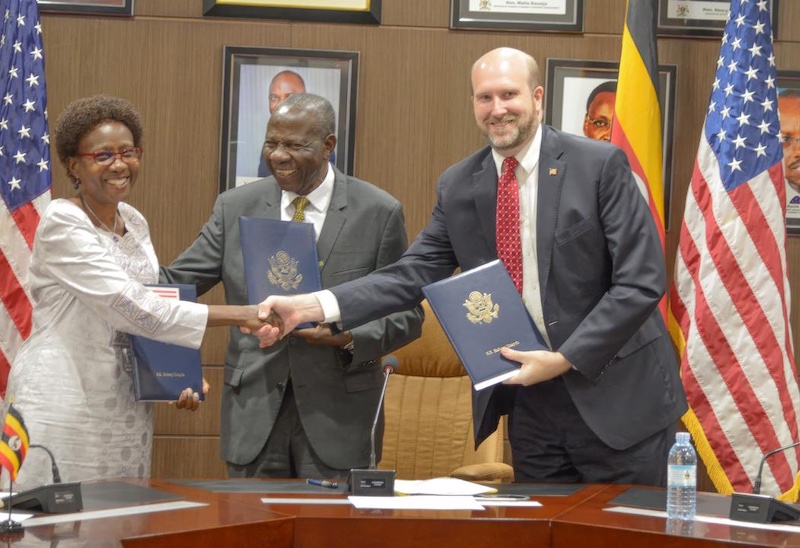
Because of this, the US signed a five-year bilateral health memorandum of understanding [MOU] with Uganda on December 10, 2025. The deal is valued at $2.3 billion [8.2 trillion shillings], and is meant to combat HIV/Aids, TB, malaria and other diseases while strengthening the local health system.
The good faith in negotiating this deal is questionable because in his first week of office, President Trump froze funding to US HIV global programs. This created thousands of daily infections of the virus, and an increase in drug-resistant strains of the killer disease. For bilateral relationships to thrive, the parties involved need mutual respect between them.
Which isn’t the case between the US and Uganda. The lack of reciprocity is evident in how the program is going to be executed and the tone set by prominent US officials. In May 2025, Secretary of State Marco Rubio, while appearing before the House of Foreign Affairs committee, said, “Foreign aid is designed to further national interests of the US.”
He has gone on to say in a series of interviews that, “The US government is not a charity.” This position is evident in how the program has been designed. The deal comes off as a religious act of tokenism targeted to benefit a large Christian base, which is in line with President Trump’s spiritual beliefs.
The US signed the treaty with Uganda, Kenya, Rwanda, Liberia, Lesotho, Eswatini and Nigeria. These have an overwhelmingly Christian population. Kenya- 85.5 per cent, Rwanda- 93.8 per cent, Liberia- 85.1 per cent, Uganda- 81.7 per cent, Lesotho- 92.1 per cent, Eswatini- 89.3 per cent, and Nigeria- 109 million Christians.
Additionally, the program is heavily reliant on the goodwill of faith-based organisations. “Faith-based programs have been successful because faith leaders are highly trusted by the community, especially in many countries across Africa where there are very high rates of religiosity,” the document reads.
It continues, “Faith-based community service provision also tends to be highly cost-efficient…” Nothing could be further from the truth when it comes to Uganda. Presently, some of the best-equipped hospitals in Uganda are faith-based: Nsambya, Mengo and Lubaga hospitals.
Even so, these kinds of hospitals are somewhat pricey for the common folk. Despite the growing rate of religiosity in the country, trust in faith leaders is at an all-time low. This is because a large number of the clergy are perceived to be stooges of the dictatorial regime. Many openly dine with the state and don’t speak out against its atrocities.
It hasn’t helped that a great majority of the ministers of the gospel are constantly in the press for criminal offences, quackery and public display of opulence. This has left a sour taste in the mouths of the general public.
“… faith-based services have the potential to be sustained independently of U.S. foreign assistance over time, as these services can be supported by either private donors or by the tithes and offerings collected by local faith organizations”, the report states.
The deal appears to be riding on Christian mercy. A likely scenario is the setting up of health facilities by faith-based organisations, to get funding from the Global Health Strategy for their personal gain, and not community service.
The dependence on religious organisations goes against President Trump’s model of dismantling the NGO complex because in Uganda, faith-based organisations are registered as NGOs. Again, the agreement will be used as a cover for US military operations.
The health strategy document in part reads, “The PEPFAR program alone has established 19 military- to-military collaborations primarily throughout Sub-Saharan Africa.”
It therefore, does not come as a shock that the US strikes on Christmas Day came just days after Nigeria signed the MoU with the US. There were concerns about the sovereignty of Nigeria after the US strikes on Christmas day because they were first announced by President Trump. Nigeria followed suit an hour later.
This reflected lack of awareness of the operation by the president of Nigeria. It is worthy of mention that the HIV six-month prevention injection— Lenacapavir, manufactured by US pharmaceutical company, Gilead Sciences Inc., is to be availed in the local market at a cost.
This is a boost to US Big Pharma who will give intellectual rights to local manufacturers at a profit when they are fully able to support demand. The African healthcare market is projected to grow to over $250 billion by 2030, and the US is capitalizing on directly accessing this opportunity through the First Global Health Strategy.
To milk the opportunity for all it’s worth, the US is willing to engage to the maximum extent possible its global health surveillance. To make this possible, the US “will also coordinate data exchange as appropriate with countries …” to manage their health foreign program.
This brings into question the safety of personal data that will be exchanged with the US and its healthcare and pharmaceutical partners under the guise of assessing possible global health threats.
When I contacted the minister of Health, Dr Ruth Aceng to establish how the MOU she was a direct signatory to, would strengthen Uganda’s bilateral relationship with the US, her response was: “So sorry. I am busy with campaigns. Merry Christmas.”
While the US looks out for its interests in increasing access to emerging markets, what is awaited is how Uganda capitalizes on this opportunity to better its health sector.
In the past, monies from foreign health assistance partnerships like Global Fund, have ended up in the pockets of local authorities rather than the intended communities. The chances of this reoccurring are unchallengeable.
kidambamark3@gmail.com
About the Author