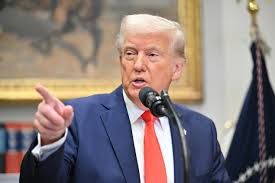
U.S. President Donald Trump used what was billed as an economic policy address in Las Vegas to launch a broad political offensive against progressive Democrats, portraying their recent primary victories as a growing threat to the Democratic Party and the country’s future ahead of November’s midterm elections.
The speech marked the latest effort by the White House to shift public attention toward ideological divisions within the Democratic Party as the administration faces persistent criticism over the economy, inflation and the ongoing conflict with Iran.
Addressing supporters at Red Rock Casino on Wednesday, Trump celebrated key provisions of last year’s Republican spending package, including temporary tax relief measures eliminating federal taxes on tips, overtime pay and Social Security income for many Americans.
“If you’re a waiter, a waitress, a bartender, a bellhop… you pay zero taxes on your tipped income,” Trump told the crowd.
Progressive Primary Wins Take Centre Stage
Although the event focused initially on economic policy, Trump devoted much of his speech to attacking progressive Democrats following their strong performances in Tuesday’s Democratic primary elections in Michigan.
The president argued that the party’s leftward shift represented what he described as the greatest ideological threat facing the United States, repeatedly linking progressive politics to socialism and communism.
“I think it’s the greatest threat,” Trump said.
However, while some progressive candidates across the country identify as democratic socialists, neither of the two victorious Democratic candidates in Michigan’s major statewide primaries has publicly embraced that label.
Political analysts also note that democratic socialism and communism are distinct political ideologies. Democratic socialism advocates expanding public ownership and social welfare through democratic institutions while maintaining democratic governance. Communism, by contrast, seeks the abolition of private property in pursuit of a classless society.
Trump Singles Out Abdul El-Sayed
Trump reserved some of his strongest criticism for Abdul El-Sayed, the physician and former public health official who secured the Democratic nomination for the U.S. Senate in Michigan and is set to face Republican candidate Mike Rogers in November.
The president accused El-Sayed of harbouring hostility toward Israel and Jewish people, alleging that he “hates them with a passion.”
El-Sayed has consistently rejected allegations of antisemitism, arguing that criticism of Israel’s military campaign in Gaza and its occupation of Palestinian territories should not be conflated with hostility toward Jewish people.
During his primary campaign, the 41-year-old physician advocated for universal healthcare, ending unconditional U.S. military aid to Israel and abolishing Immigration and Customs Enforcement (ICE), positions that have made him one of the Democratic Party’s more progressive voices.
Trump Defends Economic Record
Facing declining approval ratings in recent national polls, Trump also defended his administration’s economic agenda, lamenting what he described as a lack of public recognition for his achievements.
“I don’t get any credit for anything,” he told supporters.
Trump appeared alongside Republican congressional candidate Marty O’Donnell, who is seeking to unseat Democratic Representative Susie Lee in one of Nevada’s most closely contested House districts.
He credited Las Vegas hospitality workers with inspiring the “No Tax on Tips” provision included in the Republican-backed spending package, describing it as a direct response to concerns raised by service industry employees.
Democrats Keep Focus on Economy and Iran
Democrats have unanimously opposed the Republican legislation, arguing that while it provides targeted tax relief, it disproportionately benefits higher-income Americans and offsets those cuts through reductions to social safety-net programmes, including Medicaid and food assistance.
Party leaders have instead sought to make rising living costs and the administration’s handling of the Iran conflict central campaign issues heading into the midterm elections.
A recent Reuters/Ipsos poll found that only about one-third of Americans support the U.S. military campaign involving Iran, highlighting the political challenges facing Republicans as inflation and the cost of living continue to rank among voters’ foremost concerns.
Even among Trump’s supporters at the Las Vegas event, some expressed hope that the conflict would be resolved quickly.
“We want to wrap it up as soon as possible—not only to save American lives and bring down gas prices, but because the midterms are coming,” said Francine Moshkovsky, a retired Veterans Affairs physician from Las Vegas.
With the November elections approaching, Trump’s Las Vegas appearance underscored the Republican strategy of framing progressive Democratic gains as evidence of a party moving further to the left, while Democrats continue to argue that voters are more concerned with inflation, healthcare and foreign policy than ideological labels.