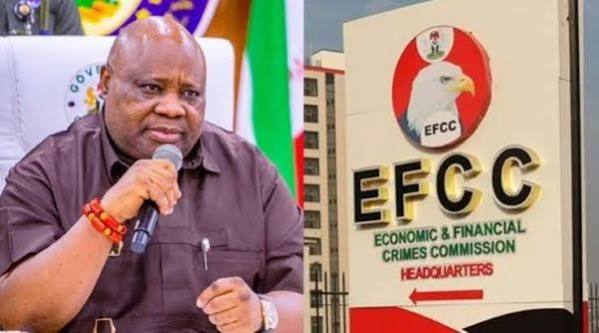
The Nigerian Bar Association (NBA) has faulted the Economic and Financial Crimes Commission (EFCC) over its decision to freeze the Osun State Government’s statutory allocation account, arguing that the anti-graft agency acted outside its constitutional powers by imposing a blanket restriction on the state’s finances without first obtaining a court order.
The legal body said while the EFCC has the statutory responsibility to investigate and prosecute financial crimes, such powers must be exercised within the limits of the law and in strict compliance with constitutional provisions governing due process.
The controversy follows the EFCC’s directive to First Bank to place a Post No Debit (PND) restriction on the Osun State Government’s statutory allocation account as part of an ongoing investigation into the alleged mismanagement of public funds.
A letter dated August 5, 2026, signed by the EFCC’s Assistant Commander, Adenike Babalola, on behalf of the Director of Investigation, instructed the bank to suspend all debit transactions on the account pending the conclusion of its investigation.
The letter, referenced 3000/EFCC/ABJ/HQ/PFS/TA/OSUN/VOL.17/666, was addressed to the Managing Director of First Bank with attention to the bank’s Chief Compliance Officer. It identified the affected account as “Osun State Government Statutory Allocation” (Account No. 2017170947).
Reacting to the development, the NBA maintained that the commission cannot, under the guise of an investigation, unilaterally freeze a state’s statutory allocation without judicial approval. According to the association, such action raises serious constitutional questions and could amount to executive overreach if not backed by the appropriate legal process.
EFCC Cites Alleged Diversion of ₦11 Billion
Defending its decision, the EFCC said the restriction became necessary after investigators uncovered what it described as suspicious movements of government funds while the investigation was ongoing.
In a statement issued on Wednesday night, the commission’s Head of Media and Publicity, Dele Oyewale, disclosed that the agency had been investigating the Osun State Government since March 2026 over the alleged fraudulent handling of about ₦11 billion in Ecology Funds, Intervention Funds and Federal Account Allocation Committee (FAAC) allocations.
According to the EFCC, several key officials, including the state’s Accountant-General, have already been questioned as part of the investigation.
The commission explained that although the investigation had been ongoing for months, it only resorted to freezing the account after detecting what it described as unusual and rapid transfers of public funds beginning on August 2, 2026.
“These ongoing investigations of the state government would not have warranted any placement of Post No Debit order on its account but for the precipitate and unwarranted movement of funds from the accounts to different suspicious accounts since August 2, 2026,” the EFCC stated.
The anti-graft agency further alleged that investigators traced substantial transfers from the government’s accounts into several corporate entities, prompting what it described as an urgent intervention to prevent further movement of the funds while the probe continues.
EFCC Rejects Political Motive Allegations
Amid concerns over the timing of the action, coming just days before the Osun governorship election, the EFCC dismissed suggestions that the account freeze was politically motivated.
The commission insisted that it could not suspend its constitutional mandate simply because an election was approaching.
“While the Commission is fully aware of the impending governorship election in Osun State, it has a responsibility to act in defence of the sanctity of the funds of the state. It will be uncharitable for the Commission to allow an excuse of an upcoming election to fold its arms to perform its legally assigned functions,” the statement said.
The EFCC also disclosed that Osun is not the only state under investigation, noting that similar probes involving other state governments are currently underway.
Legal Questions Take Centre Stage
The account freeze has triggered renewed debate over the limits of the EFCC’s investigative powers and the constitutional protections available to state governments.
While the anti-corruption agency argues that urgent intervention was necessary to safeguard public funds allegedly at risk of diversion, the NBA maintains that such extraordinary measures must be backed by judicial authorisation to preserve the rule of law and prevent abuse of executive powers.
The disagreement sets the stage for what could become another significant legal test of the balance between the EFCC’s anti-corruption mandate and the constitutional autonomy enjoyed by Nigeria’s federating states.