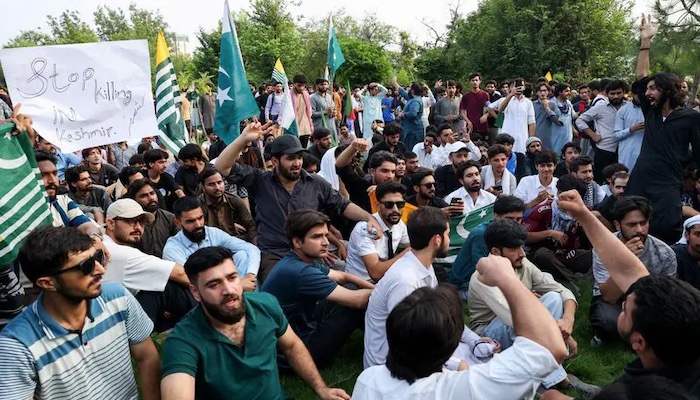
People chant slogans in support of peaceful protesters in Pakistani Kashmir, during a demonstration in Islamabad, Pakistan, July 29, 2026. REUTERS/Salahuddin
Families of victims killed during weeks of deadly protests in Pakistan-administered Kashmir have accused security forces of using live ammunition against demonstrators, as unrest over economic hardship and governance continues to escalate during the region’s election period.
The protests, led by the Joint Awami Action Committee (JAAC), have spread across the region in recent weeks, with demonstrators demanding affordable electricity, cheaper flour, improved healthcare, education and the implementation of an agreement reached with the Pakistan and Pakistan-administered Kashmir governments in October.
Reports said it became the first international media organisation to gain access to the protest hotspot of Rawalakot, reported that dozens of people have been killed in clashes between protesters and security personnel over the past two months.
At a makeshift medical clinic established near one of the protest sites, doctors described an overwhelming influx of critically injured patients suffering mainly from gunshot wounds.
The physician overseeing the temporary facility, identified only as Dr. Anwar, said the clinic could only provide emergency first aid before patients requiring specialist treatment had to be transferred to hospitals. “We have enough supplies to provide first aid. We can stop bleeding, clean and dress wounds, and remove superficial bullets. But patients with serious injuries to the chest, abdomen, head, or other vital organs need advanced hospitals.”
According to him, between 50 and 60 critically injured patients had been treated at the clinic since July 27, including up to 20 people with gunshot wounds.
He added that many protesters were reluctant to seek treatment at government hospitals because they feared arrest or further attacks, a claim the authorities rejected.
Among those receiving treatment was Shafqat Hussain, who had been shot in the chest.
His friend, Ali, questioned why demonstrators demanding basic necessities had been met with deadly force. “We only asked for affordable flour, electricity and our basic rights,” he said. “Instead, our brothers are being killed. What was our crime? Why are live bullets being fired at us?”
The violence has left many families grieving.
Asma, whose only son was killed during the protests, said he knowingly accepted the risks involved in joining the demonstrations.
“We were only asking for our rights. We are not terrorists. He knew there were risks, but he believed standing up for justice was important. He used to say that dying for a just cause was an honour.”
Another resident, Salman, said his younger brother died while peacefully demanding better conditions.
“He was the youngest in the family and was loved by everyone. It is a great loss for us,” he said. “At the same time I feel proud that he gave his life while standing up for the rights of the people. He was not fighting or attacking anyone.”
Ayub, a retired member of Pakistan’s armed forces whose son also died during the protests, blamed the regional administration for calling in paramilitary forces. “I have never seen anything like what is happening now. In my opinion, it is extreme injustice, “My son had done nothing wrong. None of the protesters had done anything wrong.”
The Pakistan-administered Kashmir government has denied allegations that security forces indiscriminately targeted peaceful demonstrators, maintaining that law enforcement acted only against individuals involved in attacks on security personnel, threats to public safety or obstruction of lawful authority.
Authorities have also accused the JAAC of attempting to disrupt the ongoing elections and insist the group is armed and linked to foreign interests. The organisation, which was banned in June and designated a foreign-funded terrorist group, rejects the allegations, insisting it is a peaceful movement funded by members of the Kashmiri diaspora rather than India.
Newsmen reported witnessing food shortages in Rawalakot, with residents sharing limited supplies while many shops remained closed. Some residents said food was being smuggled into the city on motorcycles after roads were blocked.
Authorities denied preventing food or medical supplies from entering the area, saying security measures were intended to facilitate safe access.
Police have also released drone footage and displayed firearms they claim were recovered from JAAC members, alleging some protesters carried weapons and attacked security personnel.
JAAC official Umar Nazir denied the organisation orchestrated violence, suggesting without providing evidence that unidentified infiltrators may have been responsible for some incidents.
At demonstrations attended, journalists reported seeing no visible weapons among protesters, although gunfire was heard overnight from unidentified sources.
Despite the rising tensions, JAAC leaders say they remain open to dialogue but have vowed to continue protests until their demands are addressed.
Erizia Rubyjeana