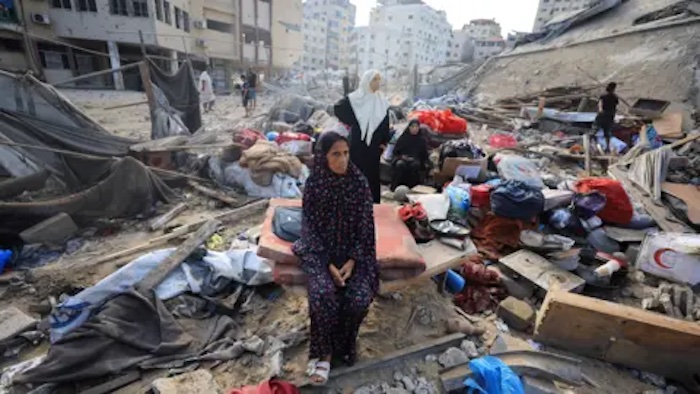
At least 13 people, including several children, were killed in fresh Israeli airstrikes across the Gaza Strip, Palestinian officials said, as uncertainty continued to surround a proposed disarmament agreement reportedly accepted by Hamas.
The latest strikes, carried out overnight, hit Gaza City, Khan Younis and Deir el-Balah, according to Gaza’s Civil Defence Authority, marking the second consecutive night of Israeli bombardment.
The escalation came days after Hamas reportedly accepted a disarmament framework that would see the group surrender its weapons under a plan overseen by US President Donald Trump’s proposed Board of Peace.
However, Israeli officials indicated that no agreement had been reached to halt military operations in Gaza.
An Israel Defense Forces (IDF) spokesperson said the strikes targeted Hamas operatives, adding that two militants were killed during the attacks.
In a statement posted on X, the IDF said it had eliminated two Hamas commanders one from the elite Nukhba force and another from the Maghazi Battalion as well as another operative from the Jabalia Battalion in an earlier strike. It alleged the three were planning attacks against Israeli targets.
Palestinian health officials said two people, including a child, were killed after a residential building in Gaza City was struck, while another person died near Jabalia in northern Gaza.
In Khan Younis, a father, mother and their nine-year-old son were reportedly killed when their home was hit, while a man and a woman died after an apartment building was struck in Deir el-Balah.
According to Palestinian officials, more than 1,100 people have been killed since a ceasefire announced last October.
Despite reports of progress on a disarmament proposal, Israeli Energy Minister Eli Cohen said on Sunday that no agreement had been reached to suspend military operations.
Cohen also maintained that Israel should assume full control of Gaza if Hamas fails to disarm, despite the proposed roadmap envisioning an eventual Israeli withdrawal from the territory.
Last week, President Trump announced that the Board of Peace had secured agreement on the “complete disarmament” of Hamas and other armed groups in Gaza.
On Friday, Trump described the proposal as “a big step for the Middle East,” saying Israel was “very happy” with the arrangement.
Nevertheless, Israeli officials remain sceptical about Hamas’ willingness to relinquish its weapons or political control of Gaza. National Security Minister Itamar Ben Gvir dismissed the draft agreement as “not acceptable.”
The proposal forms part of the second phase of a US-brokered ceasefire initiative unveiled last year. The broader framework includes the creation of the Board of Peace to supervise implementation, Hamas’ disarmament, the withdrawal of Israeli forces and the reconstruction of Gaza.
A separate 15-point implementation roadmap released on Friday provides for an inventory and secure storage of heavy weapons, military production facilities, weapons depots and tunnels, contingent on Israel fulfilling commitments under the initial ceasefire agreement.
The roadmap does not specify how Hamas’ weapons would be transferred to the Board of Peace, though reports suggest heavy weaponry would be placed under the control of a Palestinian National Committee comprising independent technocrats, which Hamas has agreed to empower. The committee is currently based in Cairo and has yet to enter Gaza.
Satellite imagery previously analysed indicated that Israel had destroyed more than 1,500 buildings in parts of Gaza under its control since the ceasefire, with the actual figure believed to be significantly higher.
The United Nations estimates that the conflict has generated approximately 60 million tonnes of debris across the enclave since October 2023.
Hamas, which has governed Gaza since 2007, is designated as a terrorist organisation by the United Kingdom and several other countries.
Erizia Rubyjeana