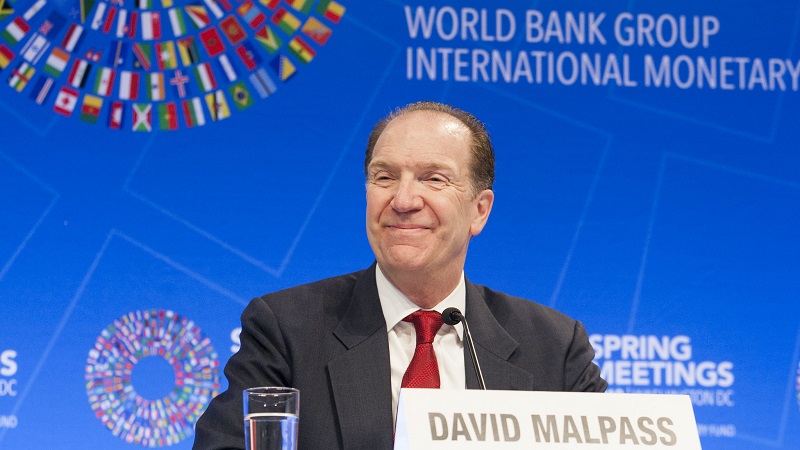
April 11, 2019 - WASHINGTON DC - 2019 World Bank/ IMF Spring Meetings. World Bank Group Opening Press Conference. David R. Malpass World Bank Group President. Photo: World Bank / Simone D. McCourtie
A former President of the World Bank Group, David Malpass, has said the concentration of income and wealth in the hands of a small elite continues to deny millions of Nigerians the benefits of economic growth, leaving the country’s median income well below its already modest per capita income.
Malpass, who served as President of the World Bank Group from 2019 to 2023, made the remarks in a Policy Research Working Paper based on his Stanley Fischer Memorial Lecture delivered at the World Bank’s Annual Bank Conference on Development Economics, seen by THISDAY.
According to him, Nigeria’s per capita income stands at roughly $1,500 annually, or about $4 per day, but the median income is considerably lower because income and wealth are disproportionately concentrated among a small segment of the population.
“Turning to Nigeria, it has a per capita income of roughly $1,500 or $4 per day. The median income is less because of the concentration of income and wealth at the top. The upside from currency reform would be massive,” Malpass said.
He noted that Nigerians working abroad routinely earn between 10 and 20 times more than workers at home, arguing that the country’s challenge is to implement reforms capable of unlocking higher incomes and stronger productivity for the average citizen.
Malpass disclosed that during his tenure at the World Bank, he engaged repeatedly with Nigeria’s previous administration and the Bank’s country team on reforms that could fundamentally transform the economy. These, he said, included currency stabilisation and unification, oil sector reforms, tax reforms and agricultural liberalisation, particularly in rice production.
He argued that implementing those measures could have an impact comparable to China’s 1993 economic reforms, which laid the foundation for decades of sustained high growth.
The former World Bank president also criticised exchange rate policies that encourage repeated currency devaluations, arguing that they enrich a privileged few while eroding the purchasing power of wage earners and worsening poverty. He listed Nigeria alongside Ethiopia and Egypt as countries where floating and multiple exchange rate regimes have contributed to wealth transfers from ordinary citizens to a narrow elite.
Beyond exchange rate policy, Malpass expressed concern over the opacity of some sovereign borrowing arrangements, warning that they could complicate future debt restructuring efforts and undermine transparency.
“More recently private sector transactions to distressed or high-risk sovereigns have become less transparent, sometimes to the point of including non-disclosure clauses, making their benefits to the people of the country unclear and hard to evaluate. Sophisticated new collateralised transactions—I saw ones in Angola, Nigeria, and Senegal—are creating a new race toward seniority in the capital structure. This will add further complexity to restructurings,” he stated.
Malpass’s remarks come as Nigeria continues to grapple with worsening poverty despite recent macroeconomic reforms. According to the World Bank’s latest Nigeria Development Update, about 75.5 per cent of Nigerians living in rural areas and 41.3 per cent of those in urban centres are below the national poverty line, with high inflation and declining purchasing power pushing millions more into poverty.
The multilateral institution has warned that while recent reforms may stabilise the economy over time, their immediate impact has been a sharp erosion in household incomes, particularly among low-income earners.
His comments also align with concerns recently raised by the International Monetary Fund (IMF) over the federal government’s derivatives-based financing arrangement with First Abu Dhabi Bank (FAB).
In its 2026 Article IV Consultation, the IMF described the up to $5 billion facility as “opaque and complex”, warning that such structures could obscure the true level of public debt, create contingent liabilities and expose the country to refinancing and market risks.
Nigeria has already drawn about $1.5 billion under the facility, while the Fund urged the authorities to strengthen debt transparency and rely more on conventional financing instruments.
Beyond the FAB transaction, Nigeria had also increasingly turned to crude-backed financing arrangements to support government finances. Existing oil-backed obligations involving the Nigerian National Petroleum Company Limited (NNPC) and the African Export-Import Bank (Afreximbank), as well as the planned multi-billion-dollar crude-backed financing with Saudi Aramco, have intensified debate over the sustainability and transparency of collateralised borrowing.
Similarly, during the event, Malpass maintained that broader reforms are required across developing economies to deliver meaningful increases in median incomes, warning that unless existing policies change, billions of people will continue to fall behind as wealth becomes increasingly concentrated at the top.
Emmanuel Addeh