Building AI From Toronto, With Kampala in My Bones
There is a particular quiet that settles over two founders when they finally stop building long enough to look at what they have built.
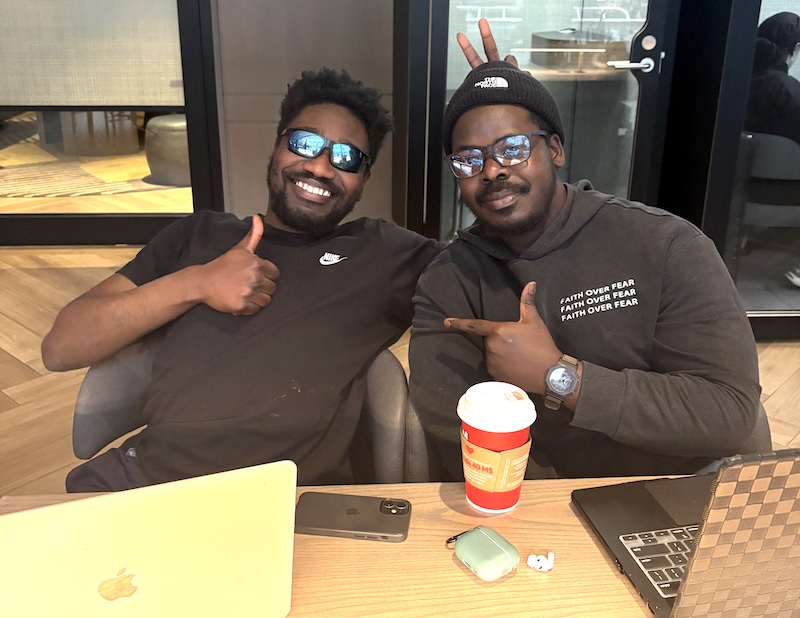
Sam and I found it on a grey Toronto afternoon, two MacBooks open on the table between us, the same two machines that have carried OptionBuddy from a sketch to a living product.
We were supposed to be planning the next sprint. Instead, we spent the first hour just talking about the road here. Sam is my co-founder, the engineer who has spent months inside Bud’s architecture.
I came to Toronto from Kampala to build in capital markets, and building artificial intelligence this far from home is difficult work. I would be lying if I dressed it up as anything else.
We set ourselves a goal that, on paper, bordered on unreasonable. One million dollars in revenue by the third of July. That date has come and gone, and no, we did not hit it. But we are revenue positive, and we are in a good place.
I have made my peace with the arithmetic of ambition: you aim for the stars so that when you fall short, you still land on the moon. The number stressed every one of us. It also pulled the product forward faster than comfort ever would have.
The first working version of Bud, our AI trading agent, arrived about seven months into the build. So I asked Sam the question I had asked him a dozen times before, except this time for the record. What was the hardest part of actually making Bud work?
Sam is honest to a fault. He will not tell you it works perfectly, because he does not believe it does yet. The hardest problem, he says, was never a single bug. It was the architecture itself.
He had studied the financial agents already out there and found too many of them brittle. The real difficulty in a trading agent is synthesis: taking a vast, noisy universe of prices, contracts and headlines and compressing all of it into one clear thesis, one strategy, one answer a trader can act on.
So he refused to build a chatbot. He built something closer to a mind with its own computer. You give the agent a brain, a purpose, and an environment stocked with everything it might conceivably need: a file system, storage, memory, a processor.
Essentially its own machine. The idea, he says, is to treat it almost like a brain living inside a computer, free to do the things a capable analyst would do at a keyboard.
That design shows up in what happens under the hood when a trader asks Bud something. Bud is not just answering the sentence in front of it. It reads context from earlier sessions to infer what the trader is really after.
Because no system can hold the entire market in its head at once, it pre-fetches, cherry-picking the relevant strategy signals, unusual options activity and trade ideas, and pulling them into its working memory before it composes a word.
Then, built like an engineer, it solves. If a question demands real statistics, Bud can write a script in a dedicated folder, run it, read the result, archive it, and move on.
The question I care about most is the one every trader should ask. How do you stop an AI from confidently inventing something when real money is on the line? Sam’s answer is less magic than discipline. Every step Bud takes is traceable from end to end.
You can see which data source it called, whether that was a live market feed or a web search, and follow the exact links back to the origin. The plan is to surface those sources to the trader too: here is the answer, and here is precisely where it came from. The rest is unglamorous work.
Because the traces are easy to follow, they find the weak points and patch them fast. And the honest truth about modern models, he says, is that if you put the right data in front of them, they rarely make things up. The craft is not the model. It is the retrieval. Get the data clean, and most of the danger disappears.
Every honest builder carries a regret. Sam’s is quantitative. Early on he told Bud to think like an engineer and code its way out of any problem. That instinct was right, and it is why the system is as capable as it is.
But he fed it words when he should also have fed it math. Starting again, he would push more numbers, raw and derived, deeper into the agent’s reasoning from day one, and insist it always ask not only what is true but how would I compute this. He is testing exactly that now.
We closed the laptops eventually. We are in the middle of a design push, a hard sprint on the interface, because Bud has plenty to say and not yet enough good ways to show it. More charts where there are still paragraphs. That is the next mountain.
The product is not finished. Neither are we. But sitting there in Toronto, a long way from where I started, beside a co-founder who bought into the vision, I felt the specific pride of having come further than the odds suggested. We shot for the stars. We are somewhere over the moon, and still climbing.
The author is a Ugandan living in Toronto, Canada.