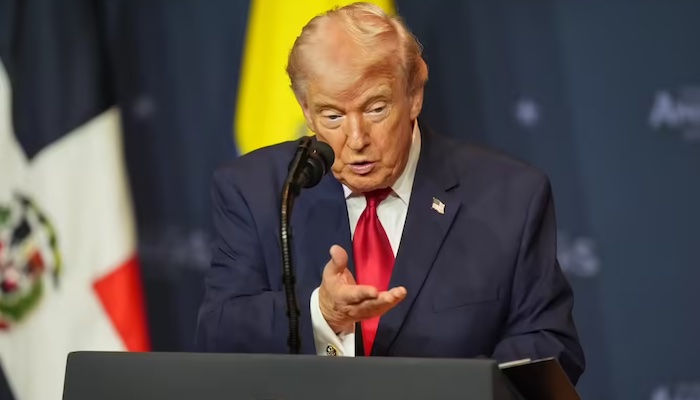
US President Donald Trump has threatened Iran with overwhelming military action after mourners at the funeral of Supreme Leader Ayatollah Ali Khamenei openly called for his assassination, as tensions continue to mount over the Strait of Hormuz and the future of nuclear negotiations.
The warning came as Washington demanded that Tehran publicly guarantee the safety of shipping through the Strait of Hormuz, one of the world’s busiest energy corridors. Iran has refused, insisting it should retain control over the waterway and be allowed to charge vessels passing through it.
Writing on Truth Social, Trump said the United States had positioned significant military assets against Iran. “A thousand missiles are Locked and Loaded and aimed at the Islamic Republic of Iran, with thousands of more to immediately follow, should the Iranian Government act on its threat.”
Trump said the warning followed threats against his life during Khamenei’s funeral, where mourners reportedly carried banners calling for the deaths of both the US president and Israeli Prime Minister Benjamin Netanyahu.
The latest escalation follows days of military exchanges between the two countries. The United States carried out airstrikes on Iranian targets after Tehran allegedly attacked three commercial vessels in the Strait of Hormuz earlier this week. Iran later retaliated by launching attacks against Bahrain, Jordan, Kuwait and Qatar.
Trump further warned that the U.S. military would “completely decimate and destroy all areas of Iran — PRAISE BE TO ALLAH!”continuing a series of remarks in which he has invoked Arabic religious phrases while criticising Tehran.
Meanwhile, senior US officials said Washington was giving negotiators only a limited window to secure a new agreement with Iran. They stressed that Tehran must reopen the Strait of Hormuz, halt attacks on commercial shipping and surrender its stockpile of highly enriched uranium before any nuclear deal could be reached.
Iran has rejected those demands.
Speaking at the United Nations, Tehran’s representative insisted that “any activity in the Strait of Hormuz, including its opening or demining operations, rests exclusively with Iran.”
Iran has also argued that vessels using the strategic waterway should begin paying fees to Tehran, challenging decades of international practice that recognises the strait as an international shipping route.
The dispute has raised concerns about global energy supplies. Around one-fifth of the world’s traded oil and natural gas passes through the Strait of Hormuz, although oil prices have eased after surging during the conflict.
Iranian Foreign Minister Abbas Araghchi travelled to Oman on Saturday for talks aimed at easing tensions, while Turkish Foreign Minister Hakan Fidan expressed optimism that a diplomatic solution could still be reached.
However, Araghchi accused Washington of violating an interim agreement after the United States ended waivers allowing Iran to sell crude oil in US dollars. Reality check: There can only be mutual compliance,” he wrote on X.
US officials also said military options remained available if negotiations failed, insisting Iran would never be allowed to retain uranium enriched to near weapons-grade levels.
Iran has repeatedly maintained that its nuclear programme is entirely peaceful, despite concerns raised by the International Atomic Energy Agency over its enrichment activities.
Erizia Rubyjeana