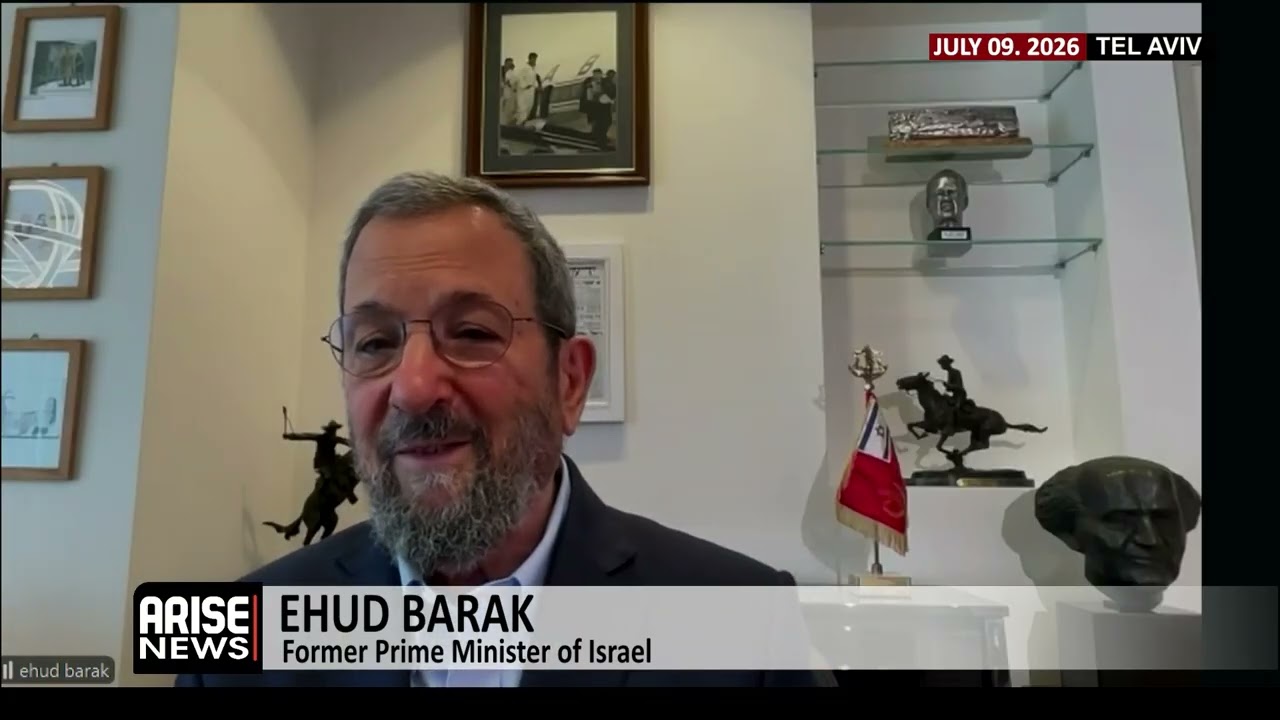
Former Israeli Prime Minister Ehud Barak has thrown his weight behind the establishment of state police in Nigeria, arguing that decentralising policing is the most practical way to confront the country’s worsening security challenges, while insisting that strong federal oversight and intelligence coordination are essential to prevent abuse.
Speaking virtually on Thursday at the ARISE News Town Hall on State Police and National Security, Barak said Nigeria’s size, complex security landscape and diverse communities make a centrally controlled policing system increasingly difficult to sustain.
Drawing on Israel’s decades-long experience in combating terrorism, Barak stressed that while Israel operates a centrally controlled security architecture, Nigeria’s circumstances require a different model.
“Israel is a tiny country. It’s about 10 million people. The whole of Israel is about the size of an average Nigerian state. Everything is controlled from the centre. Nigeria is a totally different thing. I strongly believe that the idea of having state police in a federal structure like Nigeria is a very good start and a very good step in the right direction.”
Barak said recruiting police officers from the communities they serve would significantly improve intelligence gathering, trust and operational effectiveness.
“When you mobilise and recruit policemen from within the community, they will be much more sensitive. They will understand the norms, the practices, the religious space and everything that relates to the people around them. It will be much more effective in understanding the country, the area and the people.”
Addressing concerns that state governors could weaponise state police for political purposes, Barak acknowledged the risk but argued that it could be managed through carefully crafted legislation rather than abandoning the idea altogether.
“The worry that some governor might try to use the fact that he has state police for his own political ambitions is a real issue and should be addressed. But I think it is much easier to deal with such events through very detailed legislation that gives certain authority to the President and the federal government in Abuja. It is much easier to correct this element than to try to govern a vast country like Nigeria from one central place.”
He noted that local police would be able to respond more quickly to emerging threats and would better appreciate the nuances of their operating environments.
“Response is much faster when you’re talking about state police. Response is much more calibrated to the nuances and subtleties of the arena in which it is carried out.”
Barak also argued that while community policing should be decentralised, sophisticated intelligence capabilities should remain under federal control.
“Intelligence is essential for fighting terror, organised crime and other threats. Human intelligence belongs close to the communities, but signal intelligence is extremely expensive and should naturally remain under the federal government. If those capabilities fall into the wrong hands, they can cause huge damage to the national structure.”
Reflecting on Nigeria’s security challenges, Barak observed that the country now faces one of the world’s most difficult counterterrorism environments.
“The centre of gravity of terror has moved southward toward the Sahel and Nigeria. You are facing not just Boko Haram, but other major groups as well. You are facing terror on a very wide scale.”
He argued that the answer lies in integrating state policing into a unified national security framework rather than creating isolated forces.
“The fact that there is state police does not mean there should be no coordination, dialogue or correlation with Abuja. The federal government should have access to information. There should be transparency about what happens in every state police organisation.”
Barak proposed the creation of a centrally controlled rapid deployment police force capable of reinforcing any state’s police when local resources become overwhelmed.
“There should be a central rapid deployment police force under the command of Abuja that could be sent to support any state when a problem emerges beyond its capabilities. That creates healthy dependence between state police and the federal government.”
He cautioned against relying excessively on the military for internal law enforcement, arguing that soldiers are trained for warfare rather than policing.
“Army people are much less focused on law enforcement. Their doctrine, manners and culture do not fit policing. When you send soldiers into missions that are more typical of police work, there are unintended consequences.”
Barak urged continuous information sharing between federal and state authorities to ensure an effective security architecture.
“The states should report to the federal authorities. There should be no secrets about police operations. At the same time, the federal government should remain sensitive to the changing needs of the states and provide guidance based on the intelligence available to it.”
Despite Nigeria’s security struggles, Barak praised the country’s commitment to preserving democracy while confronting terrorism, organised crime, kidnapping and separatist threats.
“We admire the way Nigeria is facing so many challenges in terror, organised crime, kidnapping and separatist attempts while remaining committed to democracy. That raises admiration.”
Responding to questions on building intelligence capacity comparable to Israel’s internationally renowned security services, Barak cautioned that such capabilities require years of sustained investment.
“You are making the right steps in improving intelligence, technology and support for your police and armed forces. But it is a process. It doesn’t come overnight. It took decades for us to develop these capabilities.”
Recalling Israel’s long history of counterterrorism operations, Barak recounted leading several high-profile rescue missions and acknowledged that Israel’s security successes were built alongside painful failures.
“We had successes, but we also had painful failures. We learn from every event. We honestly analyse our mistakes, understand what went wrong and try to correct them before the next challenge.”
He encouraged Nigeria to remain patient and persistent in strengthening its security institutions.
“It might take more time for Nigeria because you are a vast country. We are a miniature country compared to what you face. But even a long march starts with one step. I believe you are taking that step.”
Turning to developments in the Middle East, Barak described Iran as a significant source of regional instability because of its nuclear ambitions, ballistic missile programme and support for armed proxy groups including Hezbollah, Hamas and the Houthis.
“Iran is a major threat to the stability of the Middle East and indirectly to the whole world through its nuclear military programme, ballistic missile programme and its proxies around the region.”
However, he questioned the strategic assumptions behind the more recent military campaign against Iran, warning that expectations of quickly toppling the regime or eliminating its military capabilities had been unrealistic.
“There were certain illusions that we were going to topple the regime, eliminate the nuclear military programme and destroy the ballistic missile system. That was wishful thinking. You should never underestimate a country like Iran. They are a strong people with thousands of years of history.”
He also warned that any military confrontation involving Iran carries broader regional and global economic consequences.
“The whole region was shaken. When America hits Iran, Iran does not hit America directly. It strikes America’s partners in the Gulf. That is why every conflict there affects the wider world.”
Boluwatife Enome