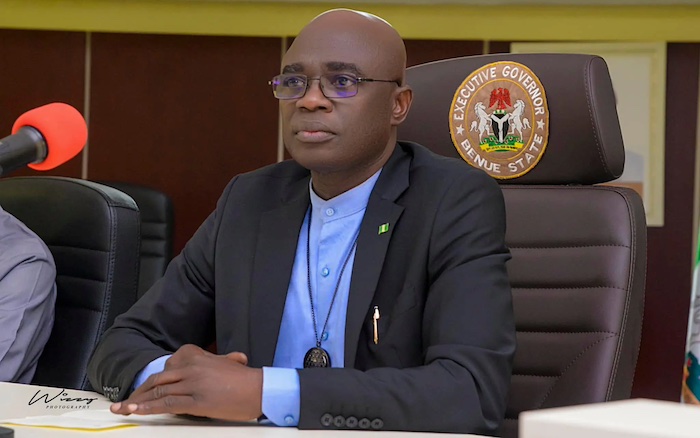
Benue State Governor, Rev. Fr. Hyacinth Alia, has defended the implementation of local government autonomy in the state, insisting that the third tier of government is operating independently in line with the Constitution.
Briefing journalists at the State House on Wednesday, Alia dismissed claims that local government and judicial autonomy were being undermined, maintaining that Benue remained fully compliant with the provisions of the 1999 Constitution.
“Our local government autonomy is sacrosanct. The judiciary also enjoys full autonomy. These are verifiable facts,” he said.
According to the governor, local government councils now independently execute development projects, while the state government focuses on supervision and accountability.
“It has reduced my burden significantly. My responsibility now is to supervise, inspect projects and ensure accountability. Once local governments receive their allocations, they execute their priorities and account for how the resources are utilised,” he said.
Alia also commended the economic reforms introduced by President Bola Tinubu, saying they had strengthened Benue’s finances, improved security, revived infrastructure and agriculture, and positioned the state as an emerging medical tourism destination.
He assured residents that every additional resource accruing to the state would continue to be managed prudently and transparently.
“My people should be fully assured that every additional resource accruing to the state will continue to be utilised responsibly and transparently, as we are doing,” he said.
The governor said prudent management of public resources had enabled the state to clear inherited salary and pension arrears while sustaining prompt payment of workers’ entitlements.
He added that his administration had rehabilitated more than 550 kilometres of roads and constructed over 420 kilometres of new roads across the state, alongside the reconstruction of schools and other public facilities.
On healthcare, Alia said improved health facilities had attracted patients from neighbouring states and the Federal Capital Territory.
“We have become a medical tourism power. If our state were not safe, people would not be coming. The most vulnerable people are the sick, and if they can travel to Benue for treatment, it tells you that security has improved,” he said.
The governor attributed the improvement in security to the Benue Civil Protection Guards, the Joint Task Force code-named Anyam Nyor, community vigilantes and technology-driven intelligence gathering.
He also said improved security had enabled many internally displaced persons to return to farming, supported by government-provided tractors, seedlings and other agricultural inputs.
Alia reaffirmed his support for the establishment of state police, arguing that community-based policing would improve intelligence gathering and security.
“When people police their own communities, they know who belongs there and who does not. Intelligence becomes much easier to gather,” he said.
He maintained that concerns over possible abuse of state police could be addressed through proper legislation, oversight and accountability mechanisms.
Deji Elumoye