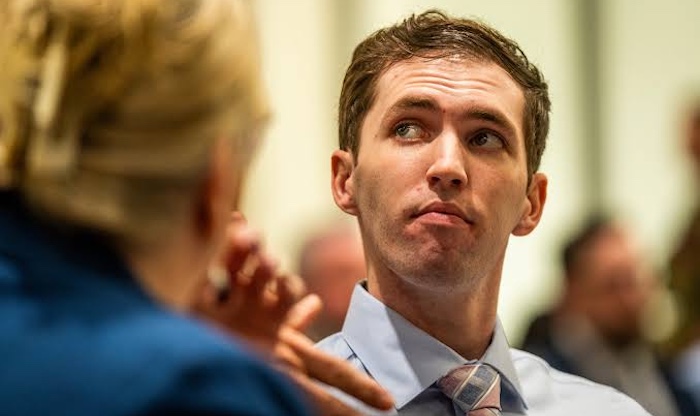
Lawyers representing the man accused of killing conservative activist Charlie Kirk have challenged DNA evidence that prosecutors say links him to the suspected murder weapon, as a preliminary hearing continues in Utah.
The defence questioned the reliability of FBI forensic testing after prosecutors presented evidence they say connects Tyler Robinson to a bolt-action rifle recovered near the scene of the September shooting. Prosecutors are seeking the death penalty and are asking the court to commit Robinson to trial on an aggravated murder charge.
During cross-examination, defence lawyer Michael Burt argued that the DNA analysis failed to conclusively identify his client. “She can’t match Mr. Robinson to the questioned samples.”
FBI DNA analyst Amanda Bakker testified that after investigators obtained a DNA sample from Robinson’s roommate, she repeated her analysis and concluded the biological material recovered from the towel wrapped around the rifle could be attributed to two people.
According to prosecutors, one DNA profile matched Robinson’s roommate, Lance Twiggs, while the second profile was highly likely to belong to Robinson. The rifle, containing one spent round, was recovered wrapped in a towel from a wooded area near where Kirk was fatally shot.
Prosecutors argued that any dispute over the scientific conclusions should be addressed during a full trial rather than at the preliminary hearing. “The point is there are explanations that are susceptible to different interpretations and arguments. The court is going to determine if it meets the threshold of reliability at trial.”
The hearing also examined surveillance footage that prosecutors say captured Robinson shortly before and after the shooting. Former State Bureau of Investigation agent David Hull testified that the footage showed the defendant climbing onto a rooftop overlooking the venue where Kirk was speaking before fleeing the scene on foot after the shooting.
The defence challenged investigators’ handling of the crime scene, questioning evidence relating to a bullet recovered elsewhere on campus. Hull testified that investigators later determined the round had been ejected by a law enforcement officer while clearing a weapon.
Prosecutors also introduced evidence they say demonstrates Robinson’s intent before the attack. They allege he left a handwritten note for Twiggs confessing his plan to kill Kirk. “I had the opportunity to take out Charlie Kirk and I’m going to take it.”
The prosecution further alleges Robinson later sent Twiggs a text message explaining his motive. “i had enough of his hatred.”
Prosecutors contend the killing endangered others attending Kirk’s campus event, an aggravating factor that could make Robinson eligible for the death penalty under Utah law. They also argue the shooting was politically motivated because Robinson allegedly targeted Kirk over his political beliefs.
The defence rejected that characterisation, arguing prosecutors had failed to establish Robinson’s state of mind. Defence lawyer Richard Novak opposed the admission of a statement describing the Christian values of Turning Point USA, the group co-founded by Kirk. “This doesn’t say anything about Mr. Robinson’s state of mind. I don’t think that this court should be deciding based on the record before it where, if at all, politics and religion intersect.”
Judge Tony Graf ruled that the statement was relevant and provisionally admitted it into evidence, while reserving a final decision on its admissibility for a later stage.
Erizia Rubyjeana