Federal Government says nearly 600 citizens have now been brought home as President Tinubu orders continued evacuations and officials begin documenting abandoned businesses for compensation claims……
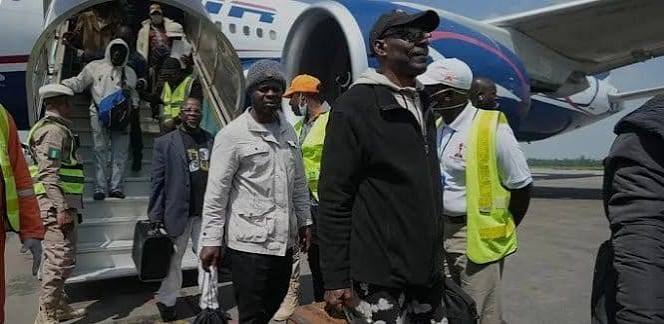
The Federal Government has stepped up efforts to evacuate Nigerians affected by the wave of anti-migrant violence in South Africa, with another 268 citizens arriving safely in Lagos on Friday aboard a special Air Peace evacuation flight.
The aircraft landed at the Murtala Muhammed International Airport, bringing home 268 returnees alongside two flight officers and crew members.
Minister of Foreign Affairs, Bianca Odumegwu Ojukwu, said the chartered flight departed O.R. Tambo International Airport in Johannesburg at 5:36 a.m., adding that the operation was fully funded by the Federal Government as part of ongoing efforts to protect Nigerians caught in the unrest.
According to the minister, President Bola Ahmed Tinubu directed that evacuation operations should continue despite the expiration of the June 30 deadline earlier issued by anti-migrant groups in South Africa.
She disclosed that nearly 600 Nigerians had already been evacuated in three separate batches before the deadline, with additional rescue flights expected as authorities continue to process citizens who voluntarily registered for repatriation.
Ojukwu stressed that only Nigerians who had completed the necessary screening and clearance procedures would be included in the evacuation programme, reaffirming the government’s commitment to ensuring the safe return of its citizens.
She described the protection of Nigerians abroad as a key responsibility of the Federal Government, saying it remains one of the priorities under the administration’s Renewed Hope Agenda.
The latest evacuation comes amid escalating anti-immigrant protests across several South African cities, where demonstrators have demanded the removal of undocumented foreign nationals.
The nationwide protests, led by groups including March and March and Operation Dudula, followed weeks of campaigns against migrants and culminated in demonstrations on June 30.
Although security agencies maintained a heavy presence, isolated incidents of violence, looting and stone-throwing were reported, particularly around Johannesburg, where police escorted foreign nationals away from hostile crowds.
In Durban, protesters marched in traditional Zulu attire, carrying spears, shields and whips, while in Cape Town, smaller demonstrations took place alongside counter-protests condemning xenophobia and Afrophobia.
South Africa continues to struggle with unemployment exceeding 30 percent, rising crime and worsening public services—factors that anti-immigrant groups argue have been worsened by undocumented migrants. However, analysts have repeatedly dismissed such claims, saying foreign nationals are being unfairly blamed for deeper economic and governance challenges.
Police have confirmed that at least four people including two Mozambicans, one Ethiopian and one Malawian have lost their lives during the latest wave of violence.
Nigeria is among several African countries, including Malawi, Ghana, Zimbabwe and Mozambique, that have launched voluntary repatriation programmes for their nationals.
Beyond the evacuation exercise, the Federal Government has also begun moves to seek compensation for Nigerians forced to abandon businesses and other valuable assets in South Africa.
Acting Nigerian High Commissioner to South Africa, Alexander Ajayi, said returnees had been directed to properly document every business, vehicle and property left behind to support future discussions with the South African authorities.
According to him, the government intends to compile verified records of the affected assets before formally engaging South Africa on possible compensation, insisting that Nigerians should not lose investments built over many years because of the ongoing crisis.