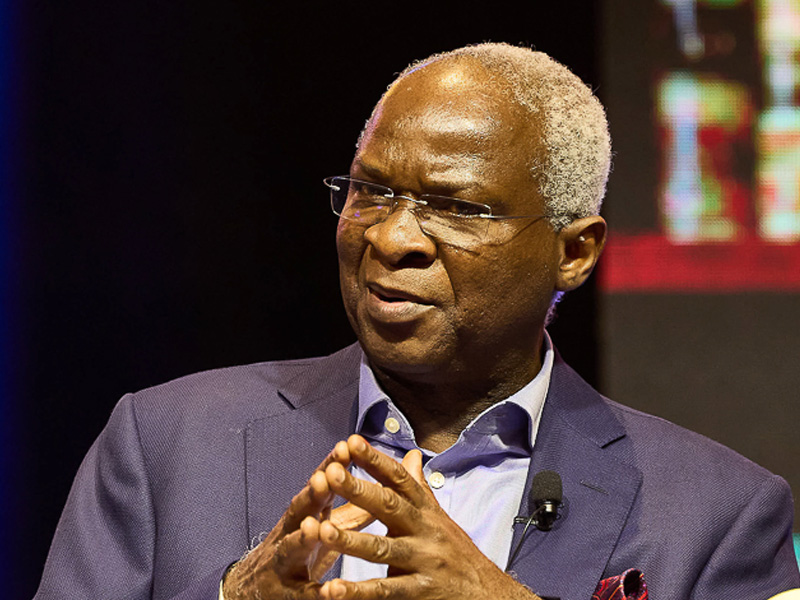
A former Governor of Lagos State, Mr. Babatunde Raji Fashola has declared that women have ruled the world in a manner that is uniquely theirs without acknowledging it.
Fashola, a Senior Advocate of Nigeria (SAN), who was a former minister of Power, Housing and Works, made this declaration on Wednesday in the National Theatre, Lagos, when he delivered the keynote speech at the Chartered Institute of Directors Nigeria’s (CIoD) “Women Directors Biennial Conference 2026,” with the theme “From Presence to Power: Advancing Women’s Influence in the Boardroom.”
He said: “The first thing I say is that women have ruled our world in a way that is uniquely theirs perhaps without acknowledging it.
“It seems to me that the assumption, or the assertion depending on what you choose, that (for women) power has not translated to influence is something that is not empirically demonstrable because my own experience does not support it.
“My experience in the public service at state level shows that there were more women than men in the Lagos State’s judiciary and in the senior management at the level of permanent secretary, which was the highest career elevation in the public service.
“Perhaps we men had not started making the case that we are now endangered.”
Fashola recalled that Lagos State has had a female head of service and three Chief Judges in immediate succession.
He said: “So by the time I left office, 40 of the 57 judges of the high court of Lagos were women.
“At the magistrate’s court level, the figure was 73 out of 101.
“Seven of the 10 most senior administrative offices in the judiciary were in women’s hands.
“These appointments were not arranged for effect. Each of the three chief judges that succeeded themselves reached that office on seniority on a ladder that women had climbed in their numbers.
“One of these successions that specially stayed with me is when the second of those three women handed the office over to the third, she was handing it to her own sister, two of them, daughters of the late Justice James, each on her own at the head of the Lagos bench.”
He added that there was nothing to suggest that the women judges were less in control of their courtrooms than the men or that the women permanent secretaries were not effectively in charge of their ministries.
In his welcome remarks during the conference, the President of CIOD Nigeria, Mr. Adetunji Oyebanji, pointed out that in the corporate world the advancement of women in leadership was no longer a niche agenda, but a mainstream priority.
Oyebanji said women’s presence in the board rooms was no longer the destination but the baseline.
According to him, “presence means being in the room; power means shaping the agenda.
“Presence is being allowed to speak; power is ensuring that your perspective redirects the trajectory of the company.
“Presence is a metric on a diversity report; power is the authority to vote down a flawed strategy, to chair the audit committee, or to pick the next CEO.”
He said a few decades ago, the struggle was simply about entry, securing a single seat, breaking through an invisible but incredibly dense glass ceiling.
However, “women fought for visibility and fought to be counted,” he said.
Delivering her welcome address, the Chairman, Women’s Group, CIoD Nigeria, Mrs. Ronke Sokefun, said the biennial conference “is where governance, enterprise, leadership and influence converge; where ideas will be tested, perspectives challenged and the future of board leadership shaped.”
Sokefun referred to the theme, which was “From Presence to Power: Advancing Women’s Influence in the
Boardroom,” and stated that women are no longer asking simply to be included but are determined to shape outcomes.
She added: “Presence may open the door, but influence shapes decisions.
“The true measure of leadership is not whether we sit at the table, but whether our contributions strengthen governance, shape strategy and leave institutions better than we found them.
“Boardrooms are not ceremonial spaces. They are where difficult decisions are made, risks are weighed, opportunities are seized and institutional futures are determined.
“That is why diversity in leadership is no longer a social aspiration; it is a strategic imperative.
“Across the world, organisations increasingly recognise that leadership diversity strengthens governance, improves risk oversight, broadens strategic thinking and builds lasting stakeholder confidence.
“Women bring perspective, resilience, emotional intelligence and measurable value. These are not simply desirable qualities – they are strategic assets for every modern boardroom.”
Dike Onwuamaeze