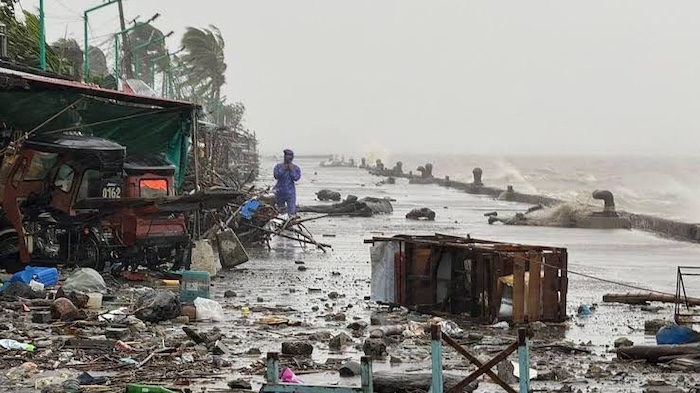
Japan battled transport disruption on Friday as authorities warned of more torrential rain and the threat posed by two approaching tropical storms, prompting high level landslide alerts and evacuation orders affecting around one million people.
More than 200 flights were cancelled, dozens of train services suspended and several expressways closed, according to Japan’s land ministry, while carmaker Toyota briefly halted operations at one of its factories in the southern Kyushu region.
Weather officials said a lingering seasonal rain front, combined with warm and moist air from Tropical Storms Mekkhala and Higos, had brought heavy rainfall across large parts of western Japan, raising the risks of landslides, flooding and overflowing rivers.
Emergency management authorities said around one million people were under evacuation orders, although some warnings had already been lifted in Okinawa and other southern areas.
Mekkhala, which had weakened from a typhoon to a tropical storm, passed over Japan’s southern Ryukyu Islands on Friday after skirting Taiwan, where severe rainfall shut down parts of the island and kept around six million people away from work and school.
“Last night the rain wasn’t too bad. But this morning the rain didn’t stop,” said Chi, a dessert shop owner in northern Taiwan’s Zhubei city. “The road outside was flooded up to the knees, and inside our shop it was a little below knee level.”
The Japan Meteorological Agency said Mekkhala was expected to accelerate and move towards western and eastern Japan by Saturday, around the same time that Higos was forecast to approach the country’s eastern regions and could make landfall.
The agency warned that the interaction between the two storms and the seasonal rain front could intensify rainfall across much of Japan.
Toyota said operations at its Kyushu factory, which had been suspended since Thursday afternoon, would resume from Friday’s second shift.
Taiwan ordered offices and schools closed in the three worst affected southern regions of Kaohsiung, Pingtung and Tainan, where severe flooding forced the closure of part of the island’s main north south railway line.
In the northern city of Hsinchu, home to the world’s largest contract chipmaker TSMC, offices and schools shut from noon.
In a statement, TSMC said its factories were operating normally and that precautionary measures had been implemented across its facilities in Taiwan in preparation for the severe weather.
Around six million people live in the four affected areas of Taiwan, with parts of the largely rural Pingtung region recording almost one metre of rainfall since Thursday.
No casualties were reported in Taiwan, but authorities in Hualien county were evacuating nearly 200 residents from two townships located downstream of a rapidly filling barrier lake in the mountains.
Barrier lakes occur when landslides, rocks or other natural obstructions create a dam across a river, trapping water and restricting natural drainage.
Last year, 19 people died elsewhere in Hualien after another barrier lake burst its banks during Super Typhoon Ragasa, sending a wall of water and mud into homes.
Despite the destruction, the rainfall also brings some relief to southern Taiwan, which depends heavily on the annual summer and autumn typhoon season to replenish reservoirs after typically dry winters.
Faridah Abdulkadiri