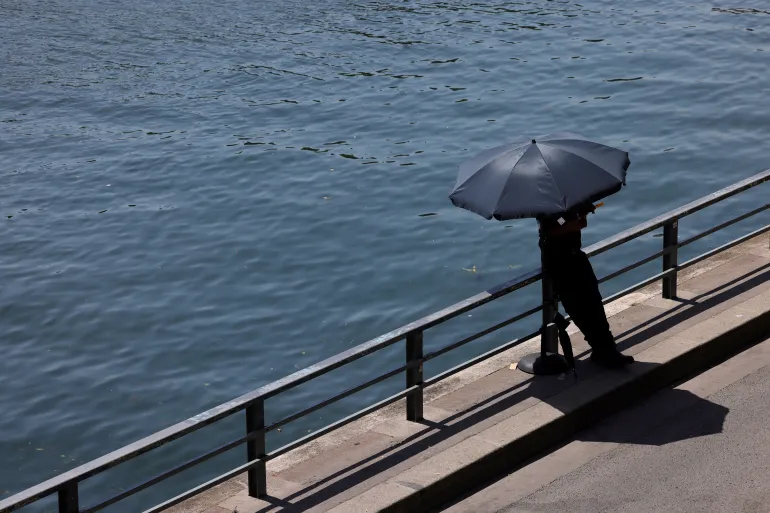
Thousands of households in northern France were left without electricity as authorities raced to restore power amid an intense heatwave that has gripped much of western Europe and pushed temperatures to dangerous levels.
French officials said healthcare facilities and other critical sites were being prioritised in recovery efforts following power outages on Tuesday that were blamed on a transformer incident. Generators were also deployed to retirement homes affected by the disruption.
“The incident was accidental and related to the current heat wave,” officials said in a statement. “No one was injured.”
The outages came as Europe continued to endure record breaking temperatures, with readings reaching as much as 18 degrees Celsius above seasonal norms, according to the Reuters Climate Monitor.
The extreme weather has disrupted transport services, forced the closure of schools and tourist attractions, and placed growing pressure on power systems across the continent.
France’s weather agency, Meteo France, said current conditions are comparable to the devastating August 2003 heatwave, which lasted 16 days and was linked to an estimated 80,000 excess deaths across Europe.
Meteorologists remain uncertain how long the current episode will last. The heatwave has been driven by an Omega block weather pattern, which traps hot air and allows temperatures to build over several consecutive days.
The World Meteorological Organisation has warned that Europe is warming at more than twice the global average rate, increasing the likelihood and severity of prolonged heatwaves.
The soaring temperatures have forced builders to adjust working hours to protect employees from the worst of the heat. Retailers have struggled to keep up with demand for fans and portable air conditioners, while farmers have shifted grain harvesting operations to nighttime after afternoon work restrictions were imposed because of wildfire risks.
Across Europe, dozens of people have drowned after seeking relief from the heat in rivers, lakes and other bodies of water.
In Britain, electricity grid operators called on generators to increase power output as temperatures climbed towards record levels.
Health authorities issued only the second ever “red heat” alert, warning that the extreme conditions posed a risk not only to vulnerable groups but also to healthy individuals.
Train operators advised passengers to undertake only essential travel on Wednesday and Thursday as speed restrictions were introduced to prevent heat related damage to railway infrastructure.
The heatwave has also been linked to fatalities. In southeastern France, autopsies showed that two children aged two and four who died inside a parked car outside their family home succumbed to excessive heat.
Their mother said the children had entered the vehicle without her knowledge, according to the regional prosecutor.
Italy’s Health Ministry issued its highest heat alert for 16 cities, including Florence, Milan, Rome, Turin and Verona.
Forecasters warned conditions could worsen further, particularly across central and northern Italy, with the heatwave expected to peak between Sunday and Monday.
Temperatures could reach 41 degrees Celsius in parts of Tuscany and Emilia. In coastal regions such as Liguria, the combination of extreme heat and humidity could push perceived temperatures as high as 45 degrees Celsius.
Faridah Abdulkadiri