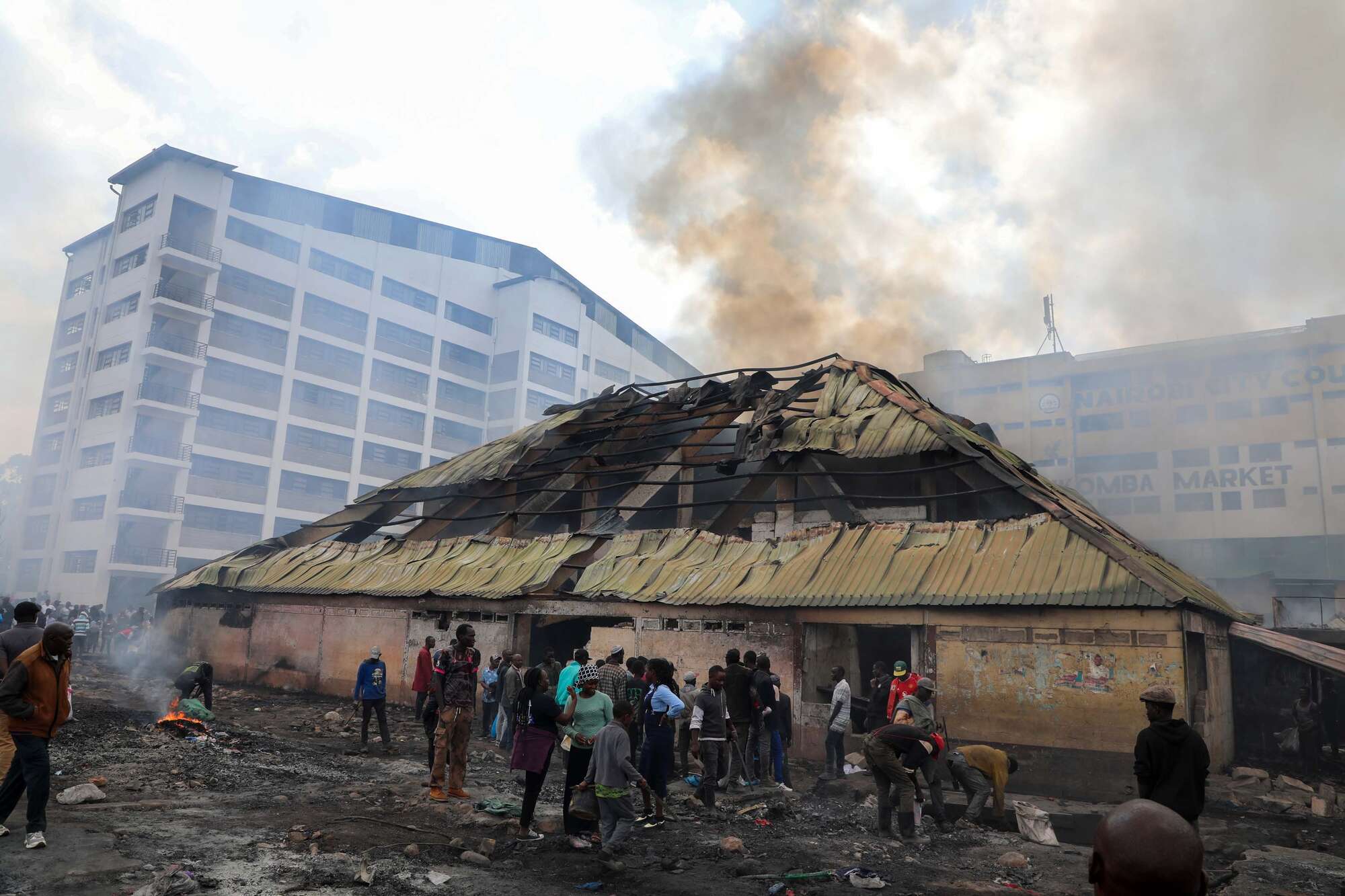
Nairobi’s sprawling Gikomba Market was again reduced to a landscape of ashes, twisted metal and shattered dreams after a fire swept through it in the early hours of Sunday morning, leaving behind a trail of destruction that claimed two lives and injured several people.
The latest blaze, whose cause remains unknown, has revived painful memories of previous infernos that have repeatedly ravaged one of Nairobi’s most important commercial hubs, often without answers and with little accountability.
By sunrise, thick smoke still hung over sections of the market as devastated traders sifted through charred debris, desperately searching for anything salvageable.
“I could not save anything,” one trader told the Nation, as she estimated her loss at more than Sh100,000.
Preliminary assessments by the Nairobi County Government indicate that large sections of the market suffered extensive damage, with traders counting losses running into millions of shillings.
But beyond the immediate destruction, the latest tragedy has once again exposed long-standing concerns about safety infrastructure and preparedness at the market.
Gikomba Traders Association chairman Mugo Kibathi said that approximately 75 per cent of the market was destroyed, disrupting the livelihoods of nearly 50,000 people.
“Millions of shillings in investments have gone up in smoke,” Mr Kibathi said in an interview.
For traders, the recurring fires have become a painful cycle of loss and rebuilding with many questioning why lasting solutions remain elusive despite repeated promises by authorities.
Their frustration is now focused on the stalled construction of a fire station adjacent to the market, a project they believe could significantly improve emergency response and reduce the devastation caused by future fires.
Recurring infernos
The fire station project was expected to be completed within six months. Located next to the market, it was intended to serve as a critical safeguard for traders who have endured years of recurring infernos.
When Governor Johnson Sakaja assumed office in 2022, he assured traders that completing the facility would be among his administration’s priorities.
However, with less than a year remaining before the end of his first term, the project remains unfinished.
According to Nairobi County Chief Officer for Disaster Risk Management and Coordination Bramwell Simiyu, the project was allocated Sh60 million and awarded through a competitive procurement process.
Yet recent audit findings have raised questions about its implementation.
In a review of county projects, Auditor-General Nancy Gathungu noted that the contractor had already been paid Sh30 million but there was no supporting technical report detailing completed works or outstanding tasks.
“The inspection and acceptance certificate dated June 28, 2024, for Sh30,024,578 was not supported by a technical report detailing the work completed and the remaining works, making it difficult to assess progress against the contract period,” the auditor-general observed.
She further noted that there was no evidence confirming the extent of work completed despite the expiry of the contract period, making it impossible to establish whether public funds had been properly utilised.
For traders, the delay has become difficult to understand.
“That is negligence on the part of Nairobi County officials. When we visited State House with the governor, he promised us in the presence of President William Ruto that the remaining works would be completed within three months. To date, that has not happened,” Mr Kibathi said.
Over the years, fires have become a recurring nightmare at Gikomba, often striking without warning and leaving traders to shoulder devastating losses.
The market’s congested layout, narrow access roads and densely packed stalls complicate firefighting operations.
The latest incident has once again raised concerns about whether enough is being done to protect thousands of traders whose livelihoods depend on the market.
Former Law Society of Kenya President Faith Odhiambo said the cycle of destruction points to deeper failures in urban planning and disaster preparedness.
“What Gikomba needs is proper market planning, effective fire safety infrastructure and transparent investigations into these recurring infernos that continue to target one of Nairobi’s most important economic centres,” she said.
“No family should have to repeatedly rebuild from ashes while questions about safety, accountability and lasting solutions remain unanswered.”
Ms Odhiambo called on authorities to move beyond promises and implement meaningful reforms.
“We stand in solidarity with Gikomba traders and commit to amplifying their call for justice, compensation and lasting reforms so that ‘never again’ finally means something,” she said.
As investigations continue, another familiar concern has resurfaced among traders — the possibility that the repeated fires could be linked to attempts to seize the valuable market land.
The claims have circulated after previous fires, though no evidence has conclusively linked the incidents to land grabbing schemes.
Aware of the growing anxiety, Governor Sakaja sought to reassure traders that no one would be displaced as a result of the latest disaster.
“I assure you that no one will take advantage of this fire to displace any trader from their space. We will allow all traders to rebuild where they were, even as we continue with plans to modernise Gikomba,” the governor said, and he also pledged support for the affected traders.
“My administration is reviewing immediate measures to support recovery efforts and help traders get back on their feet. We will not abandon you,” he said.