Most men will never know they have prostate cancer until it has already begun narrowing life’s options.
It also remains the most commonly diagnosed cancer among South African men across every population group, with one in every 16 men expected to face the disease during their lifetime.
Among Black South African men, the lifetime risk rises to one in four, while local mortality rates remain significantly higher than the global average.
Options become more limited
The disease operates in stealth, according to Dr Julius Jacobs, a specialist urologist at Life Wilgers Hospital in Pretoria and an accredited robotic surgeon.
“By the time symptoms appear, we are often dealing with advanced disease where our options become more limited. Men need to understand that waiting for signs is waiting too long.”
Family history remains one of the strongest risk factors, Jacobs said.
“When a man’s father or brother has had prostate cancer, his own risk roughly doubles. If multiple relatives are affected, that risk climbs further.
“These are the men we need to reach with screening, because we can catch this disease while it is still confined to the prostate and treatable.”
Waiting too long
A study published in the European Journal of Cancer Prevention in 2024 found South Africa recorded the highest age standardised prostate cancer mortality rate among BRICS countries.
Prostate cancer accounts for 13% of all male cancer deaths in the country.
It’s a stark reality that, because of the nature of the disease, often requires surgery to save lives.
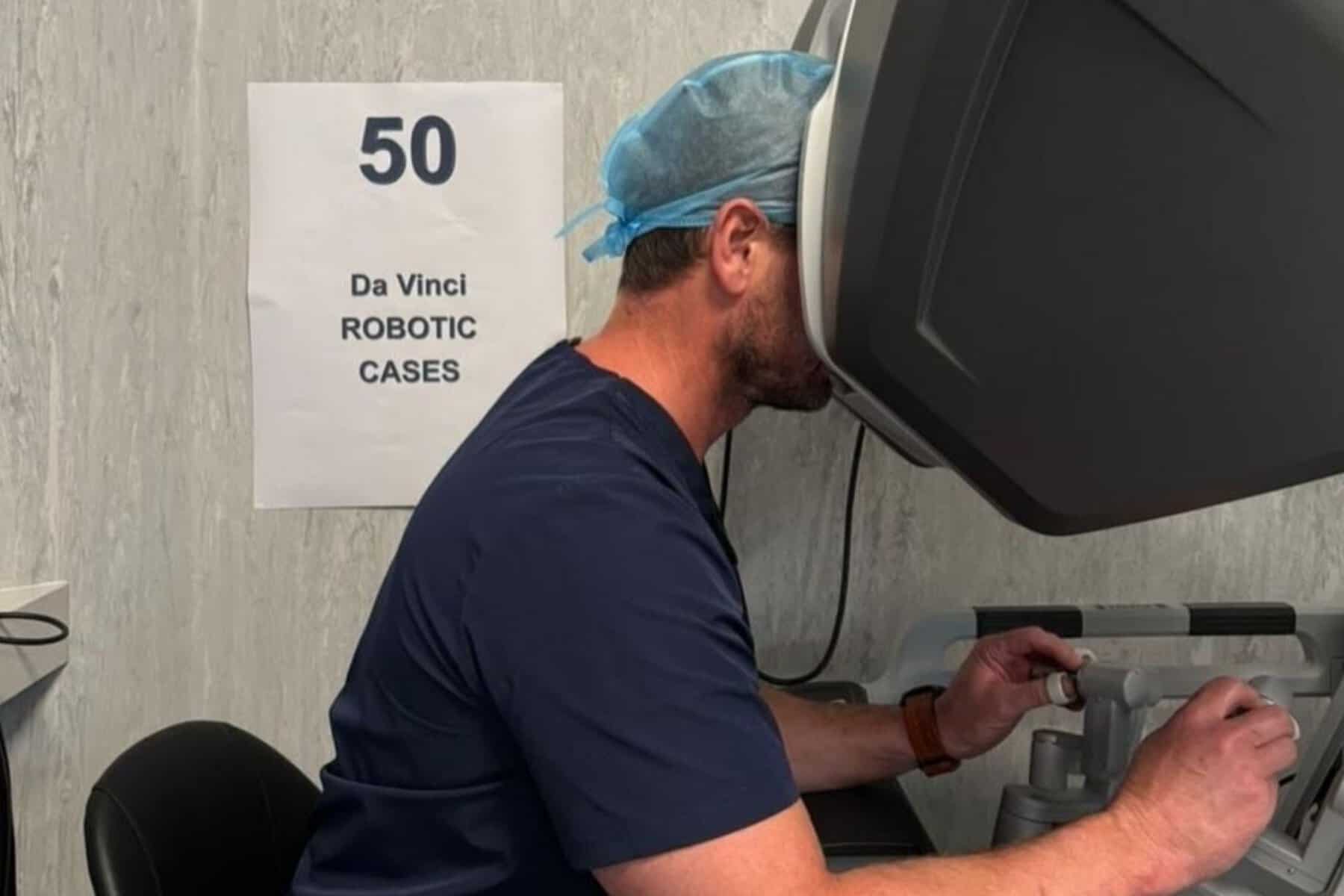
This, said Jacobs, is also why doctors are paying closer attention to robotic surgery, a technology that is rapidly changing how prostate cancer is treated in South Africa.
Robotic surgery is a form of minimally invasive surgery performed through several small incisions in the abdomen.
Surgeons operate from a console a short distance away from the patient, controlling specialised instruments that offer a greater range of motion than the human hand while viewing the surgical field through a highly magnified three dimensional image.
Where the cancer remains confined to the prostate, the objective is single minded.
“The aim is cure rather than control,” he said.
Cure is the objective
The growing use of robotic surgery is also reflected in data from elsewhere on the continent.
A meta analysis published in the Journal of Minimally Invasive Surgery examined 1,328 robotic procedures performed in South Africa, Egypt and Tunisia, the three African countries with established robotic surgery programmes at the moment.
Urological procedures accounted for just over 90% of all robotic operations performed, while robotic prostatectomy alone represented almost half of all robotic procedures recorded.
Researchers found that only 0.21% of procedures required conversion to traditional open surgery. Across all 1 328 procedures examined, mortality was zero.
Yet, access to advanced technology remains a challenge in many parts of Africa.
A World Health Organization report published in 2023 found around 60% of hospitals in Sub Saharan Africa experience regular power outages, while 15% have no access to electricity at all.
Despite those obstacles, South Africa continues to expand its robotic surgery capabilities, with hospitals building experience and contributing to a growing body of African data.
Jacobs said one of the biggest misconceptions about robotic surgery is that it remains out of reach for most South Africans.
While the procedure is expensive, he said funding has improved considerably over the past few years, with most medical aid schemes now covering robotic assisted prostate surgery, although some still require co-payments.
Public sector access is also beginning to emerge, with three state centres currently offering robotic surgery through public-private partnerships.
Access to technology is growing
Technology, however, is only part of the solution.
Jacobs said the bigger challenge remains getting men through the doctor’s door before the disease advances beyond the point where surgery can offer a cure.
“A PSA blood test at forty five. At forty, if your father or brother had prostate cancer. It is a simple blood test through your GP, though not a diagnosis. It is information.”
If the disease is detected while still localised, he said, patients have several treatment options available.
Once it has spread beyond the prostate, the conversation changes entirely.
“The technology is only useful if you show up early enough to use it.”