South Africa crossed the 392-consecutive-day mark without a single load shedding interruption this week, a milestone that would have seemed impossible just two years ago.
Yet for hundreds of thousands of Gauteng residents, that headline tells only half the story.
Load reduction continues to cut power to homes across the province twice daily, and Eskom says full relief for Gauteng will not arrive before 2027.
Despite this, Eskom said on 12 June that its load reduction elimination programme is advancing steadily.
“Eskom’s load reduction elimination programme remains on track across all provinces, with about 726 324 households, approximately 43% of affected customers, already restored to normal supply,” the utility said.
The remaining 57% of targeted households, heavily concentrated in Gauteng and KwaZulu-Natal, are still waiting.
What load reduction is and why it is still happening
Load reduction is not the same as load shedding.
While load shedding is a systemwide response to a shortage of generating capacity, load reduction is a localised intervention applied to specific feeders where illegal connections, meter tampering and infrastructure overloading have pushed the network to its limits.
Eskom applies it as a temporary protective measure to prevent equipment failure and safety hazards in high-risk areas.
The utility acknowledged on 12 June that despite a stable national power system, certain communities remain a persistent concern.
“Although the power system remains stable and generation capacity continues to exceed demand, illegal connections and meter tampering persist in certain localised areas, driving infrastructure damage and posing serious safety risks,” Eskom said.
It added that load reduction is being applied “as a temporary, targeted measure in high-risk areas to protect both communities and the electricity network”.
Areas affected by load reduction this week
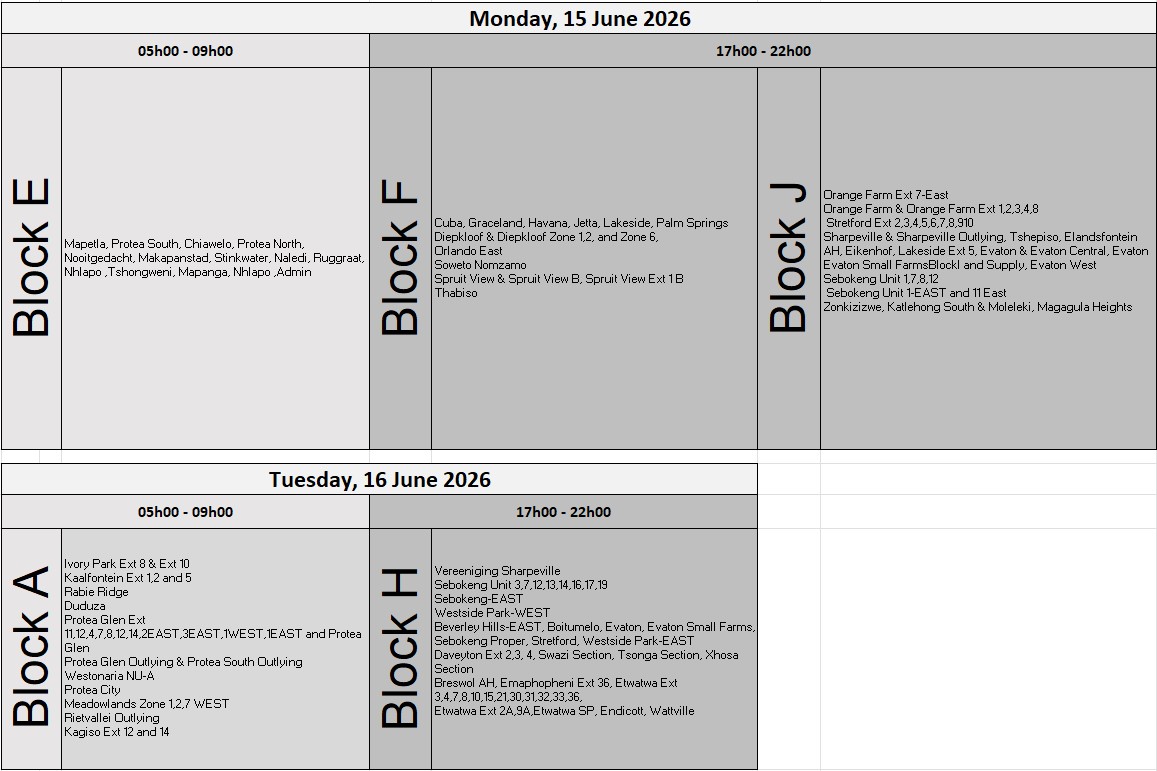
Outages run from 5am to 9am and again from 5pm to 10pm daily.
On Monday 15 June, Block E is affected, covering areas including Mapetla, Protea South, Chiawelo, Protea North, Nooitgedacht and Naledi.
Block F, which includes Cuba, Graceland, Havana, Jetta, Lakeside and Palm Springs, is also off, along with Block J covering Orange Farm, Stretford extensions, Sharpeville, Evaton and Sebokeng Units 1, 7, 8 and 12.
On Tuesday 16 June, Block A is affected, covering Ivory Park Ext 8 and 10, Kaalfontein, Rabie Ridge, Duduza, Protea Glen and Meadowlands Zones 1, 2 and 7.
Block H is also off, covering Vereeniging, Sharpeville, Sebokeng, Etwatwa, Daveyton and Wattville.
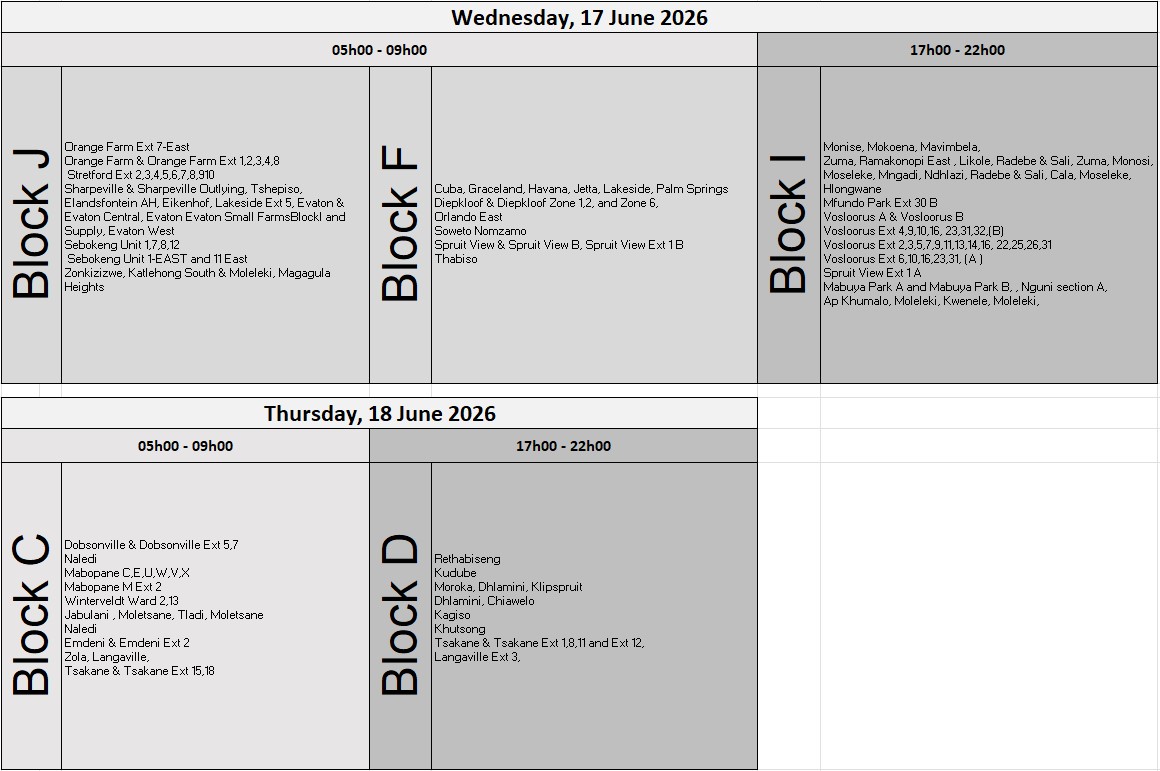
On Wednesday 17 June, Block J covers Orange Farm, Evaton, Sebokeng and Katlehong South.
Block F covers Cuba, Graceland, Havana, Diepkloof, Orlando East and Soweto Nomzamo, while Block I affects Vosloorus A and B, Mabuya Park, Spruit View Ext 1A and Mfundo Park Ext 30B.
On Thursday 18 June, Block C is affected, covering Dobsonville, Naledi, Mabopane, Winterveldt, Jabulani, Emdeni, Zola and Tsakane.
Block D covers Rethabiseng, Kudube, Moroka, Dhlamini, Kagiso, Khutsong and Tsakane Ext 1, 8 and 11.
Weekend load reduction
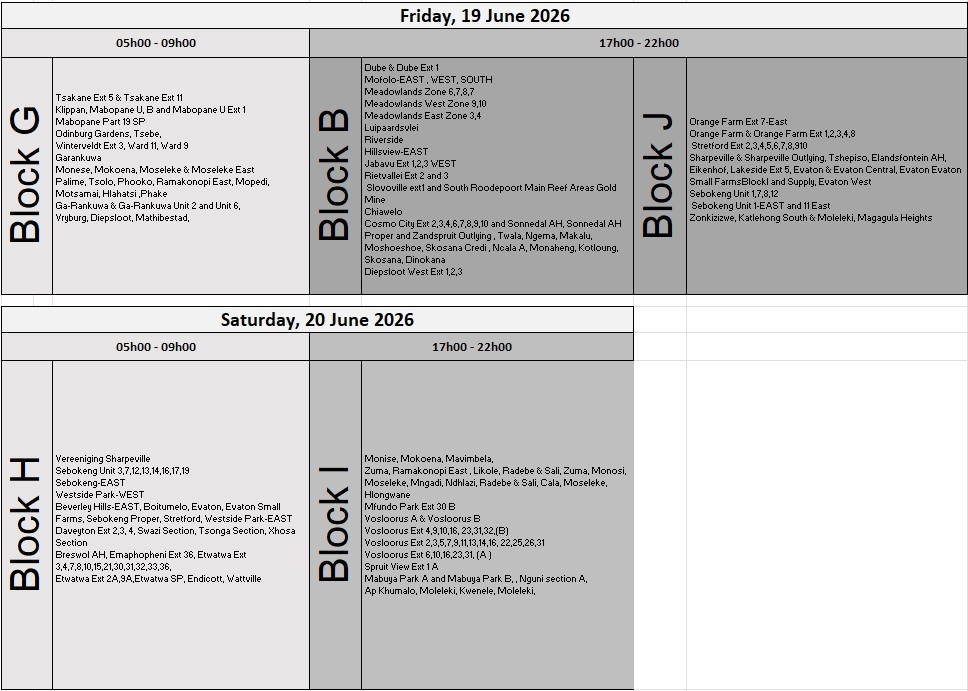
On Friday 19 June, Block G covers Tsakane Ext 5 and 11, Klippan, Mabopane, Winterveldt, Ga-Rankuwa, Diepsloot and Mathibestad.
Block B covers Dube, Mofolo, Meadowlands, Luipaardsvlei, Cosmo City and Diepsloot West, while Block J again affects Orange Farm, Evaton, Sebokeng and Zonkizizwe.
On Saturday 20 June, Block H covers Vereeniging, Sharpeville, Sebokeng, Etwatwa, Daveyton and Wattville, while Block I affects Vosloorus, Mabuya Park, Spruit View and Mfundo Park.
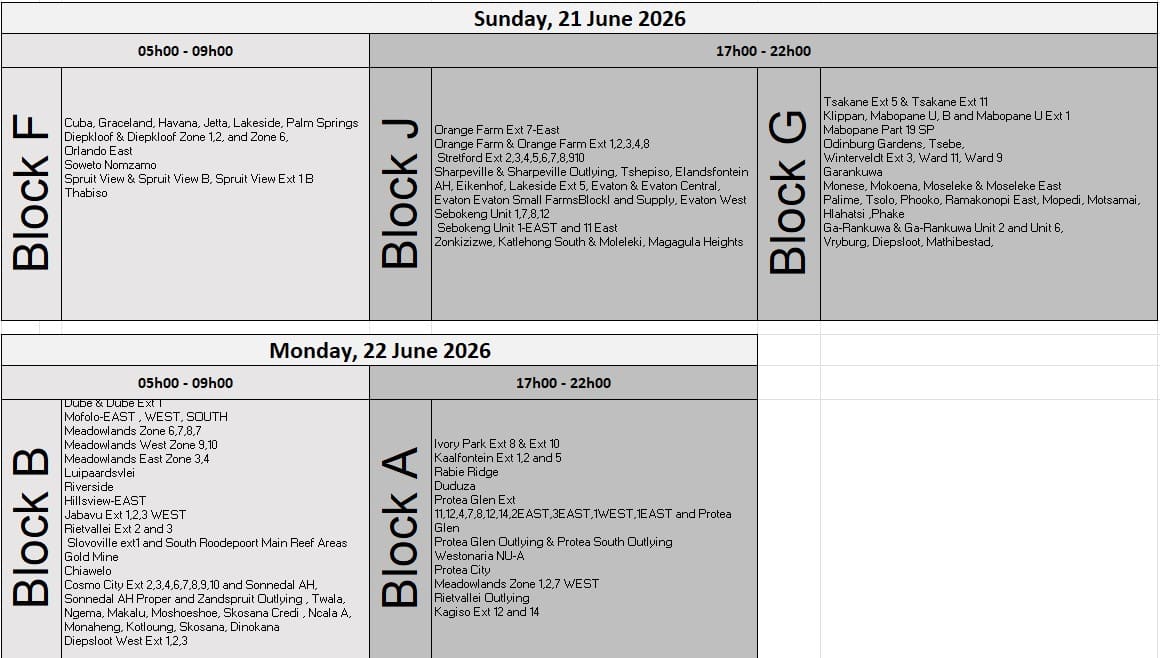
On Sunday 21 June, Block F covers Cuba, Graceland, Havana, Diepkloof, Orlando East and Thabiso.
Block J affects Orange Farm, Evaton, Stretford and Sebokeng, and Block G covers Tsakane, Klippan, Mabopane, Ga-Rankuwa, Winterveldt and Diepsloot.
On Monday 22 June, Block B covers Dube, Mofolo, Meadowlands, Cosmo City, Luipaardsvlei and Diepsloot West, while Block A affects Ivory Park, Kaalfontein, Rabie Ridge, Protea Glen, Meadowlands and Westonaria.
Click below to see if your area is affected:
447 feeders cleared, Gauteng lags behind
Nationally, Eskom has removed 447 feeders from load reduction against a planned target of 971, representing just under 46% progress.
The Northern Cape and Western Cape have achieved complete elimination, having met or exceeded their respective targets.
Combining the North West and Northern Cape, 12 feeders were cleared against a target of nine, translating to 133% of the target.
Progress in Gauteng, however, remains the most challenging.
Eskom said 236 feeders in Gauteng have been cleared – only 39% of the province’s target of 604.
“Full elimination is targeted in seven provinces by October 2026, with the remaining provinces, Gauteng and KwaZulu-Natal, expected to follow in 2027 as targeted interventions continue to address localised network constraints and overloading pressures,” the utility said.
Elsewhere, 72 feeders were cleared across Limpopo and Mpumalanga (48% of a target of 150), and 117 across the Free State and KwaZulu-Natal (60.6% of a target of 193).
National grid in good shape
The broader electricity picture is markedly better than it was a year ago.
Between 5 and 11 June 2026, average unplanned outages fell to 10 143MW – a drop of 4 304MW from the 14 447MW recorded over the same period in 2025.
Eskom noted this improvement “is almost equivalent to the capacity of Kusile Power Station”.
The Unplanned Capacity Loss Factor improved to 21.18% from 29.61% in the corresponding period last year, a reduction of 8.43 percentage points.
On Monday, 15 June, Eskom said it would bring an additional 2 462MW of generation capacity online ahead of the evening peak.
“Today’s evening peak demand is forecast at 26 325MW, with 30 138MW of available capacity,” it said, leaving a comfortable buffer above projected demand.