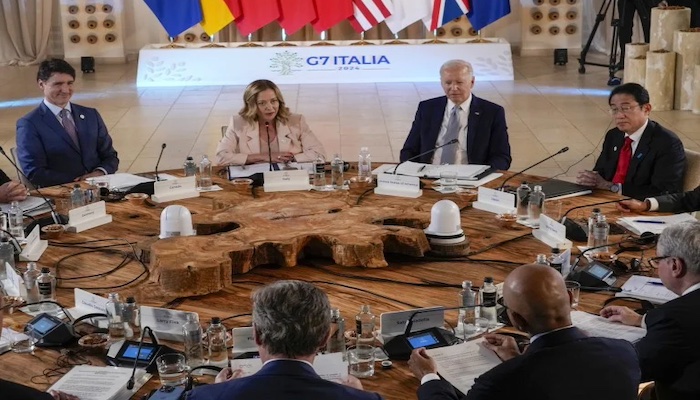
Leaders of the Group of Seven (G7) nations are meeting at a lakeside resort in France after the United States and Iran announced a preliminary agreement aimed at ending their war.
The June 15-17 summit in Evian-les-Bains is expected to focus on the next steps following the US-Iran agreement, alongside discussions on the war in Ukraine, global economic imbalances and efforts to secure critical minerals from sources beyond China.
US President Donald Trump is due to arrive on Monday for the summit, where leaders are seeking to navigate a period of uncertainty in global affairs. French officials welcomed Trump’s participation after he left last year’s G7 summit in Canada ahead of schedule.
Trump’s recent actions have had significant effects on the Middle East, global trade and diplomacy, raising questions among allies about Washington’s commitment to the international order established after World War II.
During the summit, Trump is expected to hold talks with Middle Eastern leaders and participate in a working session with Ukrainian President Volodymyr Zelenskyy.
The meeting with Zelenskyy comes as Russian advances in Ukraine have slowed and Kyiv seeks additional military support from its allies. Zelenskyy’s position has strengthened since Trump told him in the Oval Office last year: “You don’t have the cards”.
A key focus of the summit will be the US-Iran agreement. A memorandum of understanding is expected to be signed in Switzerland on Friday, although details of the deal have not yet been released.
Trump said the Strait of Hormuz, a crucial route for global oil and gas shipments that Iran had effectively closed for months, would reopen on Friday. He also said he had ordered an end to the US blockade of Iranian ports.
In a statement, Iran’s Supreme National Security Council said military operations across all fronts, including Lebanon, would end permanently from Monday night.
Iran’s Deputy Foreign Minister Kazem Gharibabadi said negotiations on a broader agreement would continue during a 60-day ceasefire period, including discussions on sanctions relief. Iran’s nuclear programme is expected to be addressed during those talks.
The United Arab Emirates, Qatar and Egypt, all of which played significant roles during the conflict and mediation efforts, will also attend the summit.
For French President Emmanuel Macron, the gathering represents a major diplomatic event during the final year of his second term. Macron is expected to welcome Trump on Monday and host leaders at a state dinner at the Palace of Versailles on Wednesday.
France has used its G7 presidency to push discussions on global economic imbalances, arguing that China overproduces, the United States overconsumes and Europe underinvests. Brazil, India, Kenya and South Korea have also been invited to participate in the discussions, while Macron has encouraged China to boost domestic consumption.
Faridah Abdulkadiri