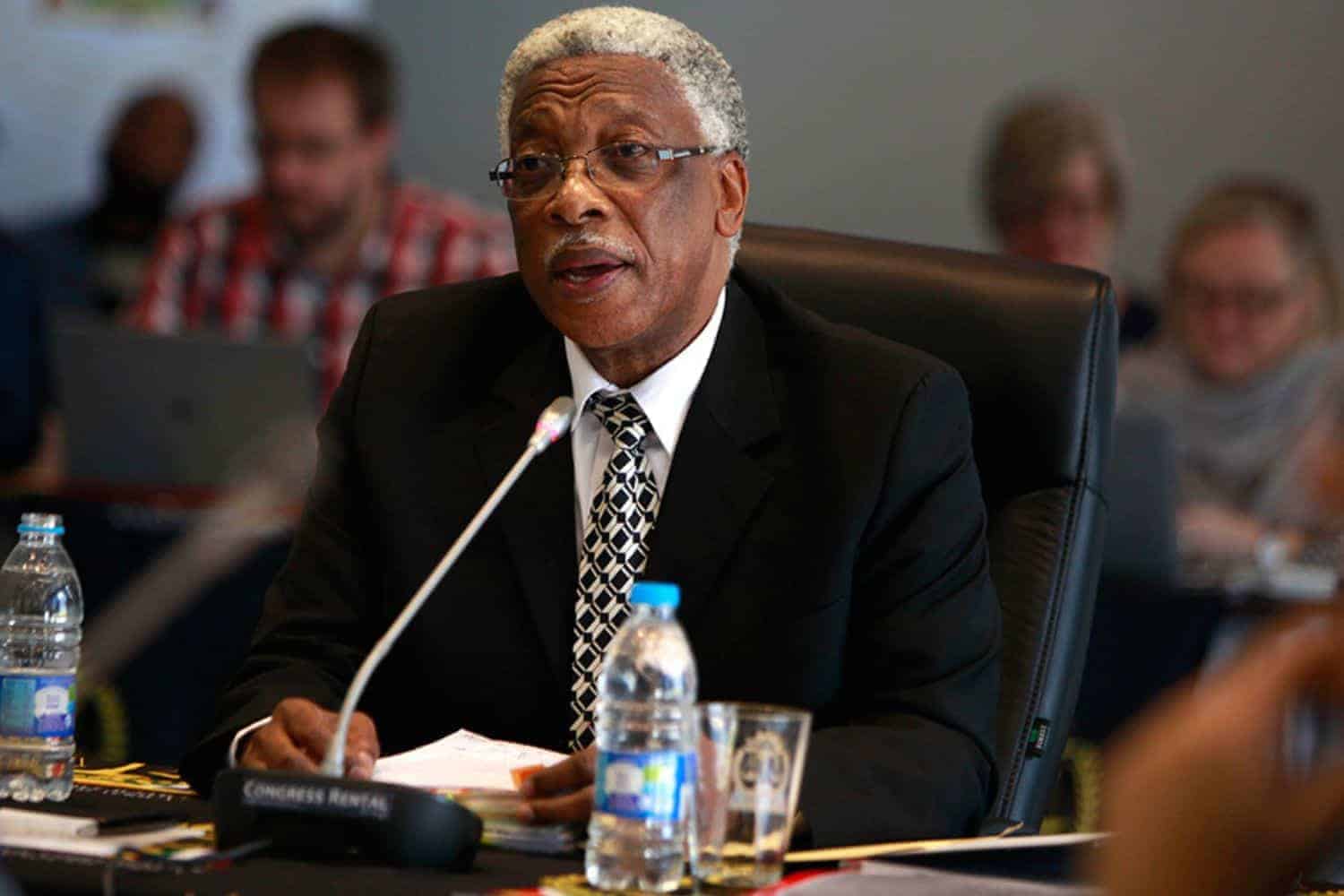
Eastern Cape Judge President Selby Mbenenge has filed a review application against the Judicial Service Commission’s (JSC) findings of gross misconduct against him.
The findings against him stem from a complaint by the secretary for judges, Andiswa Mengo, who accused him of sexual harassment after he allegedly persistently asked her to send him explicit images and also sent her his own in exchange.
She accused him of sexually harassing her through WhatsApp messages, inappropriate comments, gestures regarding her appearance, and another incident that occurred in his chambers in November 2022.
The judge has claimed that the sexual interactions between him and Mengo were consensual. Mbenenge, the first senior judge in the country to risk impeachment for sexual misconduct, has also denied sending an image of his penis.
Judicial Conduct Tribunal’s finding against Mbenenge
Following months of hearings, the Judicial Conduct Tribunal found Mbenenge not guilty of gross misconduct, gross incompetence, and gross incapacity in January 2026.
However, he was found guilty of a lesser offence, which would not lead to his impeachment.
“It is the finding that Mbenenge is guilty of a degree of misconduct that does not amount to gross misconduct in that he, at a place of work and during working hours, initiated and subsequently conducted a flirtatious relationship with Mengo through a series of WhatsApp messages exchanged between them,” said the Judicial Conduct Tribunal at the time.
The matter was referred to the JSC for a final decision.
JSC disagrees with Judicial Conduct Tribunal
On 5 March 2026, the JSC held a meeting to consider the Judicial Conduct Tribunal’s report on Mengo’s complaint against Mbenenge.
The JSC did not accept the Tribunal’s findings that Mbenenge was guilty of misconduct that did not amount to gross misconduct.
“The Commission found that on the common cause facts, the conduct of Judge President Mbenenge constitutes gross misconduct in terms of section 177(1)(a) of the Constitution,” said the JSC at the time.
“The Commission will accordingly submit to the Speaker of the National Assembly its finding, together with reasons and a copy of the report in accordance with section 20(4) of the JSC Act. The JSC has invited the parties to make written submissions on whether, pending the process in terms of section 177(1) of the Constitution, the Commission should advise the President in terms of section 177(3) to suspend Judge President Mbenenge pending the process in section 177(1).”
Court papers
Mbenenge has now approached the High Court in Pretoria to review and set aside the decisions of both the Judicial Conduct Tribunal and the JSC.
“The Judicial Conduct Tribunal’s (JCT) finding of misconduct simpliciter under article 5.1 of the Code was made in breach of the audi alteram partem principle; was beyond its terms of reference; was arbitrary and procedurally unfair; and was not rationally connected to the information and evidence before it,” argues Mbenenge in court papers.
“The JSC’s finding of gross misconduct under section 177(1)(a) of the Constitution depended on the JCT’s flawed article 5.1 finding; departed materially from the JCT’s factual findings without proper justification; was made without notice to me of the case I had to meet, mischaracterised the JCT’s reasoning on the issues of power relations, the ‘ought to have known’ standard, the cumulative versus individual assessment of exchanges, and the appropriate sexual-harassment test; and was substantively irrational, unreasonable, unconstitutional and unlawful.”
Further, he has petitioned the court to restrain the JSC from referring its finding to the Speaker pending the review and setting aside of the decisions of the JSC and the JCT. He also seeks appropriate ancillary relief and costs against any respondent that opposes his application, including the costs of three counsel.

