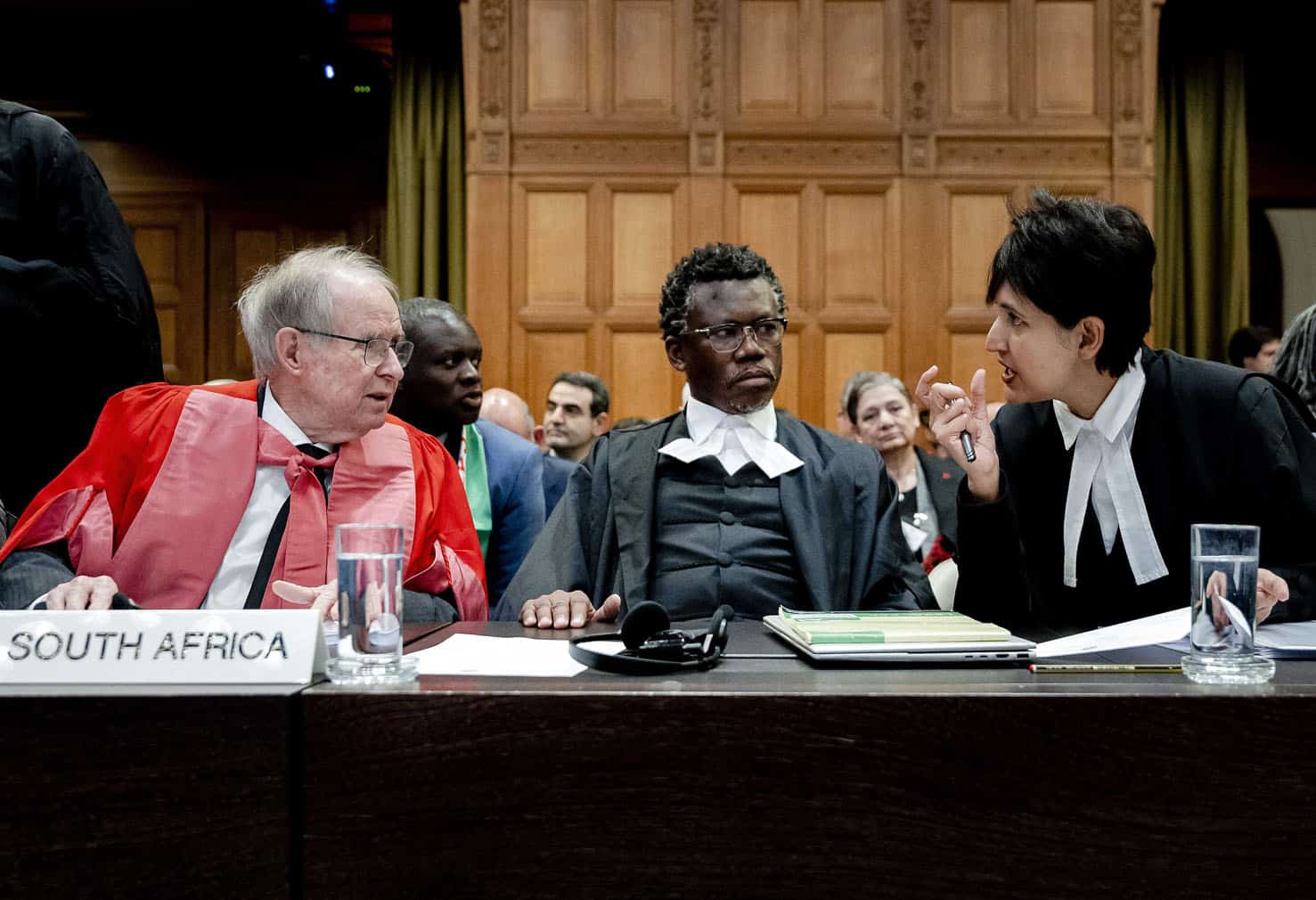
The International Court of Justice (ICJ) has set firm deadlines in South Africa’s genocide case against Israel, marking a critical procedural step in one of the most consequential disputes before the world’s highest court.
After Israel filed its Counter‑Memorial on 12 March 2026, more than seven months after the Court’s original deadline of 28 July 2025, the ICJ ordered Pretoria to file its Reply by 22 November 2027. Israel will then have until 22 May 2029 to submit a Rejoinder.
ICJ Order
The Presidency confirmed that this timeline means the case will stretch more than five years from its launch in December 2023.
The Order was issued on 21 May 2026 following a 29 April meeting in The Hague between ICJ President Judge Yuji Iwasawa of Japan and representatives of both parties to discuss procedural steps.
Application
South Africa first lodged its 84‑page application on 29 December 2023, urging the Court to find Israel guilty of genocide and to order an immediate halt to its invasion of Gaza. Since then, Pretoria has approached the Court four times seeking interim measures.
Although three binding orders have been granted, they have had little impact in halting Israel’s attacks or ensuring humanitarian aid reaches Gaza.
“A second round of written pleadings is common in ICJ cases; in fact, in all previous cases brought under the Genocide Convention, parties have submitted a Reply and a Rejoinder,” the Presidency said.
“Moreover, as Israel has now objected to the jurisdiction of the Court in its Counter‑Memorial-submitted in March 2026, and not, as contemplated in the Rules of Court, ‘as soon as possible, and not later than three months after the delivery of the Memorial’-South Africa will now have to address these objections in its Reply.”
ICJ rules
Under ICJ rules, written pleadings remain confidential until the Court decides otherwise.
At the time of filing, Israel’s counsel publicly declared that “its Counter‑Memorial [proves] its legitimate objectives in the war have always been to eliminate the military and governing capabilities of Hamas and other terrorist organisations.”
SA unequivocal
South Africa’s response has been unequivocal.
“Whether or not Israel’s war on Gaza is authorised by, or has complied with, the international law regarding self‑defence, as claimed by Israel’s counsel, South Africa’s response is a simple one: self‑defence is not a defence to genocide, there is none,” the Presidency said.
“The ICJ has already issued three provisional measures Orders at South Africa’s request, determining that Palestinians in Gaza face a “real and imminent risk of irreparable prejudice.”
“These Orders oblige Israel to ensure its military does not commit genocidal acts, to guarantee “without delay, in full co‑operation with the United Nations, the unhindered provision of urgently needed basic services and humanitarian assistance,” and to allow “unimpeded access” for UN commissions of inquiry and other investigative bodies,” it said.
‘Baseless’ claims
Israel’s Foreign Ministry responded defiantly, posting on X that South Africa’s “baseless genocide case at the ICJ is collapsing.”
“South Africa has requested an extraordinary 18‑month (!) extension to submit its arguments. The written submissions will not end before 2029. All the claims of ‘urgency’ have now turned into South Africa’s quiet requests to buy more time.
“This case was never about the facts. It has always been a propaganda campaign by South Africa in the service of Hamas, masquerading as a legal process,” it said.
Israel’s denial of genocide
Israel has repeatedly denied allegations of genocide, insisting its military operations are acts of self‑defence following the 7 October 2023 attacks. The government has argued that the term genocide has been weaponised against it. However, South Africa’s International Relations Minister Ronald Lamola has stated that Pretoria is committed to pursuing the case “through to its conclusion.”
Gaza crisis moral test
President Cyril Ramaphosa has framed the Gaza crisis as a moral test for the international community.
“We must all answer to the call to defend the principles of international law and to reassert the vital role played by the UN and international dispute settlement mechanisms like the ICJ,” Ramaphosa said.
He added: “South Africa remains committed to playing its part, along with others, to fulfil the promises of the Genocide Convention and the UN Charter to liberate humanity from the ‘odious scourge’ of genocide as described by the 1948 UN Genocide Convention and ‘save succeeding generations from the scourge of war’ as universally pledged in the UN Charter preamble.”
Death toll
Meanwhile, the humanitarian toll continues to mount.
The Palestinian Health Ministry in Gaza reported last month that the death toll from the conflict had risen to 72 938.