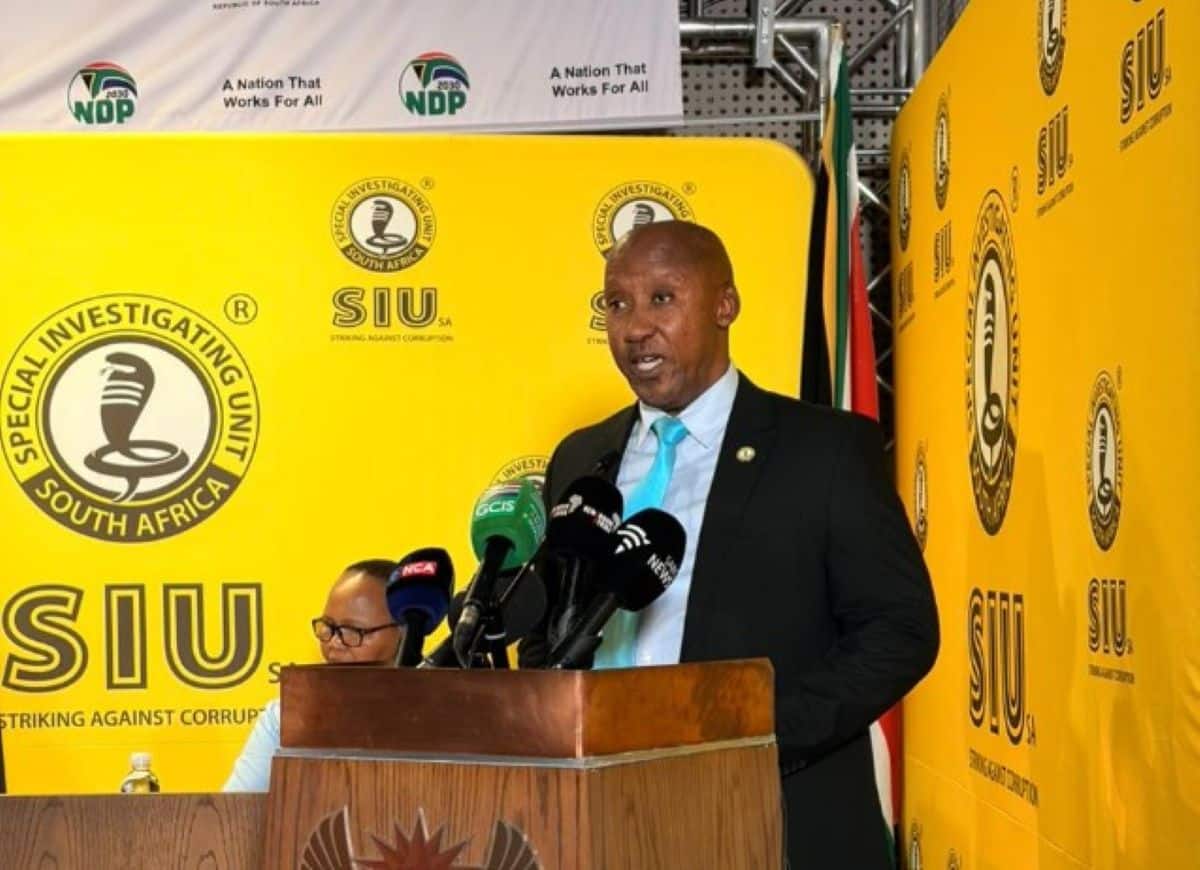
The Special Investigating Unit (SIU) has uncovered serious maladministration, unauthorised awarding of bursaries and irregular expenditure at the Free State Office of the Premier.
On Tuesday, the acting head of the SIU, Leonard Lekgetho, provided an update on the investigation outcomes into the bursary funds in the premier’s office from 2017 to 2018.
Every year, the provincial government allocates funds through bursaries to support needy students in accessing higher education and to address the shortage of scarce skills in the province. However, officials awarded them to their relatives, the deceased and foreign nationals, as well as to ineligible officials, and left millions in university accounts unaccounted for, the SIU said.
The investigation was initiated following a referral from the Auditor-General of South Africa (AGSA) concerning irregularities. The AGSA’s reports from 2019 and 2020 revealed serious irregularities in the management of bursaries and funds.
Bursaries approved negligently
According to the SIU, officials approved bursaries negligently, failed to comply with the eligibility criteria, and irregularly extended bursary contracts.
In one case, an official awarded bursaries to relatives without following due process. In another case, an official did not submit a bursary application for his studies, which commenced in 2017, but ended up receiving funding. When he applied for the bursary in 2017 for the 2018 academic year, he did not meet the requirements.
There is also an official who applied for an international government-funded bursary. The official received the benefits while in office and continued to receive them after resigning.
“A copy of an incomplete Memorandum of Understanding provided by [the Office of the Premier (OTP) ] between OTP and an international tertiary institution, provided that the institution would contribute 65% towards the scholarship, and OTP would contribute 35%. However, the SIU found a contradiction in the ‘agreement’, with OTP eventually contributing 65% of the scholarship. This resulted in an irregular expenditure over R8.3 million, which the SIU is now seeking to recover,” said Lekgetho.
Ineligible students
Some of the students who were awarded bursaries failed some modules during their studies. However, the bursary contracts were never terminated by the OTP; instead, they transitioned from three-year to seven-year contracts.
In some cases, the OTP awarded bursaries to applicants for qualifications not included in the 2018-19 Provincial Workplace Skills Plan. The required processes were not followed before the approval of the bursaries.
In one case, a deceased student received bursaries from both the OTP and the National Student Financial Aid Scheme (Nsfas). In this case, Lekgetho explained that the student passed away before completing his studies, but payments into his account continued.
The OTP paid R34 891.60 to the University of the Free State, which deposited the money into a suspense account after the student’s death. Nsfas also paid R13 000 into the student’s bank account, which his parents used.
“Since the student had died before completing his studies, the funds could not be recovered, especially since the proclamation did not cover Nsfas. The parents also lack the means to pay back the money.”
Bursaries for foreign nationals
In another case, seven students who received bursaries from the OTP were foreign nationals, with six of them funded on a merit basis as top achievers. However, the SIU found no approval to deviate from the bursary policy, which specifies that bursaries are for South African citizens residing in the Free State. The OTP spent R576 734.48 on these students.
The SIU investigation further found that during the 2019-20 financial year, government officials received full-time bursaries to attend various universities. The Bursary Policy states that while officials may apply for part-time bursaries, they are not eligible for full-time bursaries.
Bursary recipients received stipends from the provincial government, with varying amounts for local and international students. However, the SIU investigation uncovered that some students received excessive sums totalling R1.8 million.
“The OTP stated that it has started reclaiming funds from students who studied abroad and did not fulfil their bursary commitments. To prevent duplication, the SIU requested that the OTP proceed with the recovery and keep the SIU informed of progress and outcomes through the office of the former director-general,” said Lekgetho.
Further, officials did not properly monitor excess funds in universities’ suspense accounts, resulting in millions remaining unused. The SIU tracked down and recovered R6.3 million from seven universities.
Acknowledgements of debts
The SIU said it had signed 18 acknowledgements of debt totalling R1.9 million with individuals who received undue benefits from the bursary scheme.
To date, a total of R283 571 has been received by the SIU through instalments. Additionally, the SIU has made 38 disciplinary referrals against implicated officials, including human resource officers, administration clerks, assistant directors, deputy directors and directors, for contravening the Public Finance Management Act and the Free State bursary policy.
Evidence indicating the commission of a criminal offence against seven individuals has been referred to the National Prosecuting Authority (NPA) for possible prosecution on charges including fraud, theft and money laundering.